Bidirectional Charging and V2G: Your EV as a Home Battery and Grid Asset
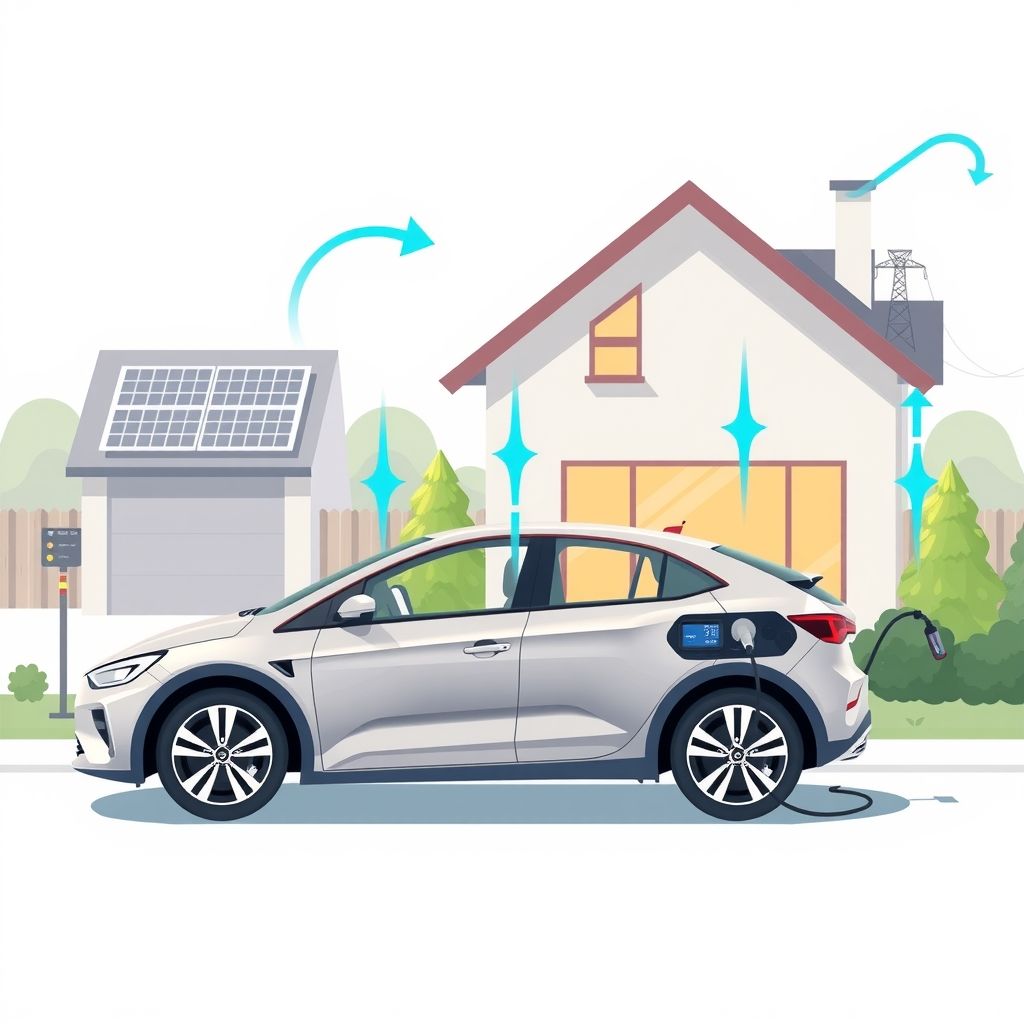
From Concept to Reality: The Bidirectional EV Moment Has Arrived
Vehicle-to-home and vehicle-to-grid charging aren't future technology. The Nissan Leaf supported V2G in Japan starting in 2013. The Ford F-150 Lightning ships with a 9.6kW onboard inverter as standard equipment. California's CPUC approved formal V2G grid tariff programs in 2024. The infrastructure gap — not the technology — is what's holding widespread adoption back. That gap is closing faster than most people realize.
V2H vs V2G vs V2L: Three Different Capabilities, Three Different Hardware Requirements
These terms get used interchangeably but they're meaningfully different in what they require and what they deliver.
- V2L (Vehicle-to-Load): The simplest form — a 120V or 240V AC outlet, often built into the frunk or bed, that powers devices directly. The Hyundai Ioniq 5 and Kia EV6 both offer V2L as standard equipment, outputting up to 3.6kW. No special charger required, no utility interaction. It's a mobile generator.
- V2H (Vehicle-to-Home): The car powers your entire home during an outage or for load shifting. Requires a bidirectional EVSE (Electric Vehicle Supply Equipment) installed at your home and, in most cases, a transfer switch or smart panel to isolate your home from the grid. The Ford F-150 Lightning does this via Ford's Charge Station Pro paired with the Sunrun home integration — the full setup runs $3,900 installed.
- V2G (Vehicle-to-Grid): The most complex form — the car actively exports power to the utility grid, and the utility pays you for it. Requires a bidirectional charger, a utility with a V2G tariff, and a communication protocol (typically ISO 15118-20 over CCS or CHAdeMO) between vehicle, charger, and grid operator. V2G requires utility buy-in that V2H does not.
Which EVs Support Bidirectional Charging in 2026
The list of capable vehicles has expanded significantly. Here's where each major platform stands:
- Ford F-150 Lightning: 80kWh usable battery, 9.6kW bidirectional output via the Charge Station Pro. V2H is fully operational in the US. At average US household consumption of 1.2kWh per hour, 80kWh gets you roughly 2.7 days of basic usage — or 1.5 days at normal consumption including HVAC.
- Rivian R1T and R1S: V2H capability through the Camp and Home Power accessories. The R1S's 135kWh Large Pack is the largest bidirectional-capable battery pack in production, theoretically extending home backup to 4+ days at conservative usage.
- Nissan Leaf (CHAdeMO): The original V2G vehicle. CHAdeMO bidirectional charging works via dedicated CHAdeMO-compatible bidirectional chargers like the Wallbox Quasar. The catch: CHAdeMO is being phased out globally. The Leaf's V2G capability is real but the ecosystem is shrinking, not growing.
- Hyundai Ioniq 5, Ioniq 6, and Kia EV6: V2L standard at 3.6kW. V2H is possible with a compatible bidirectional charger via CCS2 (in Europe and Korea) — full V2H rollout in North America is still limited by charger availability. The 800V architecture in these vehicles adds complexity to bidirectional hardware.
- Volkswagen ID.4: V2H available in select European markets via CCS bidirectional chargers. North American V2H capability exists on paper but depends on finding a compatible bidirectional CCS charger, which remains rare in the US market.
- Tesla (Model 3, Model Y, Cybertruck): Tesla's entire fleet has historically been AC-only for charging. The Cybertruck added a 240V AC outlet (PowerShare) for V2H, but it uses Tesla's proprietary software layer and requires the Wall Connector for home integration. True V2G with utility grid interaction — bidirectional DC charging — remains on Tesla's roadmap but is not deployed as of mid-2026. The NACS connector's bidirectional (DC) specification exists, but Tesla hasn't activated it.
The Hardware Requirements Nobody Talks About
V2L works with a cable. V2H and V2G require serious infrastructure investment that dealers rarely explain at point of sale.
A bidirectional EVSE costs between $1,500 and $4,000 before installation. The Wallbox Quasar 2 (CCS) retails at $3,500. The Ford Charge Station Pro is $1,310, but requires a professional installation that typically runs $500–$1,500 depending on your panel and home wiring. Total system costs of $3,000–$5,000 are common for a proper V2H setup, not counting any panel upgrades an older home might need.
The connector standard debate matters here. CHAdeMO had a head start on bidirectional but is being discontinued by most manufacturers. CCS (Combined Charging System) bidirectional was formalized under ISO 15118-20, which defines the communication protocol for V2G grid interaction. Most new bidirectional EVSE hardware is being built around CCS. NACS (North America Charging Standard, originally Tesla's connector) has a bidirectional specification, but widespread NACS V2G hardware has not yet arrived in the market — the standard exists, the certified hardware does not yet scale.
The Economics: Does Rate Arbitrage Actually Pay Off?
California's Time-of-Use (TOU) rates create the best current case for V2G economics in the US. Under PG&E's EV2-A rate, off-peak electricity costs as low as $0.06 per kWh during summer nights (after midnight). Peak rates hit $0.35–$0.45 per kWh on summer weekday afternoons between 4pm and 9pm. The theoretical arbitrage: charge 40kWh overnight at $0.06 ($2.40), discharge 30kWh during peak at $0.35 ($10.50), net $8.10 per cycle minus degradation costs.
The reality is more constrained. California's CPUC-approved V2G programs launched in 2024 under a pilot structure — not every utility offers a V2G export tariff yet, and those that do cap the number of enrolled vehicles. Pacific Gas & Electric's pilot enrolled roughly 1,000 vehicles in its first year. SDG&E has a separate residential V2G pilot that pays $0.25 per kWh for exported power during peak demand events. These numbers will improve as programs scale, but in 2026 you still need to be on a waiting list in most California utility territories.
Does V2G Cycling Degrade Your Battery?
This is the most common concern from prospective buyers, and the data from real-world programs is more reassuring than the theoretical models suggested. Nissan's V2G fleet program in Japan — running since 2013 through partnerships with utilities like Enel X — tracked battery degradation in vehicles used for V2G cycling versus standard charge/discharge cycles. The findings showed no statistically significant additional degradation in vehicles managed within 20–80% state of charge (SOC) limits.
The key variable is depth of discharge. A BMS (Battery Management System) configured for V2G use won't drain to 0% or charge to 100% — it operates in a middle range that minimizes stress on lithium cells. Ford's Pro Power Onboard system, for instance, limits the discharge floor to protect long-term cell health. The vehicles being destroyed by cycling aren't the ones in managed V2G programs — they're the ones being rapid-charged from 10% to 100% every day by owners ignoring recommendations.
Most manufacturers now offer battery degradation warranties that explicitly cover V2G use when done through approved hardware. Ford's 8-year/100,000-mile battery warranty applies to F-150 Lightning used with the Charge Station Pro V2H system.
Grid Programs Operating in 2026
Beyond California, a handful of programs represent the leading edge of V2G deployment:
- UK — Octopus Energy's V2G tariff: Octopus offers an active V2G export rate in the UK for compatible vehicles (primarily Nissan Leaf via CHAdeMO and select Hyundai/Kia models). The program uses smart charging to automatically buy and sell power based on Agile Octopus spot prices. UK households on the program reported average annual earnings of £400–£700 in 2025.
- California CPUC V2G tariff (2024–present): Pilot-stage, utility-specific enrollment. SDG&E, PG&E, and SCE each operate separate programs with different rates and vehicle eligibility. The CPUC mandated expansion reporting by 2026 Q3.
- Virtual Power Plants (VPP): Aggregators like Swell Energy and AutoGrid are enrolling EV batteries into VPP programs alongside home batteries. In a VPP, your vehicle contributes to a dispatch pool — the aggregator coordinates when your car charges and discharges based on grid signals, and you receive a monthly payment. Swell's EV VPP program was available in Hawaii and California as of early 2026.
What's Still Missing
The technology works. The ecosystem doesn't fully work yet. Specific gaps as of mid-2026:
- Utility interconnection standards vary by state and by country. A V2G setup certified for California may require a separate inspection process in Texas. There is no unified national standard.
- Most US utilities — outside of active pilots — don't offer V2G export tariffs. Customers in those service territories can do V2H for backup power but can't sell back to the grid.
- Bidirectional chargers are not bundled with vehicles. Every EV above lists them as a separate purchase, often from a third-party supplier. The charger installation process is separate from the vehicle purchase.
- NACS V2G hardware is not commercially available at scale. As more vehicles move to NACS connectors, the gap between connector adoption and bidirectional hardware will be a friction point for 2–3 more years.
- Insurance and home warranty implications of V2H setups are not yet standardized. Some homeowner policies don't clearly address EV-powered home backup scenarios.
Buyer Guide: What to Get If V2G/V2H Matters to You
If home backup power is your primary goal and you're in the US, the Ford F-150 Lightning with the Charge Station Pro is the most complete, most tested V2H solution currently available. The total installed cost of $4,000–$5,500 for the charger and integration is significant but comparable to a mid-range home battery. The 80kWh capacity exceeds a standard Tesla Powerwall 3 (13.5kWh) by almost 6x.
If you want V2G grid participation, check your utility's website before buying anything. If your utility doesn't have an active V2G tariff, you're doing V2H at best. California (SDG&E, PG&E, SCE) and UK (Octopus Energy) are the best markets for V2G economics today. Get on the waiting list for your utility's program — enrollment is the bottleneck, not vehicle availability.
If you want the most capable hardware with room to grow as V2G expands, the Rivian R1S with its 135kWh Large Pack paired with Rivian's home power setup gives you the largest bidirectional battery in production. It's more expensive upfront but the capacity provides the most flexibility for both backup and arbitrage as grid programs mature.
Avoid buying a vehicle primarily for V2G if it relies on CHAdeMO. The Nissan Leaf's V2G ecosystem is real but contracting — bidirectional CHAdeMO charger manufacturers are not expanding their product lines, and parts availability will become an issue within a few years. CCS-based V2G and the emerging NACS standard are where the hardware investment is going.