Why In-Space Refueling Could Reshape Mission Economics
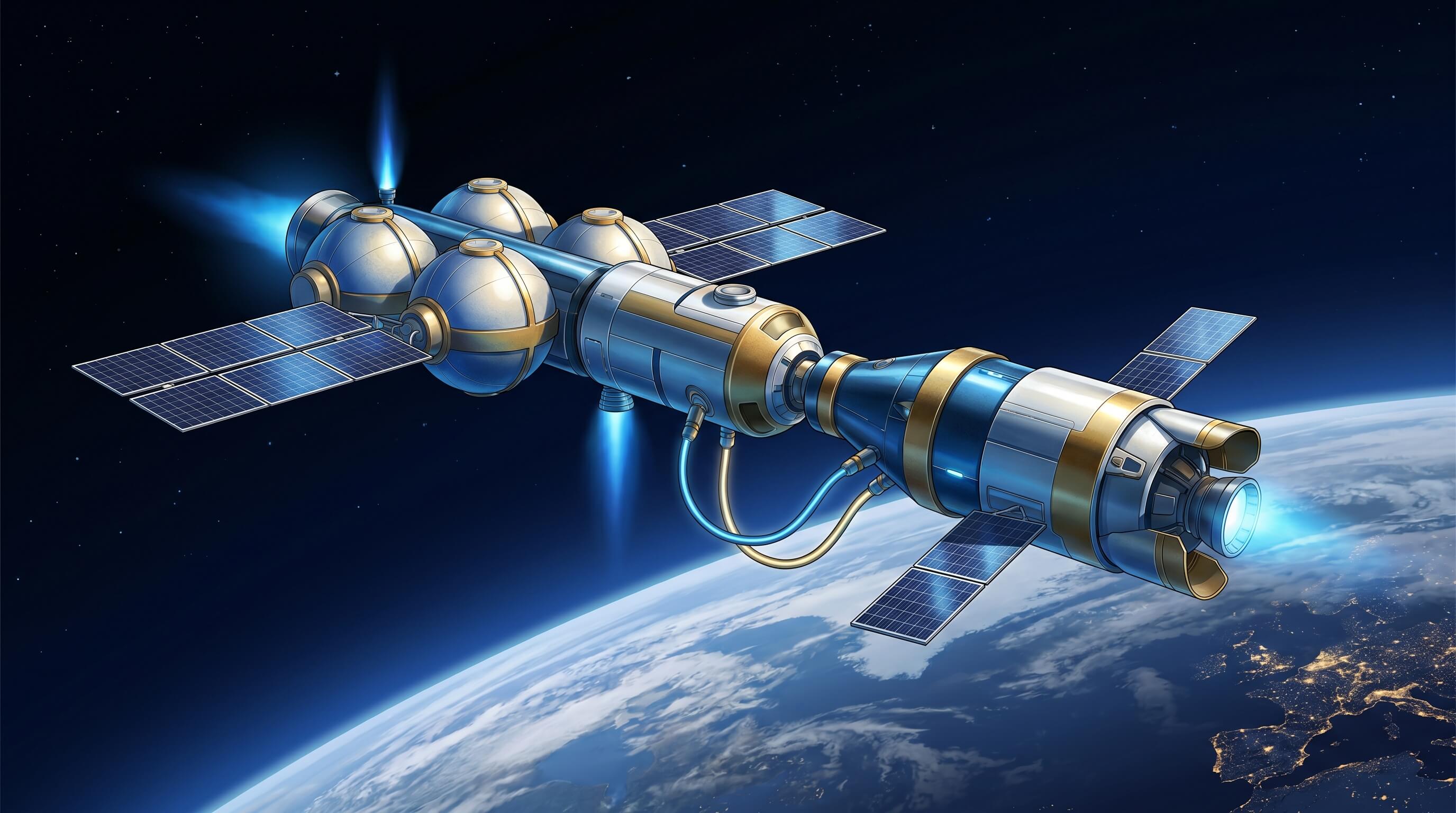
Space has long been treated as a place where every mission must bring everything it will ever need on day one. That assumption has shaped spacecraft design, launch economics, and even the kinds of missions that seem practical. A satellite is built, fueled, launched, and then expected to survive on a fixed supply of propellant until the tank runs dry. When that happens, the platform may still have working electronics, healthy solar arrays, and paying customers, but its useful life is effectively over. In-space refueling challenges that logic in a very direct way.
The important shift is not cinematic spectacle. It is logistics. Once propellant can be transferred in orbit with predictable interfaces and repeatable procedures, spacecraft stop looking like disposable hardware and start looking more like serviceable infrastructure. That is why agencies such as ESA and companies such as Orbit Fab keep emphasizing docking, fluid transfer, thermal control, and interface standards rather than science-fiction imagery. Mission economics change when fuel becomes a deliverable service instead of a fixed launch-time constraint.
Why lifetime extension matters first
The first business case is also the simplest to explain. Many high-value satellites do not fail because their payload becomes obsolete overnight. They retire because they run out of fuel needed for station-keeping, collision avoidance, and orbit adjustments. If an operator can buy more propellant for a healthy satellite, the economics can be compelling. Extending a revenue-generating geostationary spacecraft by even a few years can be worth far more than the cost of a servicing mission, especially compared with the expense and delay of building and launching a replacement.
This is why in-space refueling is best understood as an asset-utilization story. Spacecraft represent large capital investments. Refueling can spread that cost over a longer operating life, reduce replacement pressure, and give operators more flexibility in how they plan fleets. In that sense, orbital fuel is not just consumable mass. It is time, optionality, and revenue continuity.
A logistics layer enables new vehicle classes
Refueling becomes even more powerful when it supports spacecraft designed for movement rather than a single fixed assignment. Space tugs and orbital transfer vehicles are an obvious example. A tug that can be refueled in orbit can perform multiple jobs across its life: moving satellites to final orbits, relocating assets after launch, supporting constellation maintenance, or helping reposition spacecraft after anomalies. Without refueling, every mission must be sized around the tug’s launch mass and finite onboard reserves. With refueling, the vehicle starts to resemble reusable transport infrastructure.
The same logic applies to debris-removal missions and satellite-servicing craft. These missions can be propulsion hungry because they involve repeated rendezvous, proximity operations, and orbit changes. A servicing vehicle that has to retire after one or two expensive jobs creates a narrow business model. A servicing vehicle that can top up and keep working starts to look more like industrial equipment. That distinction matters because it changes whether the market supports isolated demonstrations or a durable service sector.
Why standards may matter more than rockets
Launch costs get a lot of attention, but logistics systems often depend more on interoperability than on raw transportation price. ESA has repeatedly highlighted autonomous docking, fluid transfer, thermal management, and interoperable interfaces because these are the ingredients of a real supply chain. If every spacecraft has a different fuel port, different pressure assumptions, and different software expectations, then refueling remains a custom engineering exercise. Custom work is slow, risky, and expensive.
That is why interface efforts such as Orbit Fab’s RAFTI matter. A standard attachment and transfer approach can reduce integration friction and make future missions easier to insure, certify, and operationalize. In practical terms, common interfaces can do for orbital logistics what standardized containers did for shipping on Earth. They do not eliminate complexity, but they make complexity manageable enough for markets to form around it.
The deep-space argument
Low Earth orbit and GEO are the near-term commercial focus, but the strategic importance of in-space refueling becomes even clearer beyond Earth orbit. Lunar missions, cislunar transport, and eventually deep-space architectures all benefit when fuel does not need to be launched in one giant all-inclusive stack. Depots or tanker services in the right orbits can let vehicles launch lighter, divide missions into stages, and reserve more mass for payload, habitation, or redundancy instead of carrying every kilogram of propellant from the ground.
This is one reason in-space refueling keeps surfacing in serious discussions of long-duration space operations. Sustainable exploration is not just about better landers or more powerful rockets. It is about resupply, transfer, maintenance, and the ability to adapt after launch. Those are logistics questions, and logistics questions tend to determine which grand architectures stay on slides and which ones become operating systems.
The hard parts are real
None of this means the market is easy. Autonomous rendezvous and docking remain technically demanding. Fluid transfer in microgravity is not trivial, and cryogenic propellants add another layer of difficulty because boil-off and thermal management can erase value if not handled well. Insurance models are still maturing for missions that involve close approach, docking, and fuel exchange between spacecraft owned by different parties. Early demand is also uncertain. Operators may like the option of refueling, but they still need enough confidence in future service availability to design spacecraft around it now.
There is also a classic chicken-and-egg problem. Refueling providers want more compatible spacecraft in orbit. Spacecraft builders want confidence that depots, tankers, and standards will actually exist when needed. Governments and anchor customers may have to help bridge that gap, especially in the early years when the market signal is promising but not yet deep.
Why the economics still point forward
Even with those blockers, the direction is meaningful. Refueling turns fuel into infrastructure, and infrastructure tends to reshape economics more deeply than one-off hardware improvements do. It affects procurement decisions, mission design, insurance assumptions, asset life, and the viability of adjacent services. Once operators can assume that mobility and endurance can be purchased after launch, spacecraft can be designed differently from the start.
That is why in-space refueling matters. Not because it makes space look futuristic, but because it makes space operations look more normal. Normal industries rely on maintenance, resupply, shared standards, and service networks. If space gets those tools, mission planning stops being dominated by a single irreversible fueling decision made on Earth. That is the kind of change that can quietly reshape the whole market.