Warehouse Robotics Is Shifting from Better Arms to Better Orchestration Software
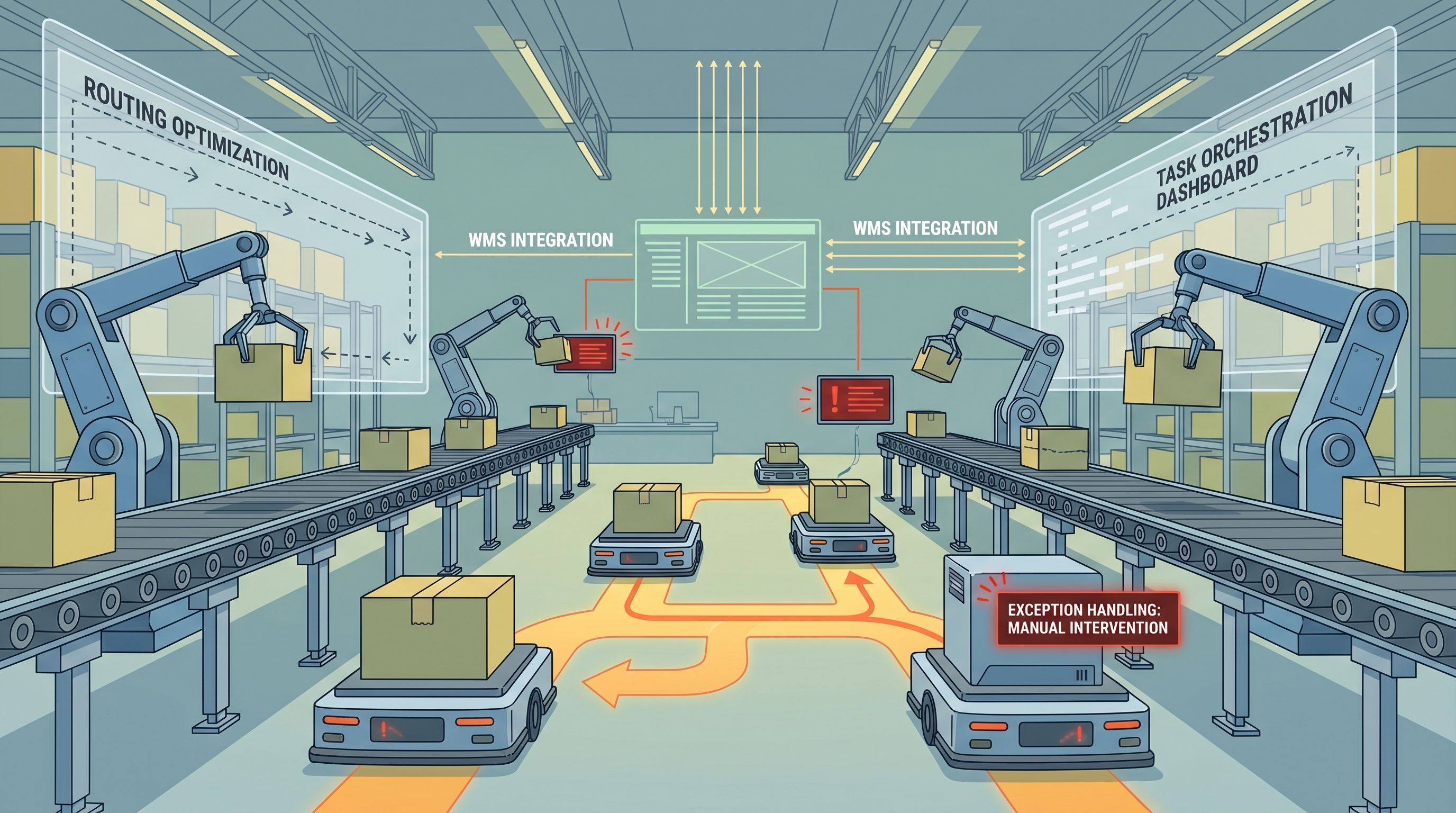
Warehouse robotics used to be discussed primarily as a hardware race. Which company had the better arm, the faster mobile base, the stronger gripper, or the more reliable perception stack? Those questions still matter. But in many practical deployments, the center of difficulty is shifting elsewhere. The hard problem is increasingly how to coordinate many imperfect machines, human operators, and enterprise systems inside a messy operating environment that changes every day.
That is why the most important advances in warehouse automation are now often software advances. Picking accuracy is not just about grasping. Throughput is not just about top speed. Reliability is not just about mean time between hardware failures. Outcomes depend on orchestration: how work is assigned, when tasks are rerouted, how exceptions are handled, what data flows through the WMS, and whether the whole system can recover gracefully when reality diverges from the plan.
Hardware improved enough to expose the next bottleneck
Many warehouse robot categories have reached a level of competence where the next gains are not purely mechanical. Autonomous mobile robots can navigate structured facilities fairly well. Arms can perform more categories of picking than they could a few years ago. Vision systems are better at identifying bins, cartons, and SKU variation. None of that means the hardware problem is solved. Edge cases remain brutal. But it does mean that in a live warehouse, incremental improvements in hardware often generate less value than better coordination across the workflow.
A robot that picks slightly faster but creates downstream congestion does not improve the operation very much. A fleet that performs well in isolation but cannot stay synchronized with replenishment schedules, labor shifts, and wave planning may look impressive in a demo and disappointing in a production site. Warehouses are systems problems. Once basic robotic capability crosses a threshold, the scheduling and integration layer determines whether that capability compounds or stalls.
Orchestration is where operational complexity lives
Consider a typical fulfillment operation. Orders enter in bursts. Inventory locations change. Human associates step in for exceptions. Some SKUs are easy to pick, others deformable or fragile. Paths get blocked. Priority orders jump the queue. A robot platform that works beautifully under static assumptions can struggle badly when these variables interact. Orchestration software is what decides how the system responds in those moments.
That software has to do more than dispatch tasks. It must understand task dependencies, dynamic routing, queue balancing, station utilization, and fallbacks when a robot cannot complete an action. It must decide when to escalate a problem to a person, when to retry automatically, and when to reroute inventory to preserve service levels. In other words, the value of robotics increasingly comes from judgment encoded in software, not only from dexterity encoded in hardware.
Exception handling is the real test
Automation vendors often shine during clean-path scenarios: repetitive picks, consistent packaging, and well-labeled inventory. Real warehouses are defined by exceptions. A tote arrives damaged. A barcode is unreadable. A bin contains mixed items. An arm misses a grasp twice. A replenishment task is late. A conveyor backs up. These are not side cases. They are daily conditions.
The systems that win commercially are not always the ones with the most elegant robot. They are the ones that absorb exceptions without collapsing throughput. That usually means better orchestration software. The system needs to know what happened, where it happened, what alternative resources exist, and how to keep the rest of the operation moving. If each exception requires manual babysitting, the labor model breaks. If exceptions are routed intelligently, even imperfect robots can still produce strong economic outcomes.
WMS integration is strategic, not clerical
One of the most underestimated parts of warehouse automation is integration with the warehouse management system. To outsiders, WMS connectivity can sound like back-office plumbing. In reality, it is strategic. The WMS contains the logic of inventory truth, order priority, location state, and workflow timing. If the robotics layer cannot exchange clean, timely data with that system, automation remains brittle.
Deep integration is difficult because warehouses rarely run from a blank slate. They have legacy software, custom business rules, site-specific process variations, and years of accumulated operational habits. Robotics vendors therefore have to build not just a machine, but an integration product. Their software must speak to APIs, event streams, and operational dashboards while remaining resilient to imperfect data. This is one reason deployments that look simple from the outside take so much real engineering effort to scale.
From point solutions to coordinated systems
The market is also moving from isolated robotic stations toward multi-agent coordination. A picker robot affects replenishment timing. Autonomous carts affect packout rhythm. Sortation decisions affect labor allocation downstream. As more automation layers enter the same building, local optimization becomes dangerous. One subsystem can maximize its own efficiency while harming the site-level objective.
That is where orchestration becomes a competitive moat. The best software can reason across stations, fleets, task classes, and service targets. It can prioritize global throughput over local vanity metrics. It can expose operators to the right control surfaces instead of flooding them with low-value alerts. It can also create a cleaner path to incremental automation, because each new machine plugs into a scheduling fabric rather than becoming another silo.
What buyers should pay attention to
For warehouse operators evaluating vendors, the practical implication is clear: do not assess robotics only by watching a demo of a single arm or vehicle. Ask how the system manages retries, congestion, queue spikes, missing inventory, and human handoffs. Ask what the WMS integration really looks like, what configuration lives in code versus UI, and how site-level policies are updated. Ask whether the vendor has observability tools that let operators diagnose bottlenecks without calling an engineer every time something unusual happens.
These questions reveal whether the company is selling a robot or an operating system for warehouse flow. In the next stage of the market, that distinction matters more. Hardware will continue improving, but more deployments will be won or lost on software that coordinates resources, absorbs disorder, and translates between machines and the rest of the warehouse stack.
The future of warehouse robotics is therefore not less robotic. It is more systemic. Better arms and better grippers still help, especially in difficult pick environments. But the real differentiator is increasingly the orchestration layer that turns a collection of capable devices into a dependable operation. In warehouses, the hardest problem is often not getting a robot to perform one task. It is getting the whole facility to keep working when every task collides with everything else.