Vision-Language-Action Models Are Becoming the Real Robot Operating Layer
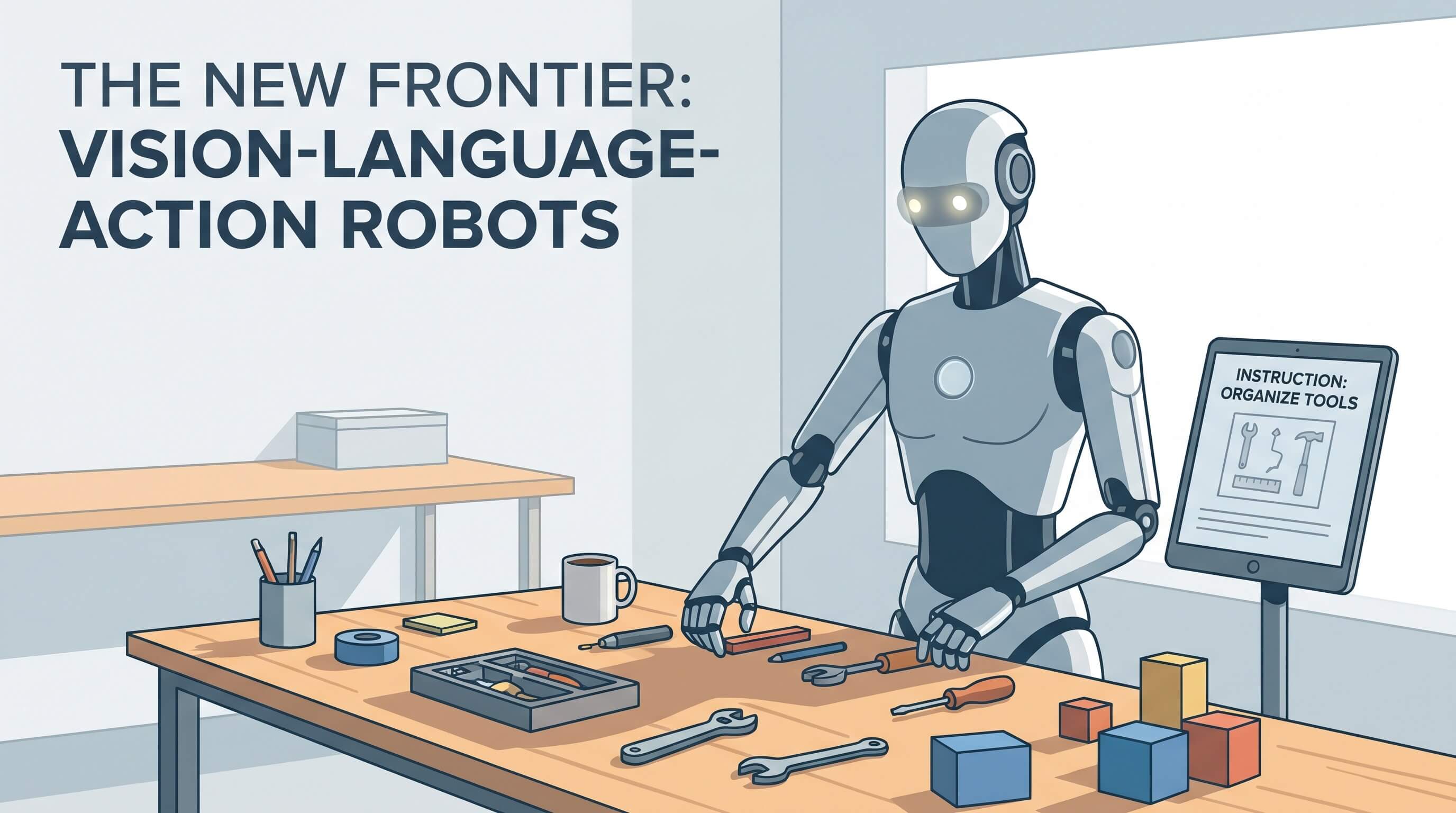
Robotics has spent years oscillating between spectacular demos and stubborn deployment limits. A robot can open a drawer in one video, fold laundry in another, and still fail the moment the lighting changes, the object is unfamiliar, or the task sequence lasts longer than a carefully curated clip. That gap is why the recent rise of vision-language-action models matters so much. These systems are not just another robotics AI trend. They represent a serious attempt to build a more general software layer between human intent and machine motion.
The most useful way to think about vision-language-action models, or VLAs, is not as robot chatbots. They are an emerging operating layer that tries to fuse three things robotics has historically handled in separate stacks: seeing the world, understanding instructions, and generating action. If they keep improving, they could do for robot behavior what modern foundation models did for text and image workflows, namely replace brittle task-specific pipelines with a more flexible general interface.
Why robotics needed a new software abstraction
Traditional robotics has achieved plenty, especially in structured industrial environments. But it typically depends on decomposition. One system handles perception, another plans, another controls motion, and engineers spend enormous effort stitching the pieces together. That works when tasks are repetitive, environments are constrained, and the value of each extra percentage point of reliability justifies the integration cost.
The model starts to break down in less structured settings. Warehouses change layouts. Homes are full of novel objects. Service robots encounter ambiguous instructions and human improvisation. The old stack can do these jobs, but usually only after heavy engineering, environment tuning, and narrow task definition. A robot that performs one new task often still needs a new data collection effort, new policies, or some amount of manual scripting.
VLAs are attractive because they collapse more of that problem into a single learning system. Instead of hard-separating perception from action, they aim to learn a direct mapping from multimodal input, including images and natural-language commands, to control outputs. In theory, that gives robots a broader ability to generalize across tasks, objects, and contexts without starting from scratch each time.
The research progress is no longer hypothetical
Several projects have made this shift concrete. OpenVLA, an open-source 7B parameter model built from collaboration across Stanford, Berkeley, Toyota Research Institute, Google DeepMind, MIT, and others, was trained on 970,000 robot episodes from the Open X-Embodiment dataset. Its importance is not just raw scale. It showed that a generalist VLA could control multiple robot platforms, adapt through parameter-efficient fine-tuning, and outperform earlier systems on a range of generalization tasks.
That open-source angle matters because it widens experimentation. Robotics has often been bottlenecked by access to hardware, data, and closed proprietary systems. An open model with real cross-embodiment ambitions lowers the barrier for labs and startups that want to build on shared foundations rather than reinventing the entire stack.
Commercial players are moving quickly too. Figure’s Helix model is a strong example of where the category is heading. The company describes it as a VLA that unifies language understanding, scene perception, and learned control for whole upper-body humanoid operation. More revealing than the headline is the architecture: a slower reasoning system handles higher-level interpretation while a faster reactive policy produces continuous control at high frequency. That split mirrors an important truth in robotics. General reasoning is useful, but the machine still needs low-latency motor competence to survive the physical world.
Generalization is the whole point
What makes VLAs more promising than many earlier robotics stacks is that they explicitly target generalization rather than only efficiency on a fixed task. Figure claims Helix can manipulate thousands of unfamiliar household objects through natural language. OpenVLA emphasized visual, physical, and semantic generalization across unseen backgrounds, distractors, object configurations, and instructions. Even if those results still reflect constrained test setups, they point in the right direction.
Robotics has always been punished by edge cases. A useful robot is not one that performs a perfect canned demonstration. It is one that degrades gracefully when reality stops matching the training data. The VLA approach is appealing because language and large-scale vision pretraining may provide the kind of semantic priors that older control systems lacked. A robot no longer needs to memorize one object and one trajectory. It may be able to infer the relevant action from a broader understanding of scenes, objects, and goals.
That could be transformative in environments where the long tail dominates. Homes, hospitals, retail spaces, and mixed human workspaces are difficult precisely because they contain too much novelty for hand-authored behavior libraries.
The bottleneck is shifting from policy design to data loops
Even so, VLAs do not magically remove the central robotics problem. They move it. The challenge becomes data, evaluation, and safe adaptation. Training a useful VLA requires large quantities of paired observation-action data across many embodiments and tasks. That is expensive to collect, messy to standardize, and hard to translate across hardware platforms.
This is why shared datasets like Open X-Embodiment matter, and why synthetic data, simulation, and teleoperation are all becoming more strategically important. A company with better data loops may end up with a stronger robot product than a company with a nominally more impressive model architecture. In robotics, the distribution of experience still shapes the ceiling of behavior.
There is also a hardware reality check. Unlike cloud chat systems, robots operate under latency, power, and reliability constraints. A warehouse robot or humanoid assistant cannot wait on a remote model for every micro-decision. On-device inference and split architectures therefore look increasingly sensible. High-level reasoning can be slower. Motor execution cannot.
Why this is an automation story, not just a humanoid story
Much of the public conversation around VLAs gets drawn toward humanoids, because humanoids make for better headlines. But the broader significance is automation. A more general policy layer could be useful long before humanoid robots become common consumer products. Mobile manipulators, warehouse systems, inspection robots, and specialized industrial machines all face the same software pain point: too much customization for each new workflow.
If VLAs reduce that customization burden even modestly, the economics of automation change. Integrators can spend less time hard-coding narrow behaviors and more time shaping goals, safety boundaries, and workflow design. That does not eliminate specialized robotics engineering. It makes that engineering more leverageable.
In that sense, VLAs could become the missing middle between human operators and robot hardware. Instead of expressing every task as a brittle sequence of machine-specific commands, teams may increasingly describe desired outcomes and let a general policy layer handle more of the translation.
What still has to be proven
The caution is obvious. Robotics history is full of systems that looked general until they were exposed to the wrong warehouse shelf, the wrong lighting condition, or the wrong human instruction. Safety remains difficult. Long-horizon tasks are still fragile. Cross-robot transfer is promising but not solved. And there is a large difference between a model that works in a demo-rich development environment and one that can run a shift every day in production.
There is also a risk that the industry over-focuses on model spectacle instead of deployment discipline. A useful operating layer for robots will need observability, fallback behavior, evaluation standards, and integration with existing industrial software. Generalist intelligence is only one part of a practical automation stack.
The real significance of VLAs
The strongest case for VLAs is not that they will produce one universal robot brain tomorrow. It is that they offer a better abstraction for building robot behavior at scale. That is the piece robotics has been missing. Hardware has improved. Sensors are cheaper. Compute is better. But software generalization has remained the stubborn bottleneck.
If VLAs continue to improve, they could make robots easier to instruct, faster to adapt, and cheaper to deploy across semi-structured real environments. That would not end the need for domain expertise. It would change where that expertise gets applied.
Robotics is finally getting a software layer that looks less like a bag of handcrafted exceptions and more like a system built to absorb novelty. For automation, that may prove more important than any individual robot form factor.