Satellite servicing found paying customers in 2026. Debris removal still hasn't.
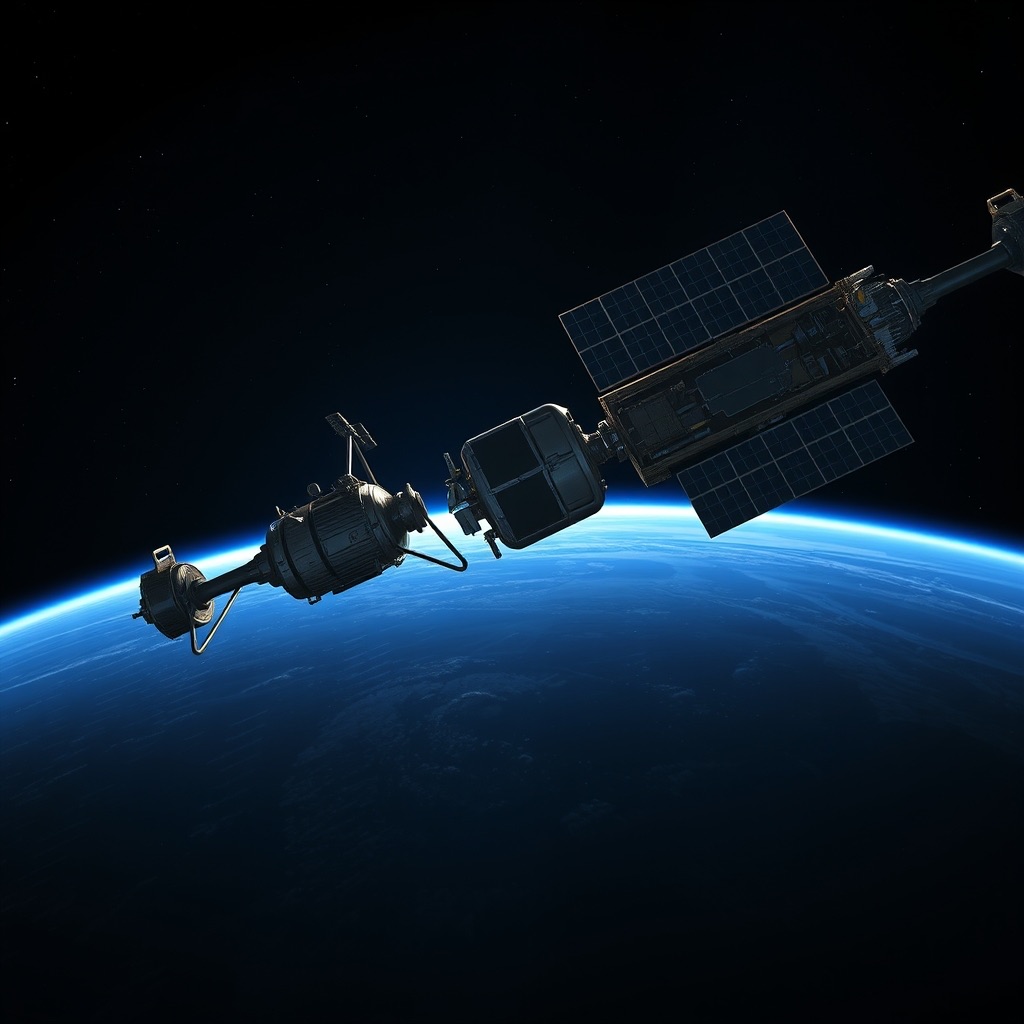
In April 2025, Northrop Grumman's SpaceLogistics division extended a four-year commercial contract with Intelsat to keep servicing the aging Intelsat 10-02 satellite through roughly 2030. A month earlier, its Mission Extension Vehicle had wrapped seven months docked to Optus D3, buying the Australian operator enough runway to negotiate a follow-on Mission Extension Pod purchase. Neither deal made front-page news. Both are more commercially significant than most of the debris-removal headlines from the same period, because both are actual customers paying actual money for a satellite that would otherwise have been retired.
That distinction — servicing versus removal — is the one most coverage of the in-orbit economy glosses over, and it matters because the two businesses are at completely different stages of maturity in 2026.
The Servicing Side Has Real Revenue
Northrop Grumman's MEV-1 and MEV-2 vehicles dock directly to a client satellite's apogee engine and take over its propulsion and attitude control, effectively turning an out-of-fuel spacecraft into a fully maneuverable one again. The company has now converted two of these missions into follow-on paid contracts — Intelsat and Optus — proving the model works commercially, not just technically. On July 21, 2026, Northrop launched its next-generation MRV-1 vehicle on a Falcon 9, carrying twin robotic arms and enough Mission Extension Pods to service three satellites (two more Intelsat spacecraft plus a second Optus unit) on a single mission. That's a fleet-servicing model, not a one-off demo.
Starfish Space has taken a lighter-weight approach with its Otter vehicle, which uses magnetic docking instead of a robotic arm. Its first commercial contract, signed with Intelsat in mid-2024, is executing through 2026. SES is separately funding one of three planned Otter vehicles for a GEO servicing demonstration. Starfish's Otter Pup 1 tech demo failed in 2023 on a thruster fault; Otter Pup 2 launched in mid-2025 and successfully demonstrated magnetic docking with a D-Orbit target vehicle — the kind of iterative, unglamorous progress that precedes a real product line.
Debris Removal Is Still Waiting
Debris removal — capturing dead, tumbling, non-cooperative objects that were never designed to be grabbed — is a harder problem, and the 2026 numbers show it. Astroscale's ADRAS-J2, a JAXA-funded mission to use a robotic arm to grapple a spent H-2A rocket stage, has slipped to fiscal year 2027. ClearSpace-1, the European Space Agency's flagship debris-capture mission, switched its target after its original object was struck by other debris, and is now aiming for a 2028 launch of a "tentacle" capture arm around the defunct PROBA-1 satellite. Astroscale's ELSA-M, using magnetic-plate docking, has also slipped to FY2028 or later.
Every disclosed removal mission to date has been government-funded: ClearSpace-1 runs on an €86 million ESA contract; Astroscale's work traces back significantly to JAXA money. No debris-removal-specific paid commercial contract — a private operator paying to have someone else's dead satellite removed — has been publicly disclosed as of mid-2026.
Why the Gap Persists
The economics explain the split. A servicing mission adds years of revenue-generating life to a satellite that's still working but low on fuel — the customer is paying to keep an asset productive. A debris-removal mission removes an asset that's already worthless to its former owner and has no clear paying customer at all, since the operator who lost the satellite has no further stake in it and no other party is obligated to pay for cleanup.
The Space Data Association's Ryan Wolff has put the mismatch bluntly: spending roughly $100 million to service or remove a satellite that cost $14 million to build and launch in the first place doesn't pencil out without a subsidy or a regulatory mandate. The Bulletin of the Atomic Scientists made the same point differently, noting ClearSpace-1's roughly €86 million capture cost dwarfs the well under €1 million it would cost to launch an equivalent mass of new hardware.
Regulation could eventually close that gap. The FCC's five-year deorbit rule, in effect for licenses issued after September 2024, and the European Space Agency's Zero Debris Charter — now signed by 228 organizations across 34 countries — are both designed to make debris a liability operators have to plan for, not an externality they can ignore. Neither has yet produced a disclosed case of an operator paying a debris-removal company specifically to comply, but both create the kind of long-term regulatory pressure that eventually turns a cost center into a line-item budget.
What to Watch
Market estimates for the two segments are still all over the place — anywhere from $1.1 billion to $1.8 billion in 2025-26 for debris removal specifically, rising toward $1.8-4.1 billion by 2030, against a broader on-orbit-servicing market pegged at $2.4-5.2 billion today and $5.1-12.6 billion by the early 2030s depending on whose definition you use. Those ranges are wide enough to be nearly meaningless as forecasts, which is itself a signal: this market doesn't have enough real transaction data yet to tighten the estimate.
The near-term signal worth tracking isn't a debris-removal contract — it's whether Northrop Grumman's MRV-1 servicing run and Starfish's Otter missions convert into a second and third round of renewals. If GEO operators keep buying life extensions rather than replacement satellites, servicing becomes a standing line item in fleet planning, and the capital and regulatory pressure that follows is what eventually makes debris removal commercially viable too — just later, and on someone else's balance sheet first.