Robotics Is Now a Software Integration Business
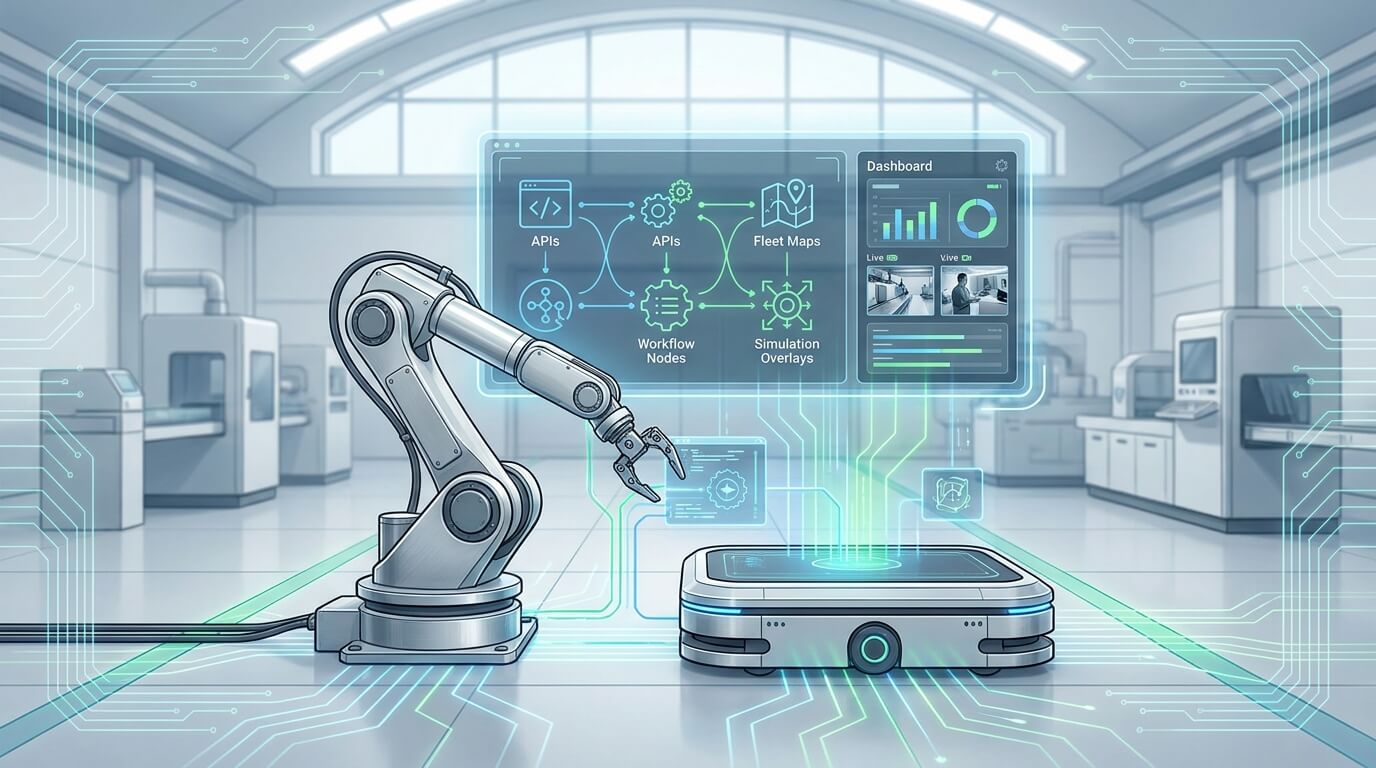
Robotics is no longer just a hardware race. In real-world automation, the robotic arm, mobile base, gripper, camera, and sensor stack still matter, but they are no longer enough on their own. The companies creating durable value are the ones that can integrate those components into a software system that can be deployed, monitored, updated, and scaled across a live operation.
That is the core shift happening in industrial robotics today: robotics is becoming as much a software integration business as a hardware business. The winners are not simply building better machines. They are building better operating layers around those machines, including fleet management, simulation, orchestration, safety controls, observability, and deployment tooling. In many facilities, those layers now determine whether automation succeeds or stalls.
Hardware Still Opens the Door, but Software Keeps the Program Alive
A robot can have excellent motion control and still fail commercially. That sounds counterintuitive until you look at how automation is deployed in warehouses, factories, hospitals, and fulfillment centers. The first demo usually focuses on the physical system: reach, payload, speed, accuracy, battery life, or perception quality. The long-term decision, however, depends on whether the robot can fit into a living workflow without creating operational friction.
If a site manager cannot see where robots are, why they are delayed, when batteries will run low, or which jobs are falling behind, the hardware quickly becomes a source of uncertainty rather than productivity. If software updates require on-site specialists every time a route changes, scaling from five robots to fifty becomes painful. If safety zones have to be reconfigured manually across every machine, even simple layout changes become expensive. In practice, the robotics vendor is not just selling a machine. It is selling an operating model.
Fleet Management Has Become a Core Product, Not a Side Utility
One of the clearest examples is fleet management. A single robot can often be supervised manually. A real deployment cannot. Once multiple robots share space, tasks, charging resources, and maintenance windows, the control problem shifts from device performance to system coordination.
Good fleet management software answers practical questions that operators care about every day. Which robots are healthy and available? Which tasks should be prioritized? How should traffic be rerouted around congestion? When should a unit be sent to charge without hurting throughput? How can one technician diagnose repeated failures across an entire fleet instead of walking to each robot one by one?
Autonomous mobile robot vendors learned this early. In warehouses, the difference between a promising pilot and a stable rollout often comes down to how well the fleet layer handles congestion, exceptions, dispatching, and visibility. A robot that navigates well in isolation is useful. A fleet that can coordinate hundreds of missions while exposing clear controls to warehouse staff is what creates enterprise value.
Simulation Is Shortening the Path from Pilot to Production
Simulation is also moving from an R&D tool into a commercial requirement. Robotics teams use simulation to test navigation policies, train perception systems, and validate edge cases before touching a production floor. But customers increasingly care about simulation too, because it reduces deployment risk.
A manufacturer planning to automate an internal transport loop can now model traffic flows, shelf placement, human crossings, and charging behavior before hardware arrives. An integrator deploying robotic picking can test workcell layouts and exception states in software before cutting steel or changing conveyors. This matters because downtime is expensive and pilots are fragile. The more operational issues teams can surface in simulation, the less they have to discover during a live launch.
Digital twins are becoming operational tools
The next step is the digital twin, where the simulated environment is kept close enough to the real site to support ongoing planning. That can help teams test rule changes, safety zones, traffic priorities, and maintenance scenarios before applying them in production. For robotics buyers, this changes the vendor conversation. They are no longer asking only whether a robot works. They are asking how quickly the entire system can be modeled, adapted, and improved.
Orchestration Software Is Connecting Robots to the Rest of the Business
Robots rarely operate alone. They depend on warehouse management systems, manufacturing execution systems, ERP records, inventory databases, elevators, doors, conveyors, machine signals, and human workflows. Orchestration software is what turns a robot from an isolated machine into a production participant.
Consider a hospital delivery robot. Its value does not come only from driving from point A to point B. It comes from receiving the right task, authenticating access to the correct floor, coordinating with elevator controls, honoring restricted zones, confirming delivery, and escalating exceptions to staff when needed. The same pattern appears in factories, where a mobile robot may need to wait for a CNC cycle to finish, trigger a door, collect a tote, log the handoff, and update upstream software before the next job starts.
That is why APIs, middleware, event handling, and workflow engines matter so much. Enterprises do not want a clever robot that sits beside the business. They want automation that plugs into the business.
Safety Layers Are Increasingly Software-Defined
Safety remains rooted in hardware, standards, and physical controls, but more of the usable safety layer is now software-defined. Speed limits by zone, geofencing, right-of-way rules, human-aware behaviors, remote stop logic, permissions, and audit logs all shape whether a robot can operate confidently around people and equipment.
This is especially important in mixed environments where layouts change frequently. A facility may need temporary slow zones near packing stations, restricted access during maintenance, or different behavior during night shifts. If those controls are hard to configure, the automation program becomes brittle. If they are flexible, visible, and auditable, the site can adapt without sacrificing compliance or uptime.
Safety software is also a trust layer
Operators trust systems they can understand. Clear safety dashboards, event histories, and permission controls help supervisors see why a robot stopped, who changed a rule, and whether a recurring incident is isolated or systemic. That transparency is not a cosmetic feature. It directly affects adoption on the floor.
Deployment Tooling Decides Whether Robotics Can Scale
The final shift is deployment tooling. Many robotics companies can get one site running with enough engineering effort. Fewer can deploy repeatedly with speed and consistency. That requires version control for robot configurations, remote diagnostics, rollout management, telemetry, alerting, automated testing, and safe update mechanisms.
This is where lessons from modern software operations are becoming central to robotics. The best teams increasingly think in terms of release pipelines, observability, rollback procedures, staged deployments, and site reliability. They know that every manual configuration step will become a scaling bottleneck later. They know that field support cannot grow linearly with every new customer installation.
A practical example is robotic picking in e-commerce fulfillment. The arm, gripper, and vision model may be impressive, but the business case depends on whether the system can be tuned across SKU changes, monitored remotely, updated safely during peak periods, and restored quickly after faults. The software layer determines whether the hardware remains productive after the demo team leaves.
What Buyers and Builders Should Do Next
For robotics vendors, the implication is straightforward: treat the software stack as part of the product, not as post-sale glue. Invest early in fleet controls, integration architecture, simulation workflows, safety configuration, observability, and deployment discipline. Those layers are not secondary. They are where repeatability and margins come from.
For enterprise buyers, procurement should go beyond payload, speed, and accuracy benchmarks. Ask how the robots are monitored, how workflows are integrated, how updates are deployed, how incidents are diagnosed, how safety rules are changed, and how a pilot becomes a multi-site rollout. The right question is no longer, "Does the robot work?" It is, "Can this system operate reliably inside our business?"
That is the actionable takeaway from the current market. Hardware still matters immensely, but robotics value is now created at the system level. Teams that evaluate, build, and buy robots as software-integrated operational platforms will make better decisions than teams still buying them as isolated machines.