Private Space Stations Are Getting Built: What Comes After 25 Years of the ISS
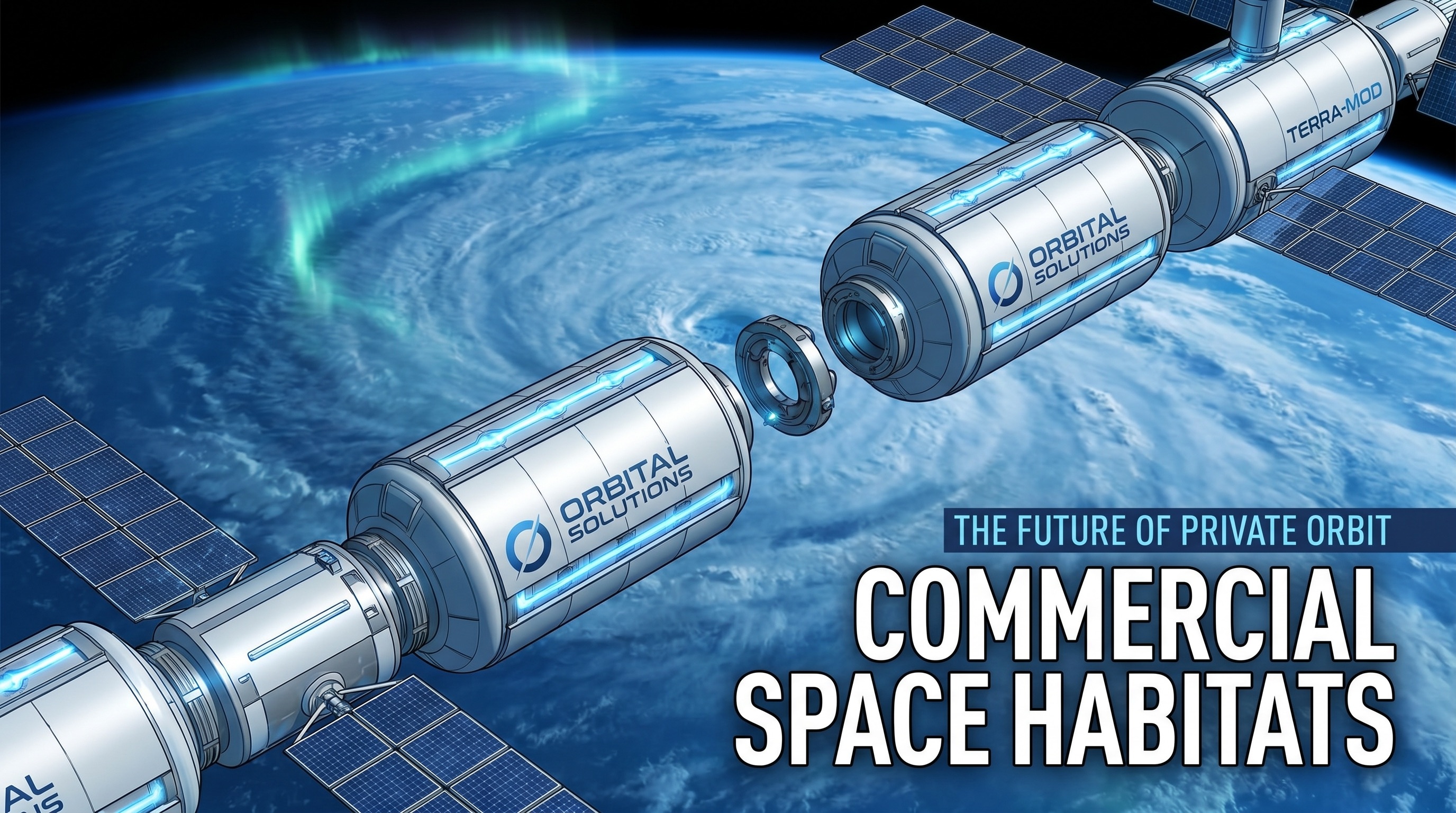
The International Space Station has hosted continuous human habitation since November 2000. By 2030, NASA plans to deorbit it in a controlled reentry over the South Pacific, ending 30 years of continuous human presence in low Earth orbit. The replacement is not a government station — it is four competing commercial stations, each backed by NASA contracts and private capital, each with a different architecture and timeline.
The transition is not hypothetical. Modules are being built, contracts have been signed, and at least one station is targeting its first crewed mission before the ISS comes down. This is what each program looks like in mid-2026, and what the shift from government-operated to commercially-operated orbital infrastructure actually means.
Axiom Station: The First Mover
Axiom Space is the furthest along in terms of hardware in orbit. The company has been attaching commercial modules to the ISS since 2021 under its AxEM (Axiom Extended Module) concept, conducting private astronaut missions to the station. Its first standalone commercial module, Axiom Module 1 (AxM1), was originally targeting a 2024 attachment to the ISS — that has slipped to late 2026 or early 2027 due to launch manifest constraints and hardware integration work.
The plan is to attach AxM1 to the ISS, then AxM2 and additional modules over subsequent years, and eventually detach the Axiom segment to operate independently as the ISS is deorbited. This gives Axiom a unique advantage: its station will not need to bootstrap crew systems from scratch — it inherits life support maturity from operating attached to the ISS.
NASA awarded Axiom a $130 million Phase 2 commercial LEO development contract. The company has also completed four private astronaut missions to the ISS (Ax-1 through Ax-4) under contracts with individual customers and national space agencies, generating revenue and operational experience while the station hardware is built.
Starlab: The Heavy-Lift Bet
Starlab, a joint venture between Voyager Space and Airbus, takes a different architectural approach: a single large-diameter module launched on a Starship or comparable heavy-lift vehicle, rather than assembled from smaller pieces. The design targets a 340 cubic meter pressurized volume — comparable to the entire US segment of the ISS — in a single launch.
NASA selected Starlab for Phase 2 development funding in December 2021, later increasing support to an $843 million Space Act Agreement in 2024 under the Commercial LEO Destinations (CLD) program. Target first launch has shifted from 2027 to a 2028-2029 window as the Starship-class vehicle required to launch the full module matures.
The Airbus partnership brings European aerospace manufacturing expertise and opens pathways for ESA participation and non-US research customers — a segment that could represent significant revenue, since non-US entities currently pay premium rates for ISS access and will face pricing uncertainty after 2030.
Blue Origin's Orbital Reef
Blue Origin's Orbital Reef, developed in partnership with Sierra Space and Boeing, received a NASA CLD Phase 2 contract in 2021. Orbital Reef is designed as a mixed-use business park in orbit: modular, expandable, and available to multiple tenants simultaneously rather than operated as a single facility.
Progress on Orbital Reef has been slower to surface publicly than Axiom or Starlab. Blue Origin's broader infrastructure challenges following Jeff Bezos's reduced day-to-day involvement have slowed development timelines. Sierra Space's inflatable LIFE habitat module — a key Orbital Reef component — completed ground testing in 2023 and 2024 at the Marshall Space Flight Center, but an on-orbit demonstration remains pending. Current public targets suggest a late 2020s initial operational capability.
VAST Haven-1: The Dark Horse
VAST, a California company backed by Jed McCaleb (co-founder of Ripple and Stellar), announced Haven-1 in 2023 as the smallest and most rapidly executable of the commercial station concepts. Rather than competing directly with the full-scale CLD stations, Haven-1 targets a 2025-2026 launch as a single-module microgravity research facility launched on a SpaceX Falcon 9 and serviced by Crew Dragon.
SpaceX signed an agreement to provide launch and crew transport services to Haven-1. If the timeline holds — the module was targeting a 2025 launch that has now slipped to 2026 — Haven-1 would become the first non-ISS human-rated space station in history, predating the larger stations by several years. Its small size limits capacity to four crew and a few weeks of habitation, but that is sufficient for private research missions and astronaut tourism.
The Business Model: What These Stations Will Actually Do
All four stations share a common commercial thesis: NASA will be an anchor tenant, purchasing research time and crew services, but the majority of revenue will come from non-NASA customers. These include: national space agencies (JAXA, ESA, CSA, and emerging space programs willing to pay for access without building their own station), pharmaceutical and biotech companies interested in microgravity protein crystal growth and drug manufacturing, materials science research, and private individuals and companies purchasing tourism flights.
The economics are uncertain. The ISS cost approximately $150 billion to build and operates at around $3-4 billion per year in US government spending. None of the commercial stations are targeting that cost structure — all are designed to be operationally sustainable at significantly lower crew size and research volume, with the assumption that commercial pricing can cover operating costs where government subsidies once did.
What This Means for the Next Decade in Orbit
The period between 2028 and 2032 will be the critical transition window. If ISS deorbits in 2030 as scheduled and commercial stations are not yet operational, there will be a gap in continuous human presence in orbit for the first time in 30 years. NASA has explicitly named this gap as a risk and is structuring CLD contracts to incentivize early operational capability.
The more optimistic scenario — which requires Axiom's module attachment proceeding in 2027 and Haven-1 operating commercially by late 2026 — produces an overlap period where both the ISS and commercial facilities are active. That overlap is the goal: an institutional handoff rather than a restart.
The private station era represents a genuine structural shift in how human spaceflight is funded and operated. Whether the commercial market is large enough to sustain multiple competing stations remains unproven. But the hardware is being built, the contracts exist, and the alternative — no crewed station after 2030 — is not the plan anyone is working toward.