On-device AI models are finally good enough to skip the cloud round-trip
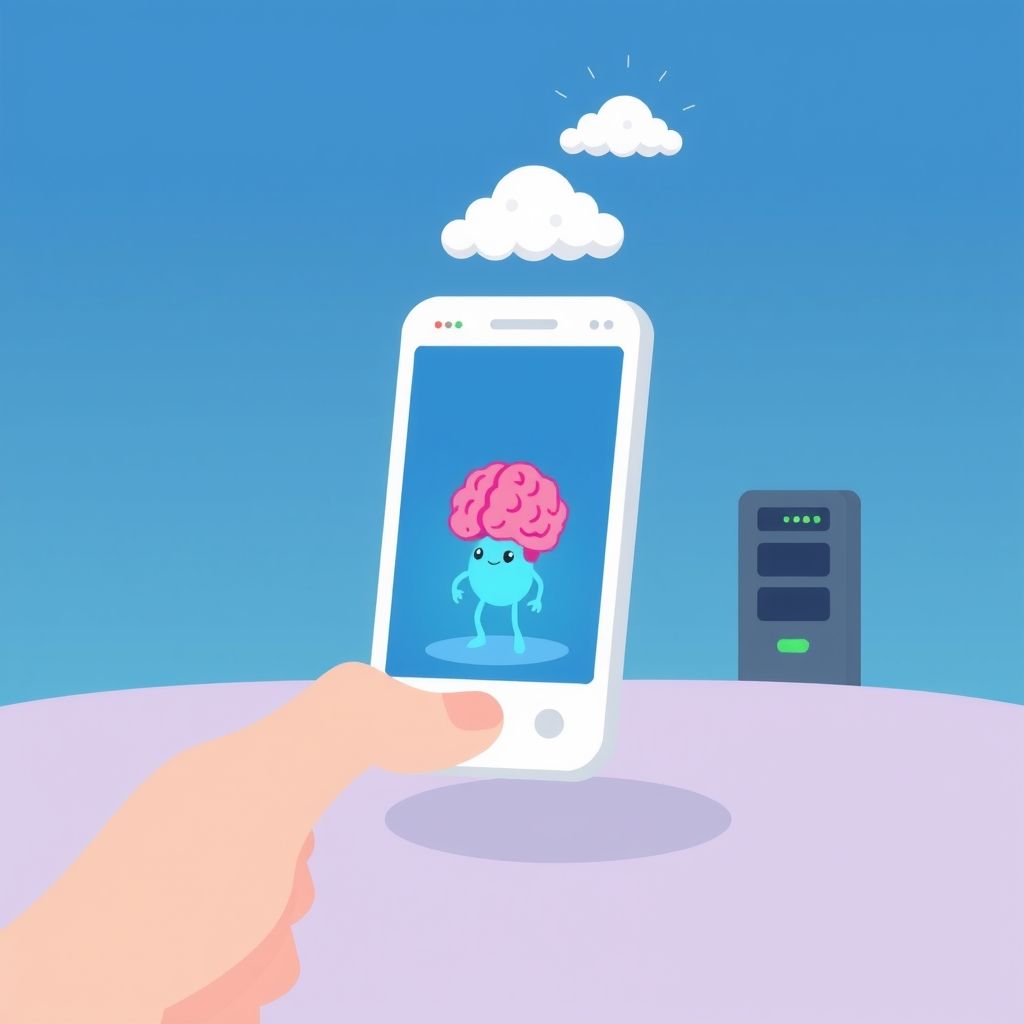
For most of the last three years, “AI on your phone” has meant a thin client shipping your voice, your photos, or your typing to a data center and waiting for an answer. That's changing, and the reason isn't a breakthrough model — it's the unglamorous grind of NPU hardware finally catching up to what on-device models actually need.
Qualcomm's Snapdragon 8 Gen 3, now standard across most 2026 flagship Android phones, delivers up to 26 TOPS (tera operations per second) from its dedicated NPU. Apple's A17 Pro dedicates more than 20 billion transistors specifically to its Neural Engine cores. Neither number means much in isolation, but the practical effect is concrete: models that used to require a cloud GPU now run locally in real time, on a phone, on battery.
The latency gap is the whole story
On-device inference now generates tokens in under 20 milliseconds. A cloud round-trip — network hop to the data center, queueing, inference, network hop back — typically runs 200 to 500 milliseconds. That's not a marginal improvement; it's the difference between an assistant that feels instantaneous and one that feels like you're waiting for a web page to load. For voice agents, live translation, and AR overlays that need to react to the world in real time, the cloud round-trip isn't just slower — it's disqualifying.
This is a big part of why Apple's iOS 27 Siri overhaul, which shipped September 14, leans so heavily on on-device processing for anything involving personal context or on-screen awareness. Reading what's on your screen and acting on it requires the kind of continuous, low-latency loop that a cloud API simply can't sustain without feeling laggy — and users notice laggy immediately, even if they can't articulate why.
Privacy stops being a trade-off
The other effect is less about speed and more about what data physically leaves the device. When an app has no network permission for a given feature and the model runs entirely on-device, call audio, camera frames, or keystrokes simply cannot leave the phone — not “we promise not to log it,” but a structural guarantee enforced by the absence of a network path. That's a meaningfully different privacy posture than “trust our data retention policy,” and it's one regulators and privacy-conscious users can actually verify by inspecting what permissions an app requests.
This matters more as on-device AI expands into call transcription, health data analysis, and financial app assistants — categories where “your data went to a server somewhere” has historically been the single biggest adoption blocker.
Where the ceiling still is
On-device models aren't replacing cloud AI outright, and won't for a while. NPU memory and compute budgets still can't match a data-center GPU cluster for anything requiring large context windows, heavy multi-step reasoning, or access to live external information. The realistic split emerging in 2026 app design is: on-device for anything latency-sensitive, privacy-sensitive, or offline-capable (transcription, autocomplete, image classification, simple assistants); cloud for anything requiring deep reasoning, large context, or real-time external data (complex research queries, agentic multi-tool workflows, anything requiring the largest frontier models).
The market is moving fast because the economics work both ways
The on-device AI hardware market is projected to grow from $10.6 billion in 2025 to $57.7 billion by 2033 — a 25.2% compound annual growth rate. That growth isn't just consumer demand pulling it forward. Every query that runs on-device is a query a company doesn't have to pay cloud GPU costs to serve. For companies burning cash on AI infrastructure debt, pushing inference cost onto the user's own hardware is a direct margin improvement, not just a UX nicety.
What this means for developers
If you're building a mobile app with an AI feature, the calculus has shifted. Before defaulting to a cloud API call, check whether the task fits in an on-device model's capability envelope — Apple's Core ML and Google's ML Kit / AI Edge SDK have both matured significantly in 2026, and the latency and privacy wins are real, not marketing. For anything privacy-sensitive (health, finance, personal communications), users increasingly expect on-device processing as a baseline, not a premium feature. And for cost-conscious teams, every feature you can move on-device is compute cost you stop paying per query, indefinitely.