On-Device AI Is Turning Smartphone Memory and Thermals Into Product Strategy
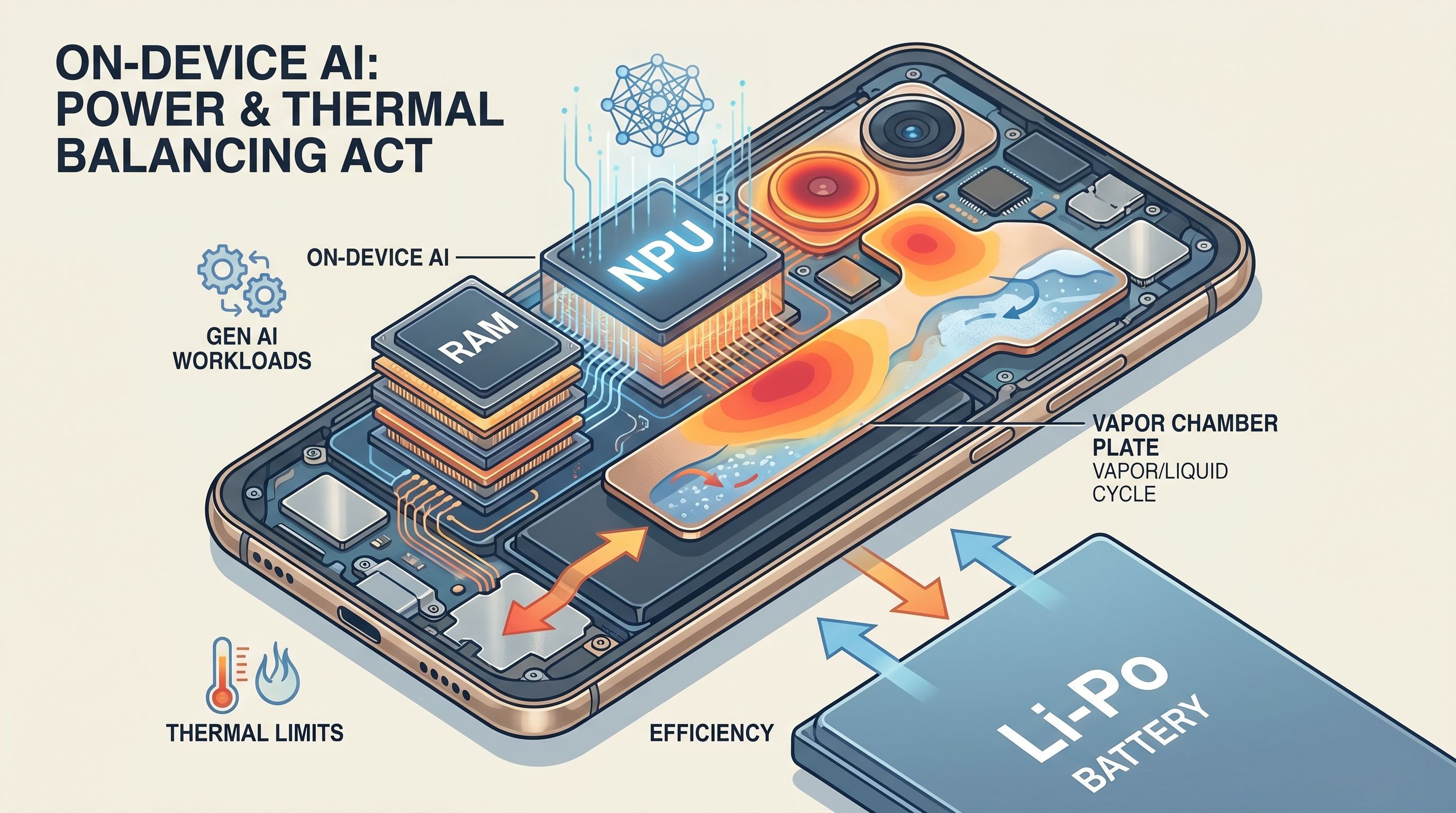
Smartphone launches used to revolve around cameras, screen brightness, and benchmark peaks. Now another layer is moving into the center of the product story: how well a phone can run AI features on the device itself without slowing down, overheating, or draining the battery. As more assistants, summarizers, image tools, and language features run locally, memory architecture and thermal behavior are no longer hidden engineering details. They are becoming product strategy.
The key shift is that on-device AI does not behave like a short bursty app workload. Many AI tasks need substantial RAM headroom, fast movement between storage and memory, efficient scheduling across CPU, GPU, and NPU blocks, and enough thermal capacity to sustain responsiveness for more than a minute or two. If any of those pieces are weak, the feature may still work in a demo, but it will feel inconsistent in daily use. That is why memory size, memory bandwidth, storage speed, and heat management are suddenly influencing positioning across flagship, premium-midrange, and even software support promises.
Why RAM is now a product decision
For years, smartphone RAM was often marketed as a simple spec race. On-device AI changes the meaning of that number. Local models, retrieval layers, background context, and multimodal processing all compete for working memory. A phone with insufficient RAM may still launch an AI feature, but it will be more aggressive about unloading apps, shrinking context windows, reducing concurrency, or shifting more work back to the cloud.
That creates a meaningful product gap. Two phones can advertise similar AI experiences, yet the device with more usable memory may support longer context, faster switching, better background continuity, and fewer wait states. In other words, RAM now shapes not only performance but also the practical feature set a vendor can sustain over time.
Storage bandwidth matters more than most buyers realize
On-device AI is also exposing the importance of storage speed. Models and intermediate assets often need to be loaded quickly, swapped efficiently, or streamed in chunks when full residency in memory is unrealistic. That means fast flash storage and good I/O behavior increasingly affect whether an AI tool feels immediate or sluggish.
This is one reason some vendors can deliver a smoother local AI experience even when their raw compute marketing looks similar to rivals. It is not just the NPU headline. The total data path matters: storage, memory controller, interconnects, scheduler behavior, and software optimization. As AI features mature, users may not know why one phone feels more fluid than another, but the difference will often come from this underlying systems balance.
Thermals are becoming part of the UX
Heat has always mattered in smartphones, but AI makes it visible in new ways. A phone that warms up quickly during transcription, photo generation, translation, or local summarization may throttle precisely when the user expects the feature to remain responsive. Sustained AI use can expose weak chassis design, conservative tuning, or insufficient dissipation more clearly than many traditional mobile tasks.
This matters because product perception is formed over repeated interactions, not keynote demos. If an assistant works brilliantly for thirty seconds but slows after five minutes, users learn not to trust it. That makes thermals a direct experience variable. Vendors are starting to make choices about vapor chambers, materials, scheduling policies, and feature defaults based on how much sustained local AI they want to promise without disappointing people.
NPU strategy alone is not enough
Chip vendors understandably emphasize NPU TOPS, but on-device AI performance is broader than one accelerator metric. Some tasks run best on the NPU, others spill across CPU or GPU resources, and real-world pipelines often include memory access, image preprocessing, indexing, and post-processing that are not captured by a single number. A phone can have an impressive AI compute claim and still underdeliver if memory pressure or thermals collapse the experience.
That is why handset makers are increasingly forced to think at the system level. It is not enough to buy the latest silicon and add a chatbot layer. The product team has to decide which AI experiences deserve always-ready performance, how much memory budget to reserve, what workloads are allowed offline, and when to hand work back to cloud services. Those are strategic decisions about identity and positioning, not only engineering implementation.
Battery life and trust are tied together
Consumers will not embrace local AI if it quietly destroys battery life. Many AI workloads are computationally dense and can trigger multiple subsystems at once: microphone input, display activity, networking, background indexing, and accelerator use. If a device repeatedly burns noticeable battery for moderate-value features, users will turn them off.
This creates a new balancing act for smartphone brands. Cloud AI may reduce local power draw but increase latency, privacy concerns, and service cost. On-device AI improves immediacy and privacy, but only if the hardware can deliver it efficiently. The strongest products will not be the ones that push every task onto the device. They will be the ones that decide intelligently which workloads belong locally, which should be hybrid, and which are better left to the cloud.
Why this changes product segmentation
As AI becomes a purchase factor, smartphone tiers may separate less by camera count and more by sustained AI capability. Flagships will justify higher prices not only through peak silicon, but through larger RAM pools, faster storage, better cooling, and longer support for local models. Midrange devices will need clearer tradeoffs. They may offer selected on-device AI features, but with smaller models, shorter context, or more aggressive cloud fallback.
This has software implications too. If a vendor promises several years of AI feature updates, it must ship hardware with enough margin to absorb larger models and heavier local tooling later. Devices designed too tightly around today's workloads may age badly once AI expectations rise. In that sense, memory and thermals are now part of long-term software credibility.
What buyers and reviewers should look for
The practical question is no longer whether a phone has AI, because nearly every premium device will. The question is how the AI behaves after the launch event. Reviewers should test sustained translation, long transcription, repeated image editing, and multitasking alongside AI features. Buyers should pay attention to RAM configuration, storage class, thermal consistency, and whether key features run locally or require the cloud.
They should also look for honesty from vendors. A company that clearly explains where on-device AI works best, where hybrid processing is used, and what tradeoffs affect battery and performance is likely making better product choices than one that hides behind generic AI branding.
The next smartphone battle is systems integration
On-device AI is turning smartphone design into a systems problem that users can finally feel. Memory capacity, bandwidth, thermal headroom, storage behavior, scheduler quality, and silicon integration all shape whether AI features become daily tools or forgotten demos. That is why these previously invisible subsystems are becoming central to product strategy.
The brands that win will be the ones that treat local AI as a sustained experience, not a feature checklist. In the next phase of the smartphone market, the meaningful differences will come from how well the whole device carries AI workloads over time, not from a single benchmark or keynote claim.