Mobile Manipulators Are Delivering Real Value, Outpacing Humanoid Hype in Warehouses
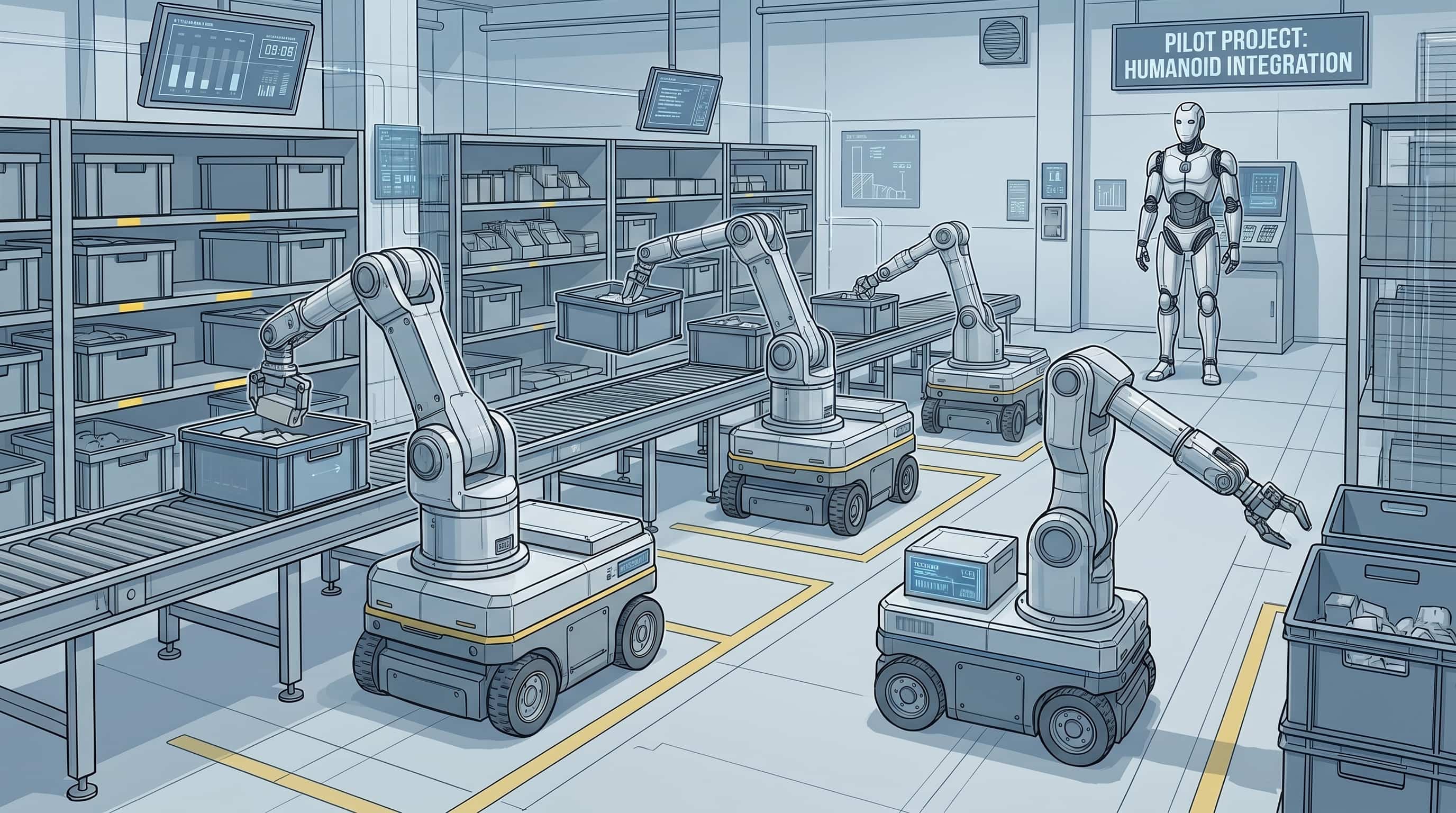
The world watches with fascination as humanoid robots take their first tentative steps, performing impressive, if often choreographed, demonstrations. From Boston Dynamics' Atlas to Tesla's Optimus, these bipedal machines promise a future where robots seamlessly integrate into human environments, potentially replacing general labor across industries. However, amidst this captivating hype, a quieter, yet far more impactful revolution is unfolding within the demanding confines of modern warehouses: the widespread adoption and proven efficacy of mobile manipulators.
This article argues that for the foreseeable future, task-specific robots, particularly mobile manipulators equipped with robust software orchestration, are the undisputed near-term winners in warehouse automation. While humanoids represent a long-term vision, current warehouse buyers are prioritizing immediate, measurable gains in throughput, safety, uptime, and seamless integration. Mobile manipulators, by design, directly address these critical needs, fitting perfectly into constrained workflows and existing fleet management systems, delivering practical gains that far outstrip the nascent capabilities of their bipedal counterparts.
The Unyielding Demands of the Modern Warehouse
Warehouse operations are a relentless ballet of efficiency, precision, and speed. Every second counts, every error costs. For warehouse managers and logistics professionals, the primary drivers for automation investment are clear: increased throughput to meet e-commerce demands, enhanced safety for human workers, maximized uptime to prevent costly disruptions, and effortless integration with existing Warehouse Management Systems (WMS) and other operational technologies. The shape of the robot is secondary to its ability to perform specific tasks reliably, repeatedly, and cost-effectively. A robot that looks like a human but cannot consistently pick a diverse range of items or navigate complex, dynamic environments without extensive human intervention offers little immediate value.
Mobile Manipulators: The Practical Powerhouses
Enter the mobile manipulator. These ingenious machines combine the mobility of an Autonomous Mobile Robot (AMR) with the dexterity of a robotic arm. This hybrid design allows them to navigate warehouse aisles, pick items from shelves, place them into totes, sort packages, replenish inventory, and even assist with packing and palletizing. Unlike fixed robotic arms, which are confined to a specific workstation, mobile manipulators bring the automation directly to the task, offering unparalleled flexibility and scalability.
Their advantages are manifold. They can be deployed rapidly, often integrating with existing infrastructure with minimal disruption. Their software platforms are typically designed for fleet management, allowing multiple units to work collaboratively and be orchestrated by a central system, often leveraging advanced AI for path planning, object recognition, and task allocation. This robust software layer, coupled with well-defined APIs, ensures smooth communication with WMS and other enterprise systems, making them a true plug-and-play solution for many specific tasks.
Consider a scenario where a mobile manipulator is tasked with picking items for an order. An AMR base navigates to the correct aisle and shelf location, guided by its internal mapping and navigation systems. The robotic arm, equipped with vision systems and AI-powered grasping algorithms, identifies the specific product, picks it with precision, and places it into a waiting tote on the robot's base. It then moves to the next pick location or a packing station. This entire process is optimized for speed, accuracy, and consistency, directly contributing to higher throughput and reduced errors.
The Humanoid Reality Check: Hype vs. Practicality
While humanoid robots are undeniably impressive feats of engineering, their current state of development presents significant hurdles for widespread, practical application in warehouses. Most humanoid pilots remain narrowly scoped, focusing on concrete, measured tasks such as moving empty totes or performing simple pick-and-place operations of uniform items. They are far from being general labor replacements capable of handling the vast diversity of items, unpredictable environments, and complex decision-making required in a typical warehouse.
The challenges are numerous:
- Cost and Complexity: Humanoids are inherently complex and expensive to develop, manufacture, and maintain. Their intricate balance, locomotion, and multi-jointed dexterity require sophisticated control systems and powerful onboard computing, often relying on high-performance GPUs for real-time perception and decision-making.
- Speed and Efficiency: Current humanoids are generally slower and less efficient at repetitive tasks compared to purpose-built industrial robots or mobile manipulators. Their bipedal gait, while human-like, is not optimized for speed or carrying heavy loads across long distances in a warehouse setting.
- Dexterity and Versatility: While they can grasp objects, their ability to handle the sheer variety of shapes, sizes, weights, and fragility found in a warehouse (from a delicate glass bottle to a bulky box) is still limited. A specialized gripper on a mobile manipulator often outperforms a humanoid hand for specific tasks.
- Safety and Integration: Operating humanoids safely alongside human workers in dynamic, unstructured environments poses significant challenges. Their integration into existing fleet management and WMS systems is also a nascent area, lacking the mature APIs and established protocols of AMRs and mobile manipulators.
- AI and General Intelligence: True general artificial intelligence, capable of adapting to novel situations and performing a wide array of tasks without explicit programming, remains a distant goal. Current humanoid "intelligence" is largely task-specific and heavily reliant on pre-programmed routines or supervised learning within controlled environments.
The Indispensable Role of Software Orchestration
Regardless of a robot's physical form, its true power lies in its software. For mobile manipulators, robust software orchestration is paramount. This includes:
- Fleet Management Systems: Coordinating hundreds of AMRs and mobile manipulators, optimizing their paths, managing battery charging, and ensuring efficient task allocation.
- Advanced Perception and AI: Utilizing computer vision and AI algorithms for accurate object detection, identification, and precise grasping, even for irregularly shaped items.
- Seamless API Integration: Connecting with WMS, Enterprise Resource Planning (ERP) systems, and other operational software to ensure data flow, task assignment, and inventory updates in real-time.
- Predictive Maintenance: AI-driven analytics to monitor robot health, predict potential failures, and schedule maintenance proactively, maximizing uptime.
Actionable Takeaways for Warehouse Operators
For warehouse operators looking to automate, the path forward is clear and pragmatic:
- Identify Specific Pain Points: Don't automate for automation's sake. Pinpoint bottlenecks, repetitive tasks, or areas with high injury rates. Mobile manipulators excel at addressing these targeted problems.
- Prioritize Proven Technologies: Invest in solutions with a track record of success. AMRs and mobile manipulators have demonstrated tangible ROI in diverse warehouse settings.
- Demand Robust Software and API Support: Ensure any robotic solution offers comprehensive fleet management, advanced AI for perception, and open APIs for seamless integration with your existing IT infrastructure. This is non-negotiable for scalability and long-term success.
- Start Small, Scale Smart: Begin with a pilot project addressing a specific, well-defined task. Measure the results rigorously. Once proven, scale the deployment incrementally.
- Focus on ROI, Not Novelty: While humanoids are exciting, their current ROI for general warehouse tasks is largely unproven. Mobile manipulators offer a clearer, faster path to return on investment.
Conclusion: Practicality Prevails in the Near Term
While the long-term vision of human-like robots working alongside us is compelling, the immediate future of warehouse automation belongs to practical, task-specific solutions. Mobile manipulators, with their proven ability to enhance throughput, improve safety, and integrate seamlessly into existing operations, are delivering real, measurable value today. They represent the pragmatic evolution of automation, focusing on solving concrete business problems rather than chasing a futuristic ideal. Warehouse operators who prioritize these proven technologies and robust software orchestration will be the ones to truly unlock the next level of efficiency and competitiveness in their operations, leaving the humanoid hype to slowly catch up.