Lunar Communications and Navigation Networks Are Becoming the Next Infrastructure Layer
The End of Ad-Hoc Lunar Missions
For decades, a mission to the Moon was a monolithic undertaking. Each lander or orbiter was an island, equipped with its own powerful, custom-built communications system designed for one purpose: to maintain a direct link with Earth. This approach was sufficient when lunar missions were rare, bespoke expeditions. However, with the European Space Agency (ESA) projecting over 400 missions in the next two decades, this model is no longer scalable, efficient, or economically viable. We are at an inflection point where the primary challenge is shifting from simply getting to the Moon to operating there sustainably and effectively.
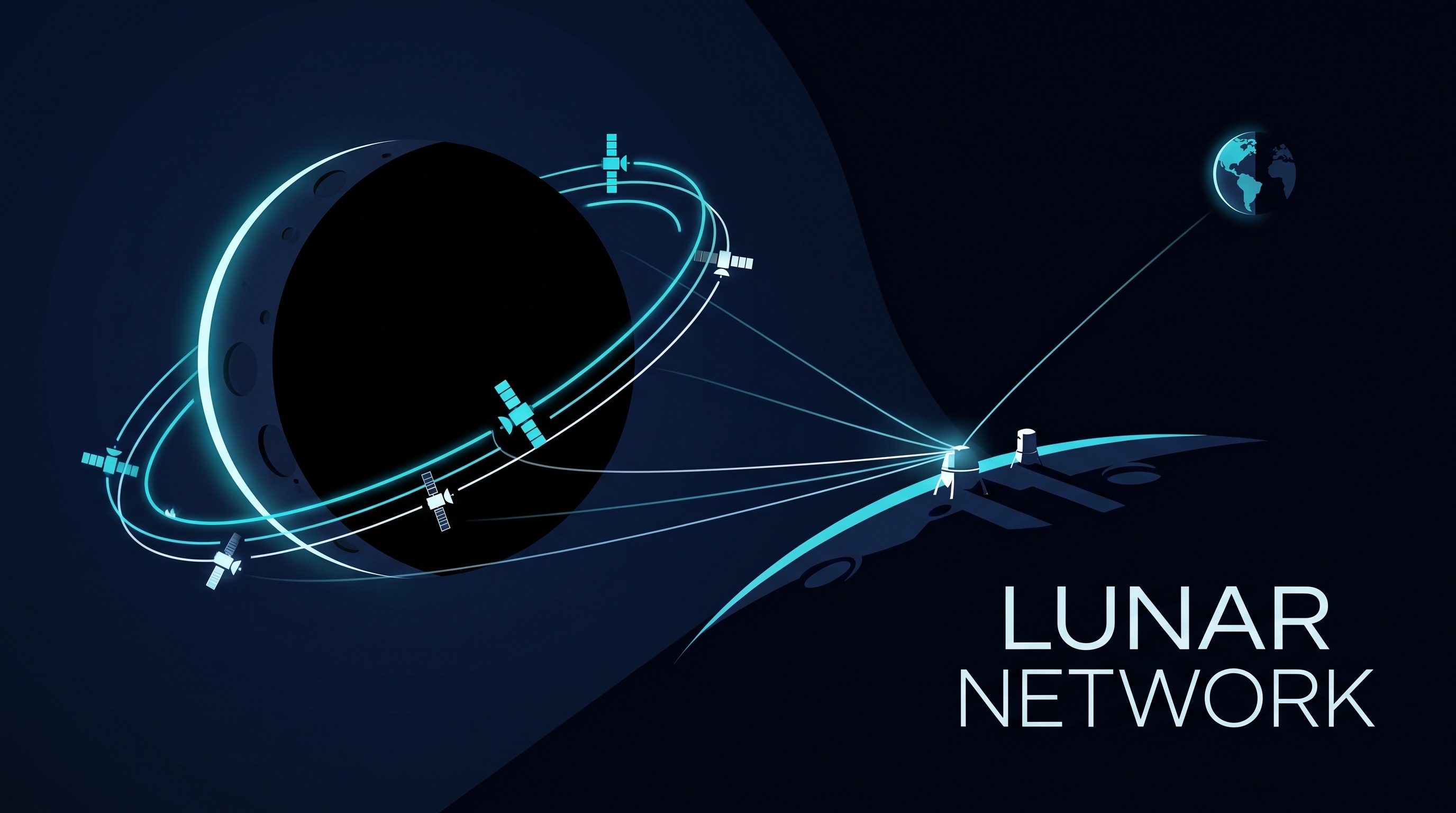
The next foundational layer of the burgeoning lunar economy is not a new type of rocket or rover, but a shared, persistent infrastructure for communications and navigation. Just as Earth's economy relies on the internet and GPS, a sustained human and robotic presence on the Moon requires a common utility for data relay and precise positioning. The current direct-to-Earth paradigm is a severe bottleneck, limiting data rates, restricting landing sites to areas with a constant line of sight to Earth, and forcing every mission to reinvent the same costly wheel. The solution lies in creating a lunar network—an ecosystem of orbiting satellites and surface nodes that provides these services to all.
The Bottleneck of Bespoke Systems
The traditional model of lunar communication presents several fundamental problems that hinder the growth of lunar activity. Firstly, it is incredibly inefficient. Each mission must carry a robust, high-power antenna capable of transmitting across 384,000 kilometers of empty space. This adds significant mass and complexity, which directly translates to higher launch costs and fewer resources for the primary scientific or commercial payload. Every kilogram dedicated to a unique communication system is a kilogram not spent on a drill, spectrometer, or life support.
Secondly, this approach creates a severe data bottleneck. The bandwidth available for direct-to-Earth links is limited and must be shared among an increasing number of missions. As rovers and habitats begin generating terabytes of high-definition video and scientific data, the capacity to transmit it all back becomes a major constraint. This forces mission planners to make difficult compromises about what data is collected and what is left behind on a lunar hard drive.
Finally, direct-to-Earth communication fundamentally limits where we can go and what we can do. It requires a persistent line of sight, effectively ruling out sustained operations on the far side of the Moon or in permanently shadowed regions near the poles—the very places believed to hold vast reserves of water ice. A rover disappearing into a crater loses contact instantly, a critical mission risk. To unlock the full potential of the Moon, we need infrastructure that provides continuous coverage, everywhere.
Building the Lunar Internet and GPS
Recognizing this impending crisis, space agencies and commercial companies are now actively building this new infrastructure layer. Two flagship initiatives, ESA's Moonlight and NASA's LunaNet, represent the architectural vision for this connected future.
ESA's Moonlight: A Commercial Service Provider
ESA's Moonlight initiative is a public-private partnership aimed at creating a constellation of lunar satellites to provide both communications and navigation services. The planned architecture includes four navigation satellites for precise positioning and one communications satellite for high-speed data relay, supported by a network of ground stations on Earth. The first precursor mission, Lunar Pathfinder, is scheduled to begin operations in 2026, with initial Moonlight services available by late 2028 and full operational capability by 2030.
The key innovation of Moonlight is its business model. ESA is not just building a system for its own missions; it's fostering a commercial service that can be sold to any lunar mission, whether from a national agency or a private company. This transforms lunar communications from a capital expenditure baked into each mission into an operational expenditure. A startup launching a small lunar rover could simply subscribe to a data plan and navigation service from the Moonlight provider, drastically lowering the barrier to entry.
NASA's LunaNet: The Interoperability Framework
While Moonlight is a specific constellation, NASA’s LunaNet is an architectural framework—a set of mutually agreed-upon standards and protocols. It’s less like a single mobile carrier and more like the TCP/IP protocol that underpins the internet. LunaNet defines how different networks, whether operated by ESA, JAXA, NASA, or commercial entities, can interoperate seamlessly. A rover using a European navigation signal could relay its data through an American satellite to a Japanese ground station without custom engineering.
This focus on interoperability is crucial. It prevents the creation of fragmented, proprietary systems—a "lunar splinternet"—and instead fosters a resilient, global network where assets from multiple providers can serve any user. This collaborative approach, which aligns Moonlight with LunaNet standards, is essential for creating a robust infrastructure that can support a diverse ecosystem of users and activities.
Extending the Network to the Surface
The infrastructure isn't just orbital. The final link is on the lunar surface itself. Nokia's deployment of LTE hardware on the upcoming Intuitive Machines IM-2 mission is a landmark experiment. It aims to prove that terrestrial cellular technology can function in the harsh lunar environment, creating local networks for astronauts, rovers, and scientific instruments to communicate with each other and with a local lander, which then acts as a gateway to the orbital relay network. This creates a complete, multi-layered communications stack, from a sensor on a rover to a scientist on Earth, routed through surface LTE, an orbital relay, and a terrestrial ground station.
Actionable Takeaways for the Lunar Ecosystem
The shift toward shared communications and navigation infrastructure has practical implications for all stakeholders in the space economy.
- For Aerospace Mission Planners: The design philosophy must evolve. Instead of building monolithic, self-reliant spacecraft, the new goal is to design missions as clients of a larger network. This means integrating LunaNet-compliant radios and relying on PNT (Positioning, Navigation, and Timing) services for navigation rather than building complex onboard systems. This shift reduces cost, mass, and risk, allowing a greater focus on the mission's core objectives.
- For Telecommunications and Tech Companies: The Moon is a new frontier and a new market. Expertise in satellite constellation management, network protocols, RF engineering, and cloud data processing is directly transferable. The Nokia lunar LTE project demonstrates that terrestrial technology can find new applications. This is an opportunity to develop and deploy ruggedized hardware and software-defined networking solutions for an entirely new environment.
- For Investors: The most durable investments in any gold rush are in the companies selling picks and shovels. Lunar communications and navigation infrastructure is the digital equivalent. Investing in the companies building these constellations and services is a bet on the growth of the entire lunar ecosystem, not just the success of a single mission. This is a long-term play on the foundational utility layer of a multi-billion dollar off-world economy.
- For Policymakers and Agencies: The priority must be on championing and enforcing open standards like LunaNet. International cooperation is paramount to ensure a single, interoperable network that benefits all of humanity's efforts on the Moon. Fostering public-private partnerships, like ESA's model with Moonlight, will accelerate development and ensure these services are commercially viable and sustainable.
The transition from bespoke communication systems to a shared utility network is not merely an incremental improvement. It is the critical enabling step that will unlock the next phase of lunar exploration and settlement, transforming the Moon from a distant destination for heroic missions into a dynamic platform for science, commerce, and human expansion.