Low Earth Orbit Is Getting Dangerously Crowded — and Nobody Is in Charge
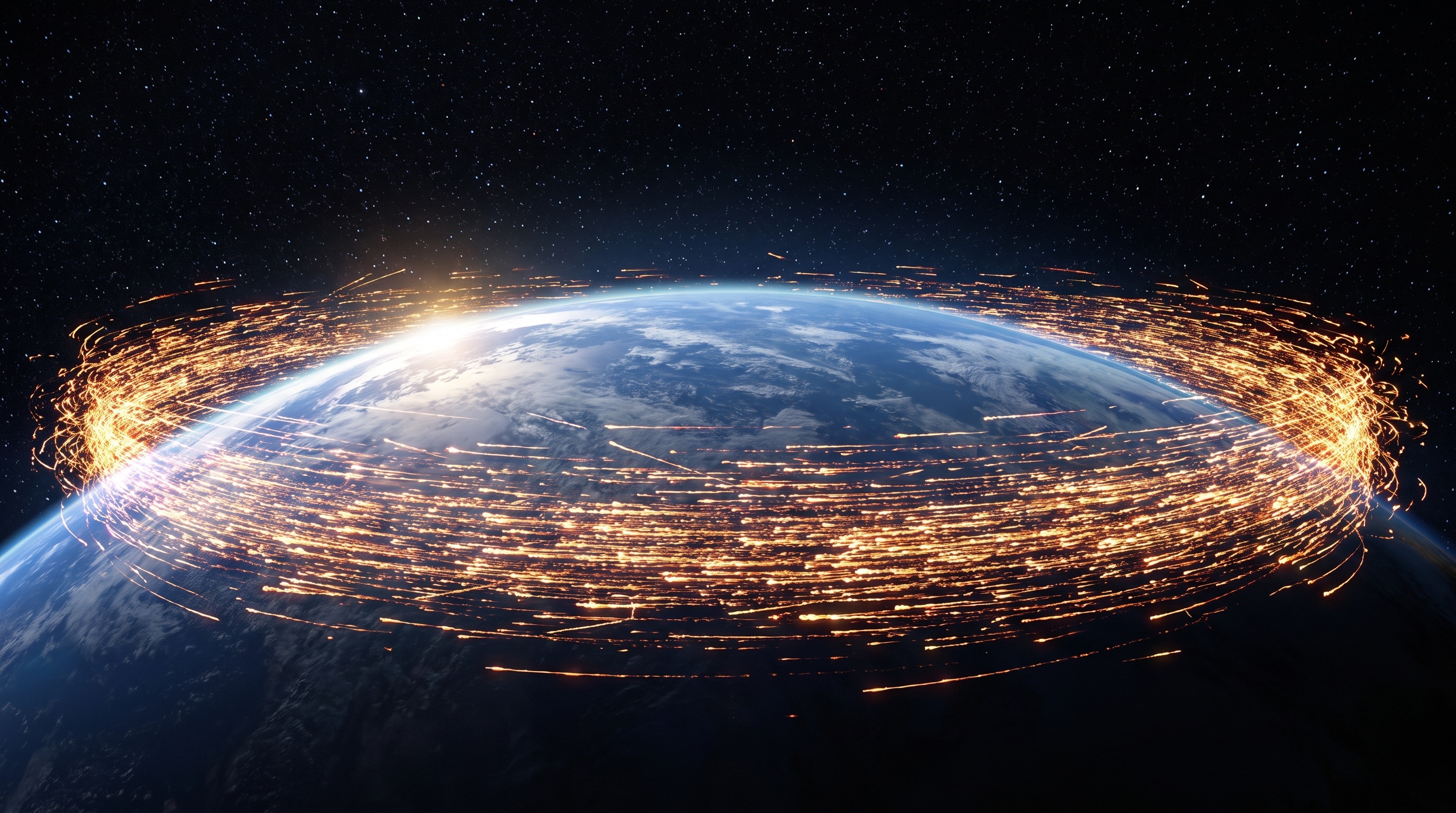
There are roughly 50,000 pieces of debris larger than 10 centimeters currently orbiting Earth, traveling at speeds of up to 28,000 kilometers per hour. At that velocity, a fragment the size of a marble carries the kinetic energy of a hand grenade. And as of early 2026, roughly 14,000 active satellites share that same volume of space — with more than 1.2 million additional satellite slots proposed or applied for by commercial operators.
The core problem is not that any individual operator is being reckless. It is that Low Earth Orbit is a shared commons with no effective governance, and the math of orbital congestion can tip from manageable to catastrophic without warning. Donald Kessler and Burton Cour-Palais described this dynamic in 1978: once debris density crosses a threshold, collisions generate more debris than deorbit events can remove, and the cascade becomes self-sustaining. That threshold is not science fiction. The question today is whether we are approaching it.
What the Numbers Actually Tell Us
The debris problem has two distinct layers that are often conflated. The first is trackable debris: objects larger than 10 centimeters that ground-based radar can monitor and predict orbital paths for. There are approximately 50,000 of these. The second layer is untrackable: fragments between 1 and 10 centimeters where the risk of impact is real but the location is unknown. Estimates put this population at 500,000 to 1 million objects.
Active satellites currently dodge debris using propulsion. The ISS performs collision-avoidance maneuvers multiple times per year. SpaceX's Starlink constellation — now exceeding 6,000 satellites — uses autonomous avoidance software. But as orbital density increases, the computational burden of avoiding collisions grows nonlinearly. More satellites means more potential collision pairs, and more collision pairs means more maneuvers, and more maneuvers means more fuel consumption that shortens satellite lifetimes and increases eventual debris.
The Governance Gap
No international body has binding authority over orbital debris. The United Nations Committee on the Peaceful Uses of Outer Space (COPUOS) produces guidelines, but compliance is voluntary. The International Telecommunication Union (ITU) allocates orbital slots and radio frequencies but does not regulate debris. The US Federal Communications Commission has introduced a new 5-year deorbit rule for satellites in LEO below 2,000 km, tightening the previous 25-year standard — but this applies only to US-licensed operators, and enforcement of even these rules has been inconsistent.
In January 2026, SpaceX filed an application with the FCC for a constellation of up to 1 million satellites to power space-based data centers operating between 500 and 2,000 kilometers in altitude. This is not a fantasy — it is a regulatory filing. The current framework has no mechanism to evaluate cumulative environmental impact at that scale before granting spectrum and slot access.
Active Debris Removal: Necessary, Expensive, and Slow
The most discussed solution is active debris removal (ADR) — physically capturing derelict objects and deorbiting them. ESA's ClearSpace-1 mission, targeting a single 95-kilogram PROBA-1 satellite for removal, carries a contract value of €86 million. The mission is scheduled for 2026. The math is stark: at that cost per object, clearing the most dangerous derelict objects in LEO would cost hundreds of billions of euros.
Several startups — Astroscale, ClearSpace, Exolaunch — are working on lower-cost ADR approaches using net capture, robotic arms, and electromagnetic tethers. Astroscale has demonstrated docking with a cooperative target. None have yet removed an uncooperative piece of debris, which is the actual challenge: most debris is tumbling, has no docking interface, and was never designed to be serviced.
The other technical lever is designing satellites for deorbit from the start. Modern Starlink satellites deorbit within five years of retirement. But the existing debris population accumulated over 65 years is not going away. It has to be actively managed.
What Needs to Change
Three shifts are required simultaneously, and none is happening fast enough. First, international coordination: orbital debris needs a binding treaty framework with enforceable deorbit standards, an equivalent of what the IAEA does for nuclear material. COPUOS guidelines exist on paper; enforcement does not. Second, economic incentives: operators should internalize the cost of debris through mandatory insurance or orbital-use fees. A fee per satellite-year proportional to debris risk would change the economics of constellation design overnight. Third, technology: investment in ADR at scale, including shared infrastructure for capturing and deorbiting derelict objects.
The precedent that LEO is effectively free for anyone to fill is set by regulatory inaction, not physics. Physics says the debris cascade is reversible if addressed early. Regulatory inaction says that decision gets deferred until it is not.
What to Watch
The ESA ClearSpace-1 mission result will be a significant data point: if it succeeds, it validates the ADR technology pathway. The FCC's enforcement of its own 5-year deorbit rule — particularly against non-compliant satellites from smaller operators — will signal whether the US regulatory posture is changing. And SpaceX's 1-million-satellite filing will test whether any regulator is prepared to evaluate cumulative orbital impact rather than approving satellites piecemeal. The debris problem is not a crisis yet. The question is whether the gap between "not yet" and "too late" is wide enough to act in.