Industrial exoskeletons are moving from pilot programs to paychecks
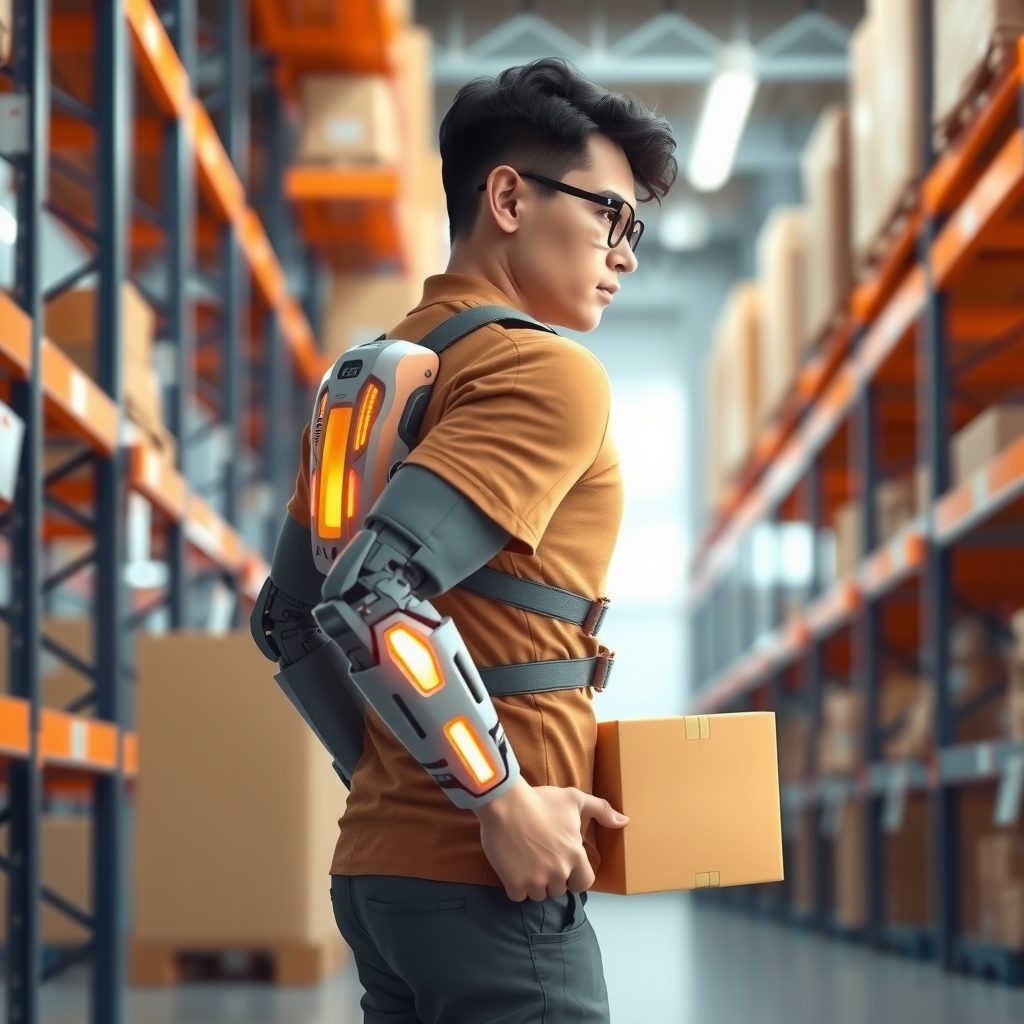
Ten thousand exoskeleton units are now deployed across warehouses and factory floors, and more than half of that adoption sits in logistics and warehousing specifically. That's not a research-lab number — it's a procurement number, and it's the clearest signal yet that passive exoskeletons have crossed from experimental safety gear into a line item that operations managers actually budget for.
The math that changed minds
A back injury in a warehouse setting costs an employer upwards of $40,000 once you account for workers' comp, lost productivity, retraining, and the ripple effects of overtime coverage. A passive back-support exoskeleton — no batteries, no motors, just engineered springs and linkages that redirect load away from the lumbar spine — costs $2,800 to $5,000 per unit. Equip a ten-person team for roughly $38,000 and prevent even one or two serious injuries a year, and the device has paid for itself inside 18 to 36 months. That's the calculation logistics operators have been running, and it's why passive devices — not the more expensive powered, motorized exoskeletons — are the ones actually shipping at volume.
Companies pairing exoskeleton rollouts with ergonomics training are reporting 20-40% reductions in back injury rates, which compounds the ROI further: fewer injuries means lower workers' comp premiums the following year, not just avoided one-time costs.
Who's actually deploying these
The vendor landscape has consolidated around a handful of names that have moved past pilot programs. German Bionic Systems, Bioservo Technologies, Laevo, and RB3D are shipping passive and semi-passive units into logistics accounts at meaningful scale, while Comau — better known for industrial automation — has brought its manufacturing-sector credibility to bear on the exoskeleton line. On the OEM side, both General Electric and Caterpillar have moved from evaluating exoskeletons to deploying them at an accelerating rate, which matters because those are companies with enough internal safety and procurement rigor that their adoption curve tends to get watched closely by peers.
The pattern across these deployments is consistent: passive back-support units for repetitive lifting and bending roles first, because that's where the injury-cost math is most favorable and the technology is simplest. Powered exoskeletons for heavier lifting or full-body support remain a smaller, higher-cost category still working through longer pilot cycles.
Where the technology still falls short
Passive exoskeletons are mechanically simple, which is both their strength and their limitation. They redirect load; they don't add power. That means they help with sustained bent-forward postures and repetitive lifting, but they don't meaningfully assist with genuinely heavy loads the way a powered lift-assist device would. Worker comfort and fit remain real adoption barriers — a device that's uncomfortable across an 8-to-10-hour shift gets left in a locker regardless of the injury-prevention math behind it, and vendors are still iterating on sizing and weight distribution to solve for that.
There's also a data gap: most of the injury-reduction figures being cited come from vendor-sponsored pilots and small-scale case studies rather than large, independent longitudinal studies. The 20-40% injury reduction figure is directionally credible given the biomechanics involved, but operations teams evaluating a purchase should treat vendor ROI calculators as a starting point for their own injury-cost modeling, not a guarantee.
What this means going forward
The industrial exoskeleton market is projected to grow from roughly $0.97 billion in 2025 to $1.08 billion in 2026, with the warehouse logistics segment alone expected to reach $2 billion by 2028. That's a market moving fast enough that procurement teams evaluating warehouse safety budgets in 2026 should treat exoskeletons as a mainstream line item alongside forklift safety programs and ergonomic workstation redesigns — not a speculative pilot to revisit next year.
Actionable takeaways
- If your operation has high-frequency lifting or bending roles, run your own injury-cost math against the $2,800-$5,000 passive device price point before dismissing exoskeletons as a novelty — the payback window is realistically 18-36 months for teams with elevated back-injury rates.
- Start with passive, unpowered devices for repetitive-motion roles rather than powered exoskeletons — the ROI case is stronger and the technology is more mature.
- Pair any exoskeleton rollout with ergonomics training rather than deploying devices alone — the injury-reduction data suggests the combination outperforms hardware by itself.
- Treat vendor-supplied ROI figures as directional, and validate against your own workers' comp claims history before committing to a fleet-wide purchase.