Humanoid Robots Are Entering Factories — What's Real and What's Still Hype
From Demo Reel to Factory Floor
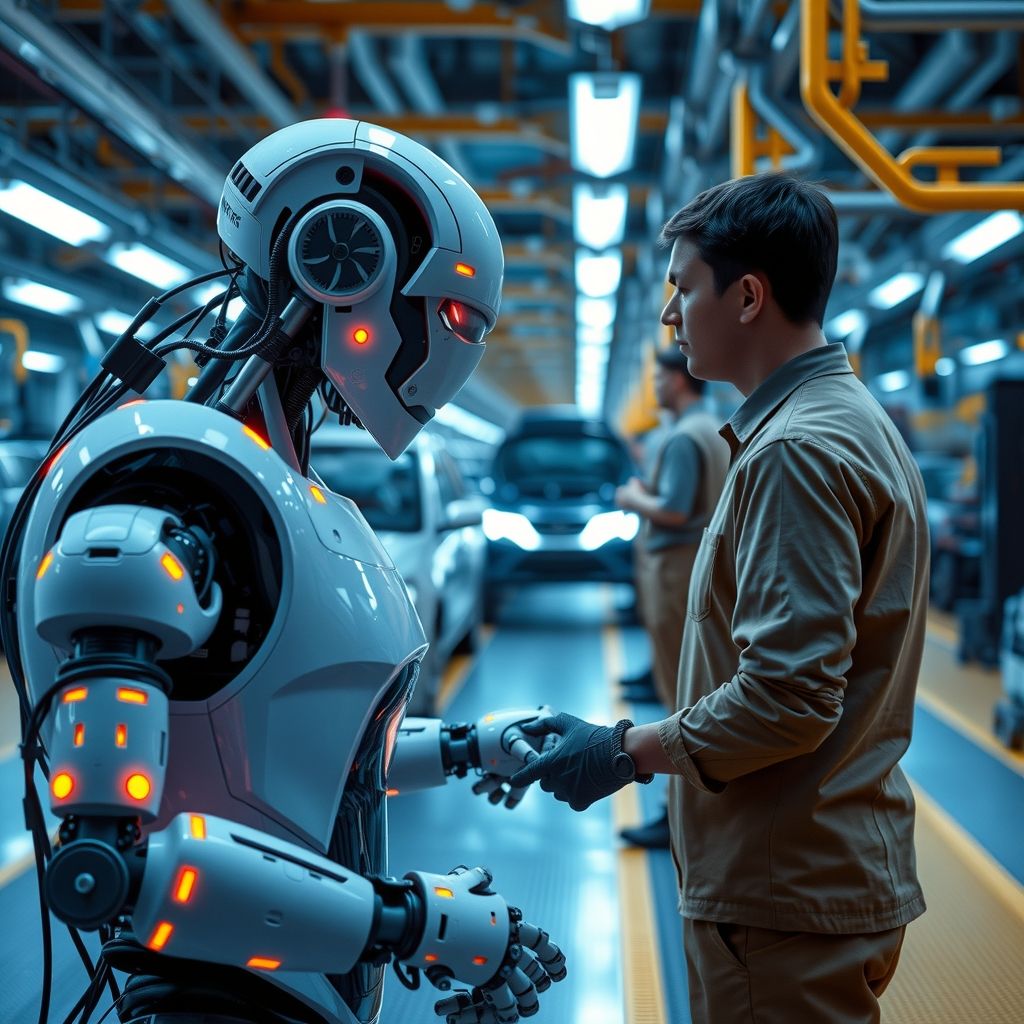
Three years ago, humanoid robots existed primarily as demo videos — carefully choreographed clips designed to generate headlines and investor interest. Today, Figure 02 is working a BMW production line in South Carolina, Tesla Optimus is doing warehouse sorting at Tesla facilities, and 1X's Neo is handling logistics at multiple commercial sites. The gap between demo and deployment closed faster than most industry observers predicted, driven by a convergence of better actuators, transformer-based foundation models, and companies willing to put capital behind real deployments rather than research alone.
This is not a story about robots taking over factories overnight. Humanoid robots in 2026 are capable, narrow, and expensive. Understanding precisely where the technology works — and where it still fails — matters more than either the optimistic press releases or the reflexive skepticism.
Figure AI and the BMW Partnership
Figure AI raised $675 million in early 2024, with backing from Microsoft, OpenAI, Nvidia, Intel Capital, and Jeff Bezos. The funding built toward a specific goal: commercial deployment at scale. The BMW partnership at their Spartanburg, South Carolina facility is the most concrete data point in the humanoid robot industry right now.
Figure 02 robots at BMW are performing component handling and parts bin picking — taking parts from bins and placing them into vehicle assembly positions. These are structured, repetitive tasks with defined pick zones and consistent part geometries. Figure 02 stands roughly 5'6", weighs 60kg, and can carry up to 20kg payload. Its hands have 16 degrees of freedom, enabling grasp patterns that earlier robot generations couldn't manage.
The OpenAI collaboration enables language-based instruction: operators can give verbal commands rather than reprogramming motion sequences. In practice, this means faster task switching and lower retraining overhead when assembly configurations change. The question of unit economics at scale remains open — Figure has not published per-unit production cost targets publicly, but industry analysts place the Figure 02 at approximately $70,000 per unit at current production volumes.
Tesla Optimus: Internal Deployment First
Tesla's approach differs from Figure's in one important structural way: Optimus is being deployed internally before any external commercial sale. As of early 2026, Tesla has deployed Optimus units in its own facilities for battery cell sorting and factory logistics — moving components between stations, managing inventory positioning, and handling repetitive transfer tasks.
Generation 2 improvements are meaningful: dexterous hands with tactile sensing, faster gait (up from 1.3 m/s to roughly 1.7 m/s), and improved balance on uneven surfaces. Elon Musk has stated a target of 1 million Optimus units produced by 2030. That number requires believing Tesla can manufacture humanoid robots at automotive scale — a significant operational leap that no company has demonstrated. The more credible near-term trajectory is tens of thousands of units deployed internally by 2027, with external sales beginning in 2025-2026 at a targeted price point around $20,000-$25,000, though actual delivery timelines have repeatedly slipped.
1X Technologies: Co-Working as the Design Principle
1X Technologies, founded in Norway and now operating with Amazon backing, takes a philosophically different approach with its Neo robot. Where Figure and Tesla optimize for maximum capability, 1X prioritizes safe proximity to human workers. Neo is designed to operate in the same space as people without the safety caging that industrial robots typically require.
1X's Amazon logistics partnership involves Neo units working in fulfillment center environments — not in segregated robot zones, but alongside human pickers. The technical bet is that co-working capability is more commercially valuable than raw performance, because it allows deployment without expensive facility retrofits. Neo's force-limiting joints and slower deliberate movements are design choices, not limitations they haven't solved yet.
Boston Dynamics Atlas: Electric Transition
Boston Dynamics retired the hydraulic Atlas in April 2024 and replaced it with an all-electric version. The electric Atlas is faster, more reliable, and doesn't require hydraulic fluid management — a meaningful operational improvement for commercial deployment. Boston Dynamics has been more cautious about commercial claims than competitors, focusing on specific industrial applications rather than general-purpose humanoid positioning.
Current Atlas deployments are limited and mostly in partnership with Hyundai (Boston Dynamics' parent company) for manufacturing evaluation. Atlas can perform parts handling, bin picking, and some assembly tasks, but its commercial deployment footprint as of 2026 is smaller than Figure or Agility Robotics. The hydraulic-to-electric transition was necessary; translating that into broad commercial deployment is still in progress.
Agility Robotics Digit: The Warehouse Specialist
Agility Robotics' Digit robot has the most mature commercial deployment story in the warehouse segment. Amazon's investment in Agility Robotics and the GXO partnership for warehouse picking represent real operational deployments, not pilot programs. Digit has been reported to achieve task success rates above 90% on tote moving and shelf-to-conveyor transfer tasks in structured warehouse environments.
Digit's design — bipedal but with a smaller form factor than human-sized competitors — is optimized for existing warehouse infrastructure. Aisles, shelving heights, and conveyor interfaces designed for humans also work for Digit without modification. This interoperability advantage is significant: it reduces deployment friction even if Digit's raw capability doesn't match larger humanoid platforms.
The Technology That Made 2025-2026 Possible
Three technology shifts converged to enable current deployments. First, transformer-based robot foundation models — Google DeepMind's RT-2 and Physical Intelligence's π0 system — allow robots to generalize learned behaviors across tasks rather than requiring task-specific programming. A robot trained on thousands of pick-and-place demonstrations can adapt to new objects without complete retraining.
Second, sim-to-real training at scale means robots can accumulate millions of training hours in simulation before touching physical hardware. The gap between simulated performance and real-world performance has narrowed substantially as simulation physics engines improved.
Third, actuator cost curves have followed a trajectory similar to early electric vehicle motors. Brushless DC motors with harmonic drives that cost $2,000-$3,000 per joint five years ago now cost $400-$800 at volume, making full humanoid builds economically feasible at production scale.
What They Can and Can't Do
Current humanoid robots perform reliably at structured, repetitive pick-and-place tasks in controlled environments: parts bin picking, tote moving, component transfer between fixed stations. These tasks share characteristics — consistent object geometry, defined pick and place locations, predictable lighting and backgrounds.
- Yes: Parts bin picking with consistent geometry
- Yes: Tote and container movement in warehouses
- Yes: Component transfer between fixed assembly stations
- Barely: Dexterous assembly of small components (connector insertion, fastener placement)
- Not yet: Unstructured environments with variable layouts
- Not yet: Tasks requiring real-time human collaboration and communication
- Not yet: Maintenance, repair, or diagnosis tasks requiring judgment
The dexterous assembly gap matters: most high-value manufacturing tasks involve small components, tight tolerances, and force feedback requirements that current robot hands struggle with. BMW's deployment uses Figure 02 for parts handling, not precision assembly — this distinction is significant.
The Cost Equation
At $70,000 per unit, Figure 02's economics require a realistic uptime assumption. A human worker on three shifts earns approximately $100,000 per year including benefits and overhead. The robot achieves cost parity only if uptime stays high — industry deployments report 60-75% effective uptime in current early deployments, accounting for maintenance, retraining, and edge-case failures.
At 65% uptime, the robot's effective labor cost advantage over three human shift workers narrows considerably when amortizing the unit cost over a 5-year depreciation window plus maintenance contracts. The math improves substantially as reliability increases and unit costs decline. Most serious analysts place the economic inflection point at $40,000-$50,000 per unit with 85%+ uptime — a target that appears achievable within 3-4 years.
Labor Market Implications
The jobs at genuine near-term risk are structured repetitive material handling roles: warehouse order picking in large fulfillment centers, parts bin picking in automotive assembly, and repetitive component transfer tasks. These roles share the characteristics that current robots handle well.
Jobs that are safer in the near term include any role requiring dexterous small-component assembly, unstructured environment navigation, real-time judgment, human communication, or physical tasks in spaces not designed for robots. Skilled trades, maintenance roles, and jobs with high variability are not on a 5-year displacement timeline from humanoid robots.
Who Should Act Now vs. Wait
Evaluate now: Automotive manufacturers with structured assembly environments, large-scale fulfillment and logistics operators, manufacturers with documented labor shortages in repetitive handling roles, and any operation where a 3-shift human labor cost exceeds $90,000/year per station.
Wait 2-3 years: Smaller manufacturers without dedicated robotics engineering staff, operations with high task variability or frequent changeovers, facilities where workspace modification would be required, and any application requiring dexterous small-component work.
The humanoid robot transition in manufacturing is real, it has started, and it will accelerate. But the 2026 reality is narrow deployments in well-defined tasks, not general-purpose labor replacement. Companies that run pilots now will have operational knowledge when the technology reaches broader capability — that learning curve advantage will matter when costs drop and reliability improves over the next three years.