Humanoid Robots Are Actually Working in Factories Now
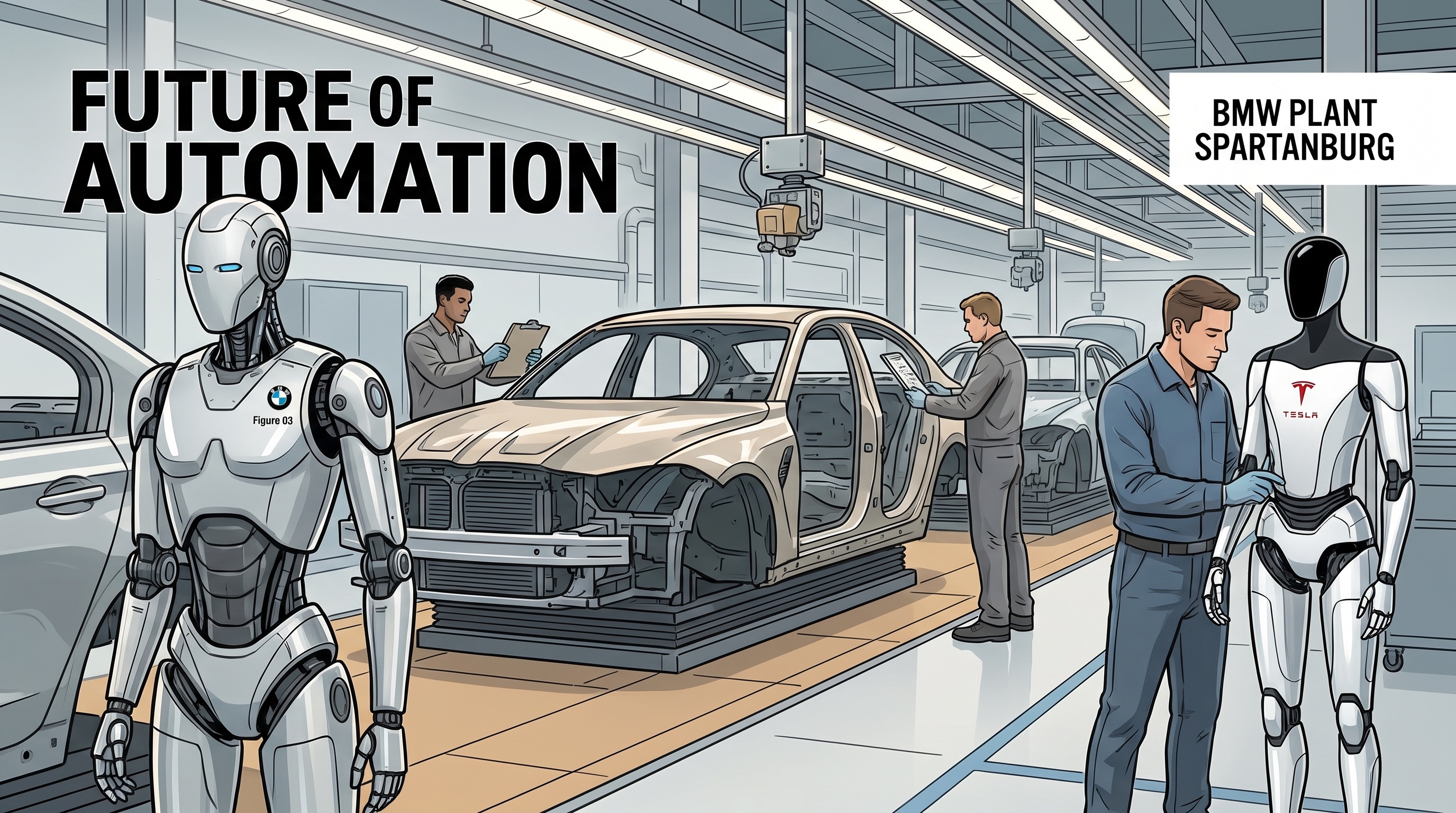
For years, humanoid robots were lab curiosities — impressive demos followed by nothing. That changed in 2026. Three platforms are now operating in real production environments, and the numbers being reported are not pilot statistics: they are factory floor outputs.
This is not a story about what robots will do in 2030. It is a report on what they are doing today, which factories they are in, and what the honest limitations still are.
Figure 03 at BMW: 90,000 Parts, 10-Hour Shifts
The most detailed commercial deployment data comes from Figure AI's 10-month pilot at BMW's Spartanburg, South Carolina plant. Figure 02 robots moved more than 90,000 sheet metal components, assisted in the production of over 30,000 BMW X3 vehicles, and logged more than 1,250 operating hours — running 10-hour shifts, five days a week.
These numbers matter because they reflect the reality of sustained industrial use, not a weekend showcase. The robots were not handling finished products; they were doing the physically demanding, repetitive material handling that accounts for a large share of factory floor injuries and turnover. BMW later expanded the deployment to its Leipzig facility in Germany.
Figure's follow-on platform, Figure 03, is now in production at its dedicated BotQ manufacturing facility at a rate of one robot per hour. That is a slow ramp by automotive standards, but it is real production — not prototype assembly.
Boston Dynamics Atlas: 56 Degrees of Freedom, Already Committed
The electric Atlas — Boston Dynamics' production humanoid, unveiled at CES 2026 — has 56 degrees of freedom and a 50 kg lift capacity. Every 2026 unit is already allocated: Hyundai's Georgia manufacturing facility and Google DeepMind have taken the full production run.
The price reflects where the technology sits. Enterprise Atlas units carry an estimated cost of $150,000 per unit, with roughly $9,500 in annual maintenance. This is industrial equipment pricing, not consumer robotics. Boston Dynamics is targeting 30,000 annual units by 2028 — a number that sounds ambitious until you realize the company has been shipping Spot robots at scale for three years and has real logistics and service infrastructure in place.
Tesla Optimus: Volume Production This Summer, Customers in 2027
Tesla is converting its Fremont factory to humanoid robot production in Q2 2026, targeting one million units annually at full capacity. Volume production begins late summer 2026, but external customer availability is not expected until 2027. For now, Optimus units are deployed internally at Tesla's own facilities.
The target retail price is below $20,000 at volume — a number that, if achieved, would be a category-defining moment. For context, the average industrial cobot today costs $35,000–$80,000 and cannot walk. If Tesla hits $20,000 for a general-purpose humanoid, the economics of human labor in many sectors change fundamentally.
The caveat: Tesla's production timelines have historically been optimistic. The company delivered on Cybertruck eventually; the question is whether Optimus follows the same pattern of delayed but ultimately real delivery, or stalls at internal deployment.
The Broader Market: 50,000 Commercial Units in 2026
Counterpoint Research estimates more than 50,000 humanoid robots will be operating commercially in 2026, up from 16,000 at the end of 2025. Goldman Sachs projects the market reaching $38 billion by 2035, with baseline estimates of 76,000 global shipments by 2027.
China is not sitting out this race. Unitree shipped over 5,500 autonomous units in 2025 and announced the world's first mass-produced manned mecha on May 12, 2026, at a starting price of approximately $650,000. Unitree's G1 humanoid, at roughly $16,000, is already the lowest-priced commercially available platform and has seen significant adoption in research institutions.
What These Robots Actually Do Well — and What They Still Cannot
Every honest assessment of humanoid robots in 2026 requires separating the real capabilities from the marketing. What works well today:
- Repetitive material handling in structured environments (the BMW example is representative)
- Pick-and-place operations where the object set is constrained and positions are predictable
- Tasks in factory-floor geometries designed around human bodies, which is why humanoid form factor matters more than it might seem
What is still genuinely hard:
- Unstructured environments — the moment a robot encounters something not in its training distribution, failure rates spike
- Dexterous manipulation — fine motor tasks like wiring harnesses, small fasteners, and fabric handling remain difficult
- Long-duration reliability — most deployments are still measured in months, not multi-year continuous operation
The Takeaway for Decision-Makers
If you are evaluating humanoid robots for industrial deployment today, the honest answer is: it depends on the task. For structured material handling in a controlled factory environment, Figure 03 and Atlas have proven track records. For anything requiring significant dexterity or adaptability to variable environments, the technology is not ready at production scale.
The 2026 milestone is not that humanoid robots have solved general labor — it is that they have graduated from lab demos to measurable factory output. That is a meaningful step. The transition from 50,000 commercial units to 500,000 will require continued progress on reliability, dexterity, and cost. But for the first time, the trajectory is based on real deployment data, not projections from demo videos.