Direct-to-Cell Satellites: The End of Dead Zones Is Coming
What Direct-to-Cell Actually Means
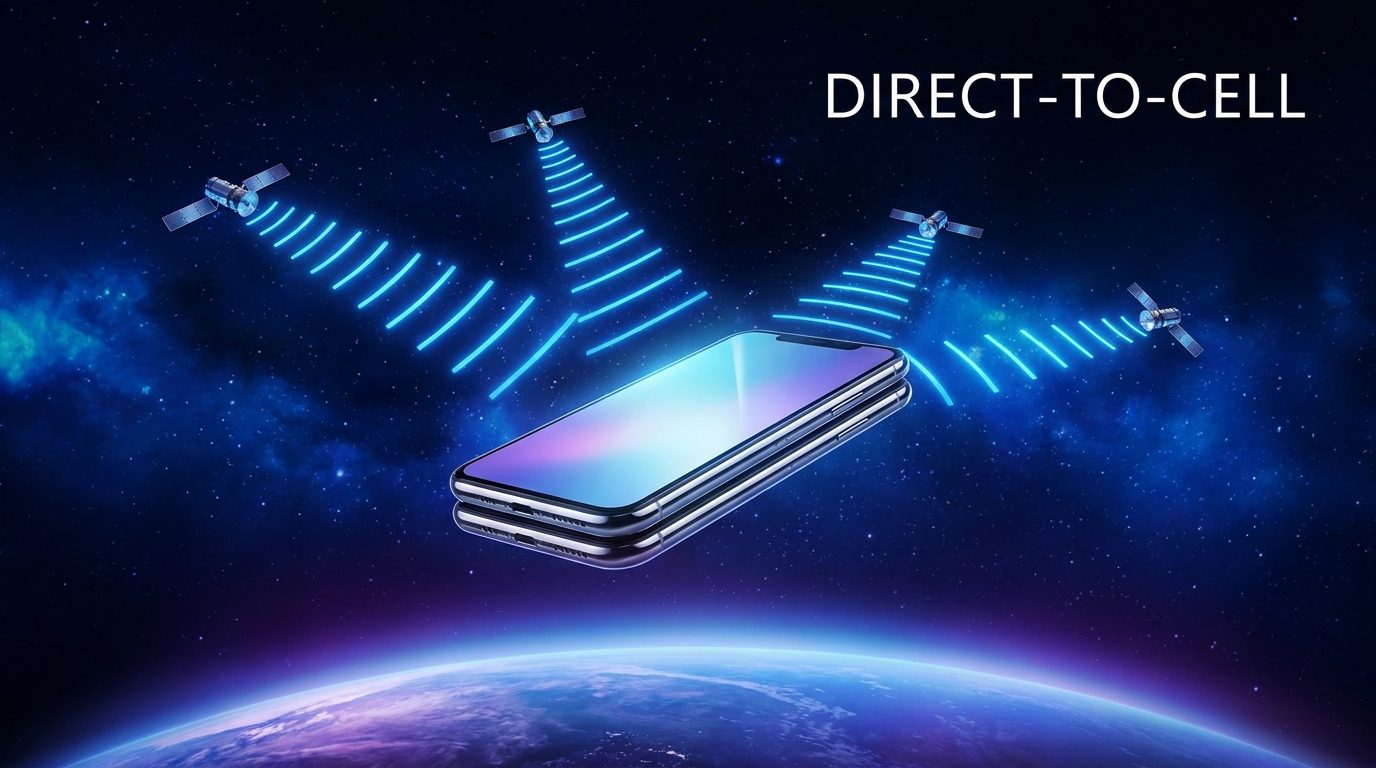
For decades, satellite connectivity required a separate device — a bulky handset, a dedicated terminal, or at minimum a specialty antenna. That constraint is dissolving. A new class of low Earth orbit (LEO) satellites carries cellular radio hardware powerful enough to communicate directly with the LTE and 5G modems already inside standard smartphones. No app to install, no hardware to carry, no satellite phone contract. The phone you have today is, or soon will be, a satellite-capable device.
The mechanism is straightforward in principle: a satellite in LEO orbits at roughly 300 to 600 kilometers altitude — close enough that its radio signal reaches an ordinary handset. The satellite acts as a cell tower in orbit, connecting to the phone using standard cellular protocols. When the phone cannot reach a terrestrial tower, it falls back to the satellite link instead. The user experience, in the best case, is seamless.
SpaceX and T-Mobile: Texts From Anywhere, Starting Now
The most visible implementation to date is the SpaceX and T-Mobile partnership. Starlink satellites with cellular payloads began limited service in 2024 and expanded through 2025 into 2026. T-Mobile customers with compatible devices can send and receive text messages from locations that have never had cellular service — mountain ranges, open ocean, remote desert. No action required beyond having a supported plan.
The honest picture of what this service delivers right now:
- SMS and messaging apps: works; latency is higher than terrestrial but messages go through
- Voice calls: rolling out, with limitations on concurrent users per satellite beam
- Data speeds: low — a single satellite beam covers hundreds of square miles, so available bandwidth is divided across everyone in that area; expect speeds suited to email or map tiles, not video
- Streaming or large downloads: not the intended use case at current satellite density
T-Mobile has moved satellite access into premium plan tiers, positioning it as a safety net rather than a primary connection. That framing is accurate for now. The value is not replacing your home broadband — it is eliminating the scenario where you are stranded, injured, or lost and cannot reach anyone.
AST SpaceMobile: A Different Engineering Bet
AST SpaceMobile is taking a distinct technical approach with its BlueBird satellite constellation. Where SpaceX deploys large numbers of smaller satellites, AST builds fewer satellites with significantly larger antenna apertures — some spanning tens of square meters. A larger antenna captures more signal from a weak handset and can transmit a stronger, more focused beam back down.
The commercial implication is higher per-satellite throughput. AST's first commercial service launched in 2025, with carrier partnerships including AT&T and Verizon in the United States and multiple international operators. The goal is broadband-class speeds to standard phones over satellite, not just emergency messaging. Whether that goal is met at scale depends on constellation buildout — fewer but more capable satellites means coverage gaps during early deployment phases.
Both approaches are valid. SpaceX prioritizes coverage density via constellation size. AST prioritizes throughput per satellite via hardware investment. Users with different carriers will likely end up on different systems, and competition between them should push both forward.
Apple's Satellite Features Are Not the Same Thing
Apple introduced satellite connectivity with iPhone 14 in 2022, and it is worth being precise about what that is and is not. The iPhone satellite link uses Globalstar's network and operates over a narrow-band channel — very low data rate, purpose-built for emergency SOS messages and location sharing. The iPhone 14 and later include a dedicated Qualcomm SDX75 satellite modem for this purpose. iPhone 15 expanded the capability to roadside assistance requests and Find My location sharing via satellite.
This is genuinely useful and has saved lives. It is not, however, direct-to-cell in the same technical sense as SpaceX or AST. Apple's implementation:
- Uses a dedicated narrow-band satellite modem, not the cellular radio
- Requires you to point the phone at the sky and hold it in a specific orientation
- Handles short structured messages only — not arbitrary data or voice
- Is available on Apple hardware specifically; it does not extend to Android devices or the broader carrier ecosystem
Apple's approach solved an urgent problem — emergency contact in remote areas — with hardware available today. The SpaceX and AST approach is trying to solve a broader problem: making satellite connectivity a routine fallback for any cellular user, on any compatible device, without a separate modem or special procedure.
The Regulatory Foundation
Widespread direct-to-cell service required regulators to catch up. The FCC formally approved Supplemental Coverage from Space (SCS) rules, creating a framework for satellites to operate as extensions of licensed terrestrial carriers rather than separate satellite services. This matters because it allows the satellite link to appear to the phone — and the network — as just another cell site. The UK and Australia have issued similar approvals, and other jurisdictions are moving in the same direction.
Amazon Kuiper and the OneWeb and Eutelsat joint venture are both developing comparable capabilities. Kuiper in particular has the capital and launch infrastructure to build a competitive constellation quickly. The regulatory groundwork means these competitors can enter markets without starting the approval process from scratch.
What the Next Three Years Look Like
The technology is not finished. Current bandwidth constraints mean direct-to-cell is a safety net and connectivity floor, not a broadband replacement. Several things need to happen before dead zones are genuinely a historical footnote:
- Constellation density: more satellites mean smaller beams, more bandwidth per user, better speeds
- Device software updates: full satellite fallback requires carrier and OS integration; this is rolling out but not yet universal
- Pricing normalization: satellite access will move from premium-tier add-on to standard inclusion as costs decrease
- International roaming: carrier agreements need to extend satellite coverage across borders the way terrestrial roaming does
Given deployment trajectories, most smartphone users in the US, UK, and Australia will have some form of satellite fallback through their existing carrier by 2028. Not unlimited broadband from orbit — that remains a harder problem — but reliable text, basic data, and emergency voice from anywhere with a view of the sky.
The dead zone problem is not solved yet. It is, for the first time, being solved. The infrastructure investment underway across SpaceX, AST SpaceMobile, Amazon, and their carrier partners is large enough and coordinated enough that reversal is unlikely. If you bought a smartphone in the last two years and carry it on a major US carrier, satellite connectivity may already be part of your plan. If it is not today, it will be soon — without buying anything new.