Direct-to-Cell Satellite Connectivity Is Finally Real in 2026 — Here's What It Actually Delivers
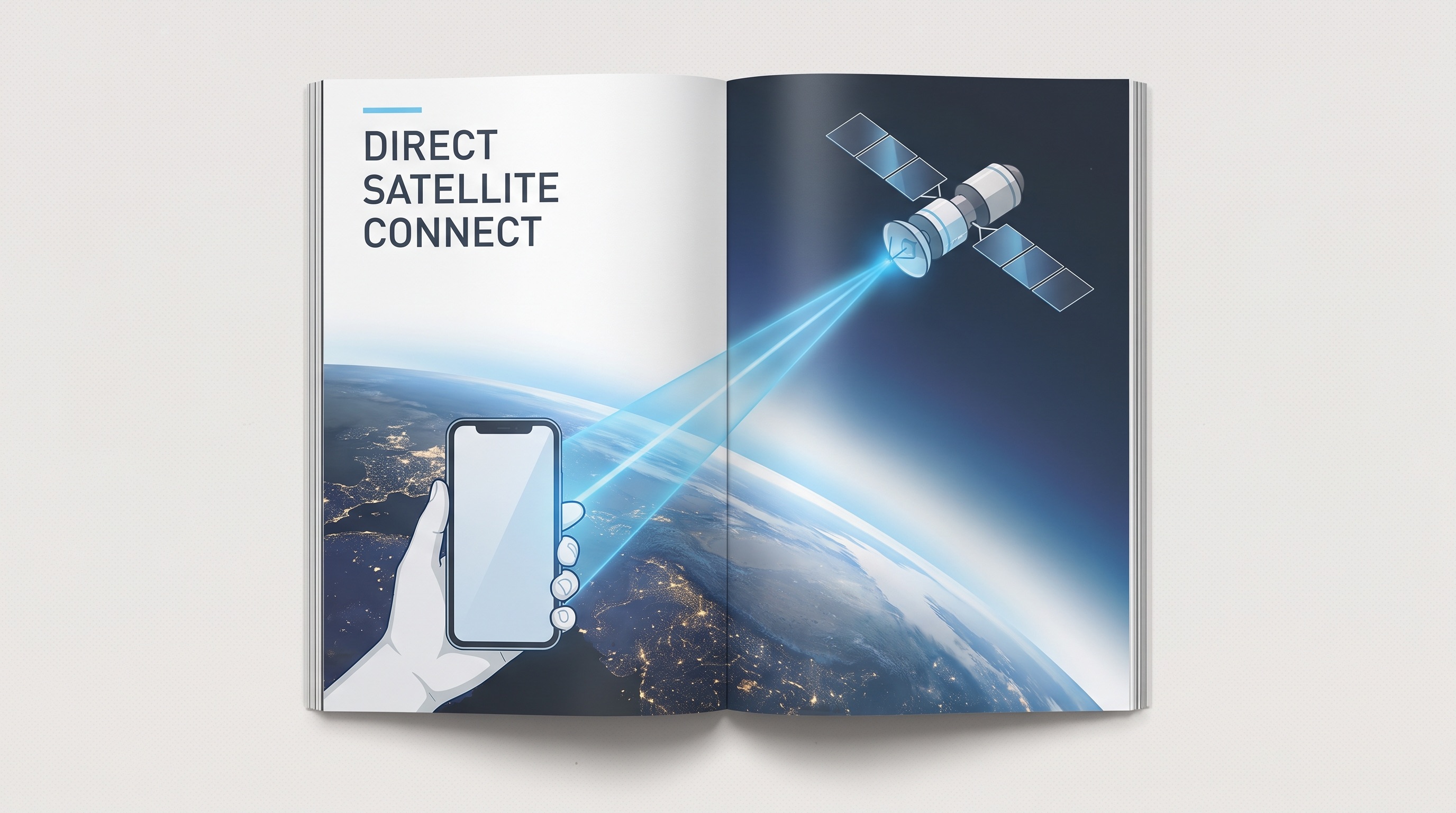
For years, "your phone will connect directly to a satellite" was a roadmap slide, not a product. In 2026, that changed. Starlink's direct-to-cell service now operates more than 650 satellites capable of reaching unmodified smartphones, and T-Mobile's T-Satellite service — built on that constellation — covers over 500,000 square miles of U.S. territory with no terrestrial towers in sight. This is no longer a future capability. It's live, and the next eighteen months determine whether it becomes a genuine utility or stays a niche safety feature.
What's Actually Working Today
The current generation of direct-to-cell service handles text messaging, location sharing, and a short list of essential apps — WhatsApp (including voice and video messages), Google Maps, AllTrails, AccuWeather, and X — over Starlink's satellite network. T-Mobile customers get this through T-Satellite, either bundled into Experience Beyond plans or as a $10/month add-on, and — notably — it's also available to customers on rival carriers who have a compatible phone and a free eSIM slot. Emergency texting to 911 is free for everyone on a compatible device, regardless of carrier.
Voice calling entered beta in late 2025 and is expected to become standard through 2026. Data connectivity testing is starting this year too, with early speeds in the 2-4 Mbps range per user — enough for email, messaging, and maps, not enough for video streaming. That's the honest state of the technology right now: good for staying reachable in a dead zone, not yet a replacement for terrestrial data.
The Competitive Field Beyond Starlink
AST SpaceMobile is the most credible technical competitor, and its approach differs in an important way: its BlueBird satellites are designed to deliver up to 120 Mbps per coverage cell — an order of magnitude above what Starlink's direct-to-cell service currently targets. AST has six BlueBird satellites in orbit as of early 2026, with three more launches planned, working toward a total of 90 satellites by 2027 and a nearer-term goal of 45-60 satellites to reach commercial service in initial markets by the end of 2026.
AST's carrier partnerships matter more than its satellite count. It has secured deals with AT&T and Verizon — the two carriers that sat out the initial T-Mobile/Starlink pairing — to use their licensed spectrum for direct-to-cell service. The FCC has already approved AST to operate a 248-satellite constellation on that spectrum. Amazon has also entered the market through its acquisition of Globalstar, and Lynk Global is pursuing a narrower niche focused on SMS and voice-centric service rather than broadband.
Why Carriers Are Cooperating Instead of Competing
The most telling development isn't any single satellite launch — it's that T-Mobile, AT&T, and Verizon are reportedly exploring a joint venture to pool spectrum resources for LEO satellite providers. That's a meaningful shift. Carriers that spent two decades competing on coverage maps are now recognizing that satellite dead-zone coverage isn't a competitive advantage worth fighting over — it's table stakes that's cheaper to build jointly than separately.
This mirrors how carriers eventually cooperated on tower-sharing infrastructure rather than each building redundant physical networks. Satellite constellations are enormously expensive to build and maintain; splitting that cost while still competing on price, service, and terrestrial network quality is the more rational play once the technology stops being a differentiator and starts being infrastructure.
Where the Real Value Is (and Isn't) in the Near Term
The current market for satellite-to-phone service in the U.S. is estimated at roughly $790 million in 2026 — small relative to the broader wireless market, and mostly driven by emergency and rural use cases rather than mainstream data consumption. That framing matters for expectations: this is not about to replace terrestrial 5G in cities or suburbs. Where it delivers real value is in the roughly 500,000 square miles of U.S. territory with no cell coverage at all — hiking trails, rural highways, boats offshore, disaster zones with damaged terrestrial infrastructure.
The economics only get more interesting once voice and meaningful data speeds ship widely. AST SpaceMobile's 120 Mbps target, if it holds up in real-world conditions rather than lab tests, would be the first satellite service genuinely competitive with terrestrial data rather than a stopgap for texting. That's the threshold to watch for — not another announcement of satellites launched, but confirmed real-world data throughput matching what's promised on paper.
Actionable Takeaways
If you travel through areas with unreliable cell coverage — rural regions, backcountry, coastal waters — check whether your phone supports eSIM and direct-to-cell today; T-Satellite's cross-carrier availability means you don't need to switch carriers to get basic emergency coverage. If you're evaluating this space professionally, track AST SpaceMobile's real-world throughput numbers rather than its satellite count, since 120 Mbps per cell is the number that would actually change the competitive calculus against terrestrial 5G. And don't expect satellite data to be a viable primary connection for anything beyond messaging and maps until multiple providers have shipped and validated true broadband speeds outside controlled test conditions.