The Digital Twin Is the New Control Tower for Industrial Automation
The Shift from Design Tool to Operational Brain
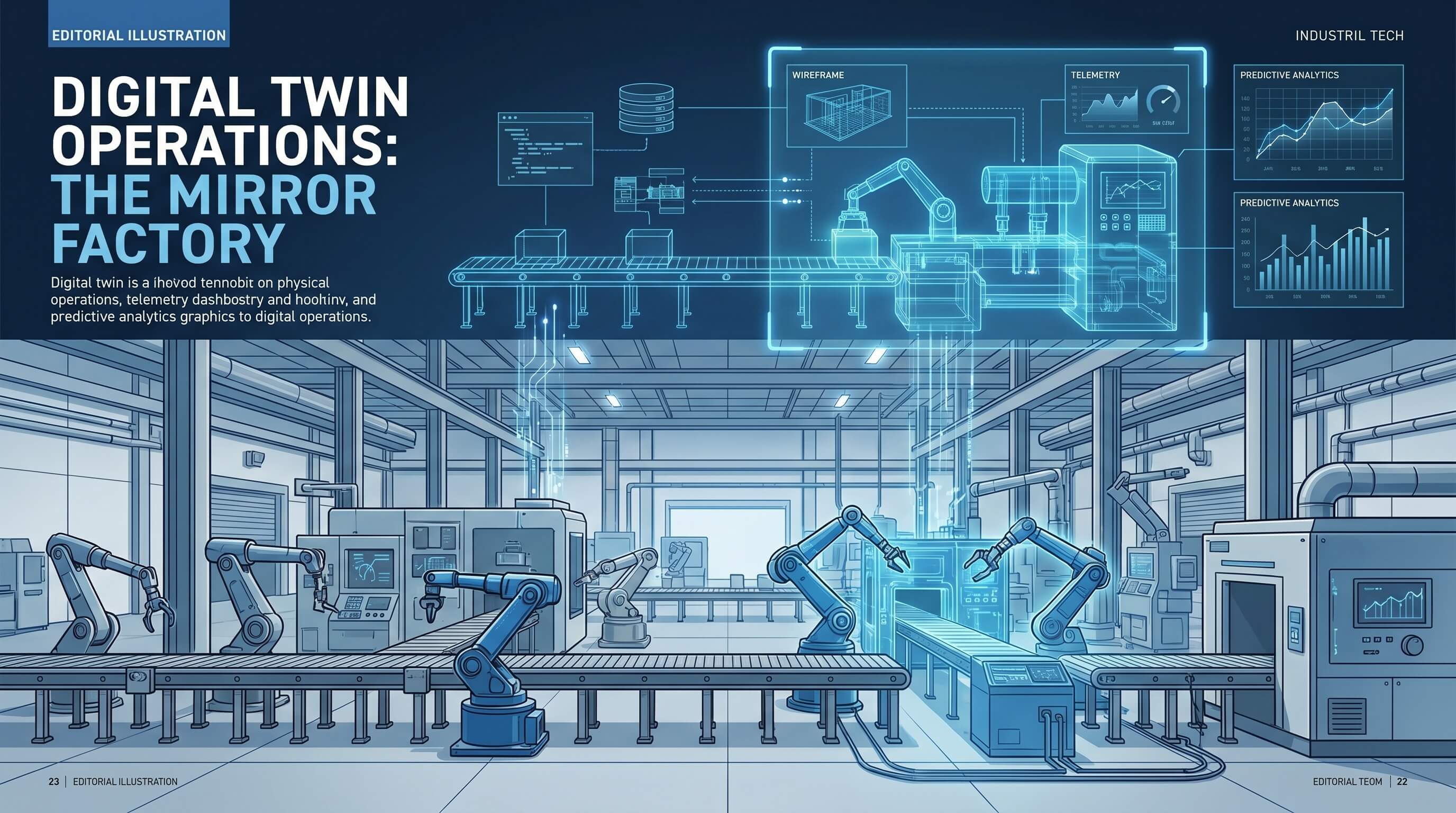
For years, the concept of a digital twin in manufacturing and logistics was closely tied to the design and simulation phase. It was a sophisticated, high-fidelity model used by engineers to design a production line, simulate material flow, or test a robot's reach in a virtual environment before a single piece of hardware was ordered. While valuable, this role was largely static and confined to the pre-production stage. Today, that paradigm is fundamentally shifting. The digital twin is evolving into the operational control tower for the modern factory and warehouse—a live, dynamic mirror of physical operations that enables real-time monitoring, prediction, and optimization.
This evolution redefines the core value of a digital twin. Its power is not derived from the photorealistic 3D rendering that impresses stakeholders in a boardroom, but from the continuous, high-fidelity stream of data that flows between the physical asset and its digital counterpart. A true operational digital twin is a living system, powered by telemetry, integrated via APIs, and capable of creating a feedback loop that drives tangible improvements in efficiency, uptime, and throughput. It’s less of a blueprint and more of a central nervous system for industrial automation.
Beyond the Blueprint: Distinguishing CAD, Simulation, and Operational Twins
To grasp the significance of this shift, it's crucial to understand the distinctions between related concepts. They are not interchangeable, but rather represent an evolutionary path.
- CAD Model: This is a static, 3D geometric representation of an object or an environment. It describes the physical dimensions, components, and layout—the 'what' and 'where.' It is a digital blueprint, but it contains no information about behavior or process.
- Simulation: A simulation takes a model (often derived from CAD) and imitates the behavior of a system over time. Engineers use simulation to ask "what if?" questions. What if we increase the conveyor speed? What if a robot's cycle time changes? However, these are typically offline analyses based on assumptions and historical data. The simulation is not connected to the live operation.
- Operational Digital Twin: This is the final stage of evolution. An operational twin integrates a high-fidelity model with a continuous stream of real-world data from sensors, PLCs, and enterprise systems (like MES and WMS). This two-way connection is key. The twin is constantly updated by the physical world, allowing it to reflect the current state with extreme accuracy. In turn, insights and optimizations derived from the twin can be fed back to control the physical operation.
The Control Tower in Action: Key Use Cases
When powered by live data, the digital twin becomes a powerful tool for operations teams to manage complexity and make smarter decisions. Its applications move far beyond initial design.
Validating Changes and De-risking Deployment
Factories and warehouses are not static. Introducing a new product, changing a line layout, or adding new robots carries significant risk of disruption. The digital twin acts as a perfect sandbox. Teams can introduce a new robotic cell into the virtual environment, program its movements, and test its interaction with existing conveyors and human workers. They can validate that the new configuration won’t create a bottleneck downstream or cause collisions—all before any physical installation begins. This dramatically reduces commissioning time and mitigates the risk of costly production halts.
Optimizing Throughput and Planning Production
An operational twin can model the entire flow of materials and products. By feeding it live data on machine status, cycle times, and buffer levels, it provides a holistic view of plant performance. Managers can use it to identify hidden bottlenecks that aren't obvious from looking at individual machines. They can run scenarios to plan for demand spikes, testing how different staffing levels, maintenance schedules, or product mixes will impact overall output. This moves throughput planning from reactive guesswork to proactive, data-driven strategy.
Enabling Predictive Maintenance
By streaming telemetry from sensors—such as vibration, temperature, and power consumption—from critical assets into the digital twin, patterns that precede failures can be identified. The twin can correlate minor changes in a motor's vibration with its operational context (e.g., the type of product being run) to predict a likely failure weeks in advance. This allows maintenance to be scheduled during planned downtime, avoiding catastrophic and expensive breakdowns.
The Engine Room: Data, APIs, and Integration
The success of a digital twin hinges entirely on the quality and timeliness of its data. The 3D visualization is merely the interface; the real work happens in the data-integration layer.
Telemetry is the Lifeblood: A twin without real-time data is just a simulation. The foundation is a robust network of sensors and connectivity to pull data from PLCs, SCADA systems, and machine controllers. This data stream must be reliable and have low latency to ensure the twin accurately reflects the current state of the factory floor.
APIs are the Connectors: Industrial environments are notoriously heterogeneous, with equipment from different vendors speaking different protocols. APIs (Application Programming Interfaces) are the essential glue. A modern digital twin platform must have a powerful and flexible API to ingest data from diverse sources, from legacy serial protocols to modern standards like OPC-UA. It also needs APIs to share its insights with other enterprise systems.
Integration is Context: To be a true control tower, the twin cannot be an information silo. It must be integrated with the Manufacturing Execution System (MES) to understand production orders, the Warehouse Management System (WMS) to know inventory levels, and the Enterprise Resource Planning (ERP) system for business context. This integration transforms the twin from a machine-centric model to a business-aware operational brain.
Where Digital Twins Fail
Despite their promise, many digital twin initiatives fail to deliver a return on investment. The pitfalls are rarely technological; they are almost always related to data and organization.
- Stale Data: A digital twin that is updated only periodically is not an operational tool; it's a report. Decisions made on outdated information can be more damaging than those based on intuition. A commitment to real-time data infrastructure is non-negotiable.
- Unclear Ownership: Is the digital twin an IT project, an engineering tool, or an operations asset? Without a clear answer, it will languish. The most successful implementations are owned by the Operations team, with support from IT and Engineering. Operations must be responsible for using the twin and ensuring its data fidelity.
- The Visualization Trap: A common mistake is to spend 80% of the budget on creating a visually perfect 3D model and 20% on data integration. The ratio should be reversed. A simpler, schematic-like visualization powered by high-quality, integrated data is infinitely more valuable than a photorealistic model fed by stale spreadsheets.
Actionable Guidance for Operators
For operations leaders considering a digital twin project, a pragmatic approach focused on business value is essential. Follow these steps to navigate a successful implementation.
- Start with a Specific, High-Value Problem: Don't try to twin the entire facility at once. Target a single production line with a known bottleneck, high downtime, or frequent changeovers. Define a clear business problem to solve.
- Audit Your Data Sources First: Before evaluating vendors, map your existing data landscape. Identify what data is available from your PLCs, sensors, and MES. Assess its quality, frequency, and accessibility. This data readiness assessment is the most critical step.
- Establish Clear Ownership from Day One: Create a cross-functional team led by a champion from Operations. Define roles and responsibilities for maintaining the twin, ensuring data quality, and acting on the insights it generates.
- Prioritize Integration Over Visuals: When talking to vendors, focus your questions on their API capabilities, data connectors, and experience integrating with systems like yours. Ask for case studies, not just beautiful demos.
- Prove Value with a Pilot: Run a focused pilot project on the line you identified in step one. Set clear KPIs before you start—for example, a 10% reduction in downtime or a 15% increase in throughput. Measure the results, demonstrate ROI, and then use that success to justify scaling the initiative.