Construction Robots Are Finally Showing Up on Real Job Sites — Here's What's Working
Why Construction Automation Took So Long
Manufacturing automation started in the 1970s. Warehouse automation accelerated in the 2010s. Construction automation is happening now, fifty years later — and the delay is not accidental. Construction sites are the opposite of factories: they are unstructured, outdoors, change daily, and produce one-off products rather than identical units. The techniques that work for placing automotive parts on an assembly line fail completely when the "assembly line" is a building site with varying weather, irregular terrain, and tasks that shift as the structure goes up.
The construction industry also has structural disincentives to automation. Projects are bid competitively on labor costs. General contractors do not own specialized equipment; they subcontract. The subcontractors who would adopt robots often lack the capital and scale to justify the investment. And the industry's fragmentation — tens of thousands of small and mid-sized firms — means that technology diffusion happens slower than in sectors with large dominant players.
What changed is the labor market. Construction employment in the US is at historically tight levels, with the Bureau of Labor Statistics consistently reporting 300,000+ unfilled construction jobs. Wages for skilled trades — electricians, ironworkers, concrete finishers — have risen sharply. Projects that were marginally profitable at 2018 labor costs are barely feasible at 2026 costs. That math has made automation economically attractive for tasks where it previously would not have justified the effort.
Dusty Robotics: What Floor Marking Robots Actually Do
Dusty Robotics makes the FieldPrinter, an autonomous robot that prints construction layout directly on concrete floors. Layout — marking where walls, columns, electrical conduit, and MEP systems will go — is a task that traditionally requires skilled workers with measuring tapes, chalk lines, and total stations. It takes significant time, requires experienced judgment, and is prone to errors that cascade through the project if the layout is wrong.
The FieldPrinter ingests a building information model (BIM) from Revit or AutoCAD and prints it directly on the slab at full scale, with accuracy of plus or minus 1/16 of an inch over distances of hundreds of feet. A single robot with one operator can print what would take a two-person team multiple days in a fraction of the time. Dusty reports that their customers typically see 10x productivity improvement for the layout task specifically, and layout errors — which can force expensive rework — are nearly eliminated.
Dusty is now in commercial deployment at projects across the United States, including data centers, hospitals, commercial office buildings, and large residential complexes. The company raised $70 million in Series C funding in 2023. The FieldPrinter is the clearest example in construction of a robot solving a specific, well-defined problem with measurable ROI — which is why it is one of the earliest success stories.
Built Robotics: Autonomous Excavation
Built Robotics retrofits standard construction excavators with an autonomous guidance system. The hardware — GPS, LiDAR, IMU, cameras — bolts onto existing Cat and John Deere machines. The software turns the excavator into an autonomous system capable of digging earthwork according to a digital site model: cut/fill specifications, grade targets, slope requirements.
The commercial use case is straightforward: earthwork on large, relatively open sites with defined geometry — solar farms, highway construction, land grading for large buildings. An operator sets up the work zone and monitors the machine; the excavator handles the repetitive digging cycle autonomously. Built's claim is that an autonomous excavator can work continuous shifts, which matters on projects where schedule is a cost driver.
Built was acquired by HCSS, a construction software company, in 2024. The acquisition was notable because it paired autonomous hardware with HCSS's existing fleet management and project software — suggesting that autonomous earthwork is being integrated into construction project management workflows rather than existing as a standalone hardware product.
Rebar Tying: The Tybot and the Problem It Solves
Rebar tying is one of the most labor-intensive and physically demanding tasks in concrete construction. Ironworkers place and tie steel reinforcing bar by hand for floor slabs, bridge decks, and other structural elements — thousands of ties per day, bending over or kneeling for hours. It is hard work to recruit for, hard on workers' bodies, and does not benefit from supervision or management attention — it just requires labor hours.
Advanced Construction Robotics makes the Tybot, a gantry robot that straddles a rebar mat and autonomously ties the intersections using vision systems to locate the crossing points. The robot works continuously and can tie rebar at speeds that multiple ironworkers working simultaneously would struggle to match. It was initially deployed on bridge deck construction, where the flat, regular geometry suited the gantry form factor.
The Tybot has now been deployed on dozens of bridge projects across the United States. The economics work because rebar tying is fully fungible labor — it does not require judgment, it requires repetition — and because the robot does not need breaks, benefits, or workers' compensation insurance.
Bricklaying: Still Hard
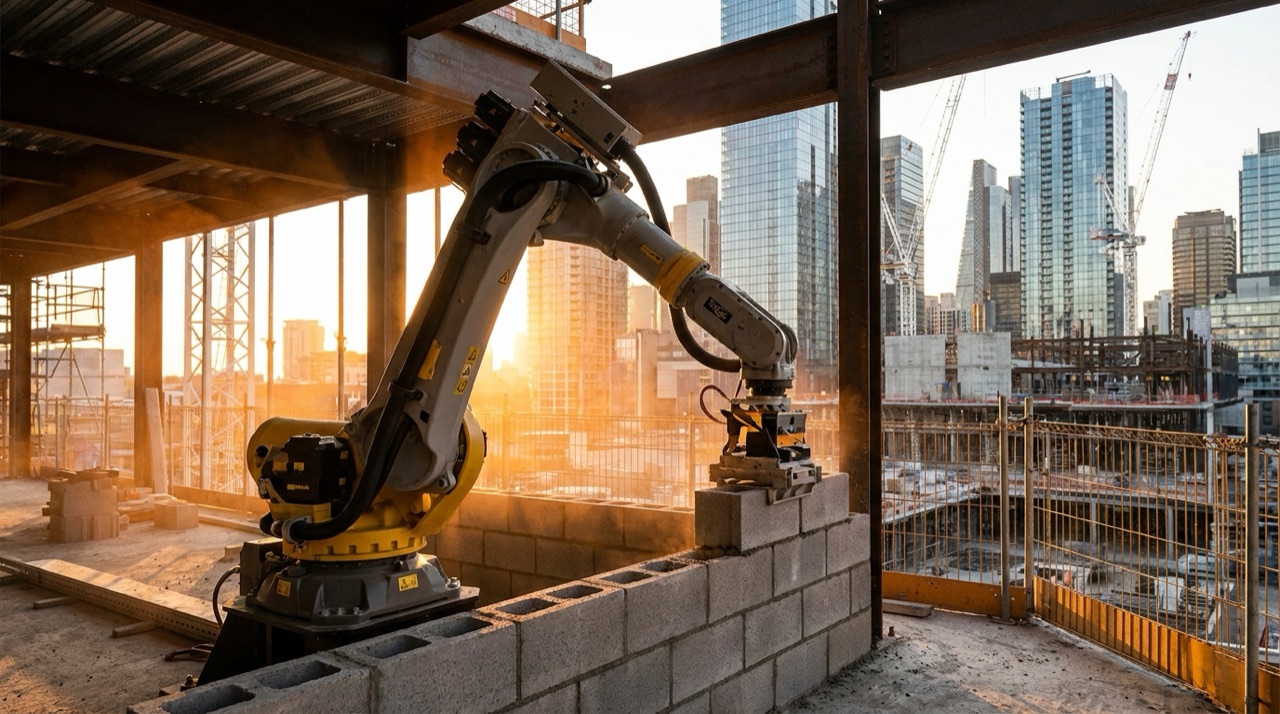
Bricklaying robots have received significant media attention, but commercial deployment has been slower than other construction robots. Fastbrick Robotics (now FBR) in Australia makes the Hadrian X, a truck-mounted robot that places blocks using a 30-meter telescoping boom guided by 3D models. The Hadrian X has been deployed on residential construction projects in Western Australia, and FBR has announced contracts for volume housing developments.
The challenge with bricklaying automation is that exterior masonry is often irregular, custom, and subject to design changes — the opposite of the constrained, repetitive tasks where construction robots have found their earliest success. The Hadrian X works best on rectangular buildings with standard block coursing and minimal features. Architectural complexity makes autonomous placement substantially harder.
SAM100 (Semi-Automated Mason) from Construction Robotics takes a different approach: a human mason directs the robot arm, which handles the heavy lifting and placement while the human handles pointing, cutting, and complex details. This collaborative model is more flexible but captures less of the labor savings than full autonomy.
Spot on Job Sites
Boston Dynamics' Spot quadruped robot has found genuine traction in construction, not for performing construction tasks, but for site inspection and documentation. Spot equipped with 360-degree cameras and LiDAR can walk a job site and capture point cloud data that is compared against the BIM model to identify deviations — installed walls in the wrong location, incorrect MEP routing, slab surfaces outside tolerance.
Skanska, Turner Construction, and several other large general contractors now use Spot on major projects for regular documentation walks. The robot captures data consistently, at times when workers would not normally be documenting, and produces records that protect against disputes about what was installed when and in what condition. This is a safety and QA application rather than a productivity application, but it addresses a real cost driver — construction defect claims and rework are expensive.
The Economics of Construction Automation
The honest summary of where construction automation stands in 2026: it works well for tasks that are physically demanding, repetitive, geometrically constrained, and well-defined by digital models. Floor layout, earthwork on open sites, rebar tying on flat slabs, site inspection walks. It does not yet work well for tasks requiring adaptability, judgment, or operation in complex, changing three-dimensional spaces.
The ROI is easiest to calculate for specialized robots targeting specific high-labor-cost tasks — Dusty's layout printing, Advanced Construction Robotics' rebar tying — and harder to calculate for general-purpose platforms. The companies that are succeeding commercially are those that started with one specific, well-defined task rather than trying to build a general construction robot.
The labor shortage that is driving adoption shows no sign of reversing. The average age of a construction worker in the United States is 43, and the trades are not attracting younger workers in sufficient numbers to replace retiring ironworkers, carpenters, and finishers. That demographic pressure, combined with rising wages, makes the economic case for construction robotics stronger with each passing year — even for tasks where the technology is imperfect.