A Ponte Conceitual: Aprenda Qualquer Tópico Técnico Instantaneamente Mapeando-o ao Que Você Já Sabe
Porque é que este prompt importa
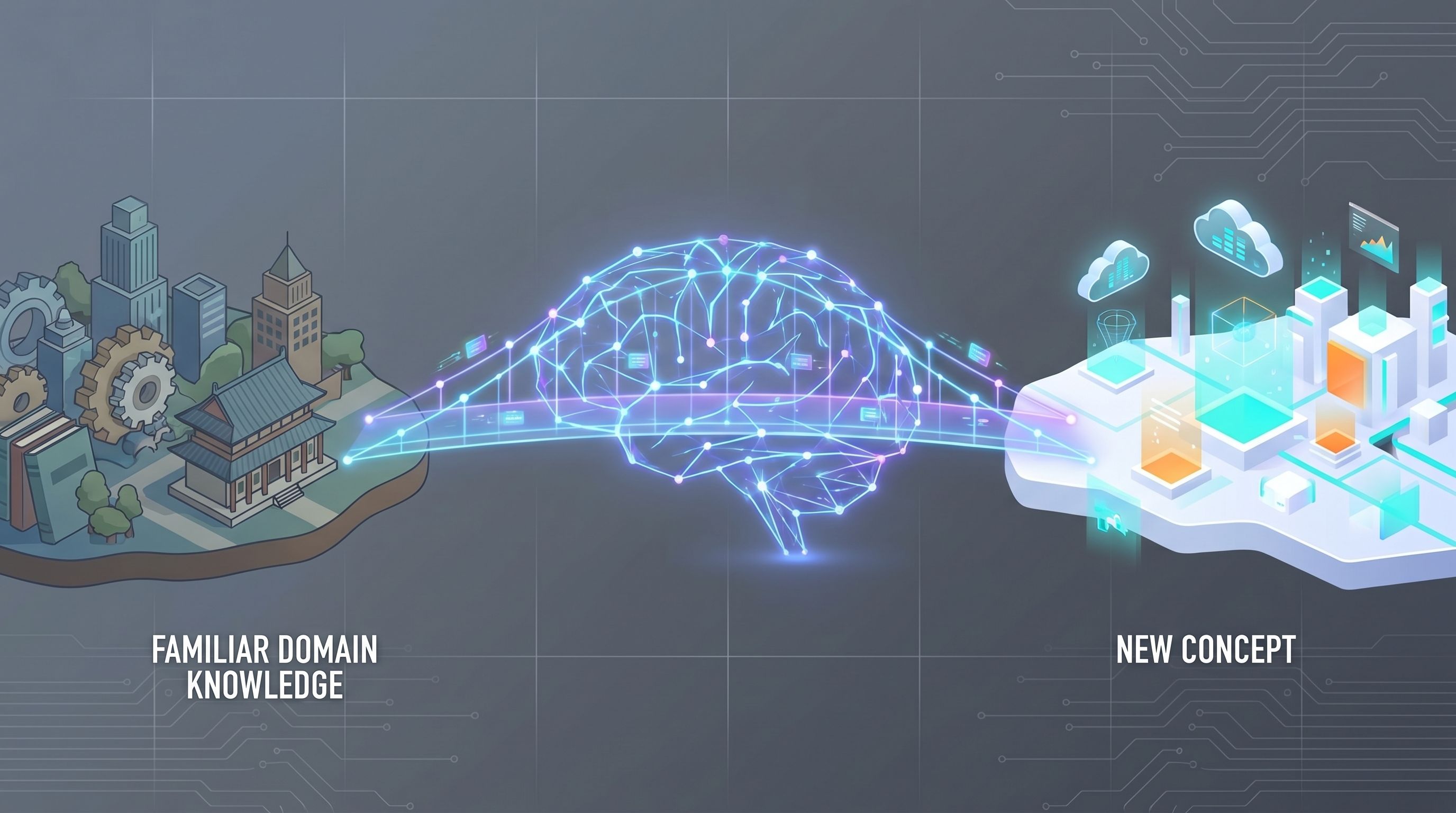
Standard technical documentation is written for people who already understand adjacent concepts in the same field. If you're a database engineer learning ML, those resources assume the wrong baseline. Anchoring new concepts to your existing mental models is measurably faster — cognitive science research on analogical transfer consistently shows 3–5x better retention when learners map new information to known structures. The prompt also forces the AI to identify where the analogy breaks, which is where most self-taught understanding fails silently.
Para que o usamos
You've been handed a task involving a technology you've never touched: a backend engineer suddenly needs to understand transformer attention mechanisms, a product manager needs to grasp distributed consensus before a 10am meeting, or a lawyer needs a working mental model of blockchain before a client call. You have 30 minutes and need genuine intuition, not a textbook overview.
Prompt
Act as a master teacher and domain translator. Your job is to explain [CONCEPT YOU WANT TO LEARN] entirely through analogies drawn from [DOMAIN YOU ALREADY KNOW WELL] — without using direct technical jargon from the new concept until after it has been introduced through analogy.

Context: I have deep expertise in [DOMAIN YOU ALREADY KNOW WELL] and I am trying to build an intuitive mental model of [CONCEPT YOU WANT TO LEARN]. I do NOT want a standard textbook explanation. I want to understand it the way a colleague who knows my domain deeply would explain it over coffee.

Task: Explain [CONCEPT YOU WANT TO LEARN] by:
1. Creating a Core Mapping — a table that maps each key component of the new concept to its closest equivalent in [DOMAIN YOU ALREADY KNOW WELL]
2. Walking through 2–3 concrete scenarios using only the language and mental models of [DOMAIN YOU ALREADY KNOW WELL]
3. Identifying clearly where the analogy breaks down — the specific points where my intuition from [DOMAIN I KNOW] will mislead me about [CONCEPT YOU WANT TO LEARN]
4. Ending with 3 self-check questions I can ask myself to verify I genuinely understood it and not just pattern-matched the words

Constraints:
- Do NOT open with a Wikipedia-style overview — go straight into analogy
- Every technical term must be introduced via its analogy before being named
- The breakdown section must be honest and specific, not just "the analogy isn't perfect"
- Keep the full response under 800 words

Output Format:
## The Concept Bridge: [CONCEPT] through the lens of [DOMAIN]

### Core Mapping
[Table: New Concept Term | What It Maps To In Your Domain]

### How It Works (in your domain's language)
[2–3 scenarios told entirely in the language of [DOMAIN YOU ALREADY KNOW WELL]]

### Where the Analogy Breaks Down
[Specific, honest limitations — the places your intuition will lie to you]

### 3 Questions to Test Your Understanding
[Self-check questions that require real understanding, not recall]
Resultado
The Concept Bridge: Transformer Attention through the lens of SQL Databases
Core Mapping
| Transformer Concept | Database Equivalent |
|---|---|
| Token | Row in a table |
| Attention weight | JOIN relevance score / query selectivity |
| Query vector (Q) | The SELECT + WHERE clause you're searching with |
| Key vector (K) | The indexed column being searched against |
| Value vector (V) | The actual data returned when a row matches |
| Multi-head attention | Running 8 parallel queries on the same table, each asking a different question |
| Context window | The table size limit — only rows within it can be JOINed |
How It Works (in database language)
Scenario 1: A single attention head. Imagine you're running: "Find all rows most relevant to the current row I'm processing." Every token simultaneously acts as both the query (what am I looking for?) and a potential result (am I relevant to others?). The attention weight is the relevance score — like a fuzzy full-text search rank rather than an exact JOIN.
Scenario 2: Multi-head attention. You run 8 different queries on the same dataset in parallel. One asks "which words are grammatically connected?", another asks "which words share meaning?", another asks about position. Each returns its own ranked result set. The outputs are then concatenated — like a UNION ALL followed by a final aggregation.
Scenario 3: The context window as table size. Your database can only hold 128,000 rows in memory at once. Any row outside that window simply doesn't exist for the current query — it can't be JOINed against or referenced. This is why context length matters: it's your working table size.
Where the Analogy Breaks Down
Weights are learned, not declared. In SQL, you define your schema and indexes explicitly. The Q, K, V matrices — the "query structure" — are learned from billions of examples. There's no schema designer.
All rows query all rows simultaneously. In SQL, you write one query at a time. In attention, every token is simultaneously acting as a query against every other token in one parallelized matrix multiplication — N² comparisons at once.
There's no primary key. A word's "identity" as a key shifts based on what surrounds it, unlike a database row with a fixed ID.
3 Questions to Test Your Understanding
- If you doubled the context window from 64K to 128K tokens, what happens to computational cost — and why? (Hint: think N².)
- Why can't a transformer "look up" information from a document it wasn't given in context, even if trained on it?
- In multi-head attention, each head learns different patterns. What would be the database equivalent of a head that specializes in long-range dependencies?
A maioria das explicações técnicas é escrita para pessoas que já entendem conceitos adjacentes no mesmo campo. Se você é um engenheiro de banco de dados tentando entender como funciona a Attention em um Transformer, tutoriais padrão farão referência a álgebra linear e intuições de Machine Learning que você não tem. O Prompt Concept Bridge inverte isso — ele força uma IA a explicar o novo conceito inteiramente através do seu domínio existente, então mapeia honestamente onde essa analogia se quebra.
O Que Torna Este Prompt Eficaz
O Prompt é construído sobre três escolhas estruturais que a maioria dos prompts "explique X de forma simples" ignora:
O Core Mapping vem primeiro. Antes de qualquer explicação narrativa, a IA deve produzir uma tabela mapeando cada termo-chave do novo conceito para seu equivalente mais próximo no seu domínio. Isso lhe dá um vocabulário antes da história — assim, quando as analogias ficam complexas, você tem uma referência para se ancorar.
A seção de Breakdown é obrigatória. A maioria das explicações baseadas em analogias omite isso, o que significa que você sai com um modelo mental que falha silenciosamente. Este Prompt exige que a IA identifique exatamente onde sua intuição de domínio irá enganá-lo. É aí que a maior parte do aprendizado técnico autodidata falha — não na superfície, mas nas bordas onde a analogia deixa de se sustentar.
As perguntas de autoavaliação usam compreensão, não memorização. As três perguntas finais são projetadas para exigir raciocínio genuíno com o modelo mental, não apenas repetir o que foi dito. Se você puder respondê-las usando a linguagem do seu domínio, você tem o conceito. Se não puder, você sabe exatamente onde se aprofundar.
Como Usar
Substitua [CONCEPT YOU WANT TO LEARN] por qualquer coisa: mecanismos de Attention em Transformer, consenso distribuído (Raft/Paxos), Smart Contracts, estruturas de dados CRDT, criptografia homomórfica, escalonamento Kubernetes. Substitua [DOMAIN YOU ALREADY KNOW WELL] pela sua expertise mais forte: bancos de dados SQL, engenharia elétrica, direito civil, teoria musical, contabilidade, logística.
O modelo funciona melhor quando a lacuna entre domínios é grande — um advogado aprendendo Blockchain, um engenheiro Backend aprendendo Machine Learning, um gerente de produto aprendendo sistemas distribuídos. Quanto maior a lacuna, mais útil a ponte. Não use para conceitos adjacentes onde recursos padrão já o encontram onde você está.
Notas sobre Modelos
Claude Opus 4.8 produz as analogias mais ricas e as seções de Breakdown mais honestas — é particularmente bom em identificar onde a analogia engana, em vez de apenas dizer "a analogia tem limites". GPT‑4o é uma alternativa sólida com tabelas ligeiramente mais estruturadas. Evite modelos menores para este Prompt; eles tendem a produzir mapeamentos superficiais que parecem corretos, mas perdem os detalhes mecânicos onde a compreensão reside.