O intérprete de testes A/B: Lançar, Manter ou Descartar em um Prompt
Porque é que este prompt importa
Bad ship/kill calls are expensive in both directions. Shipping a false positive locks in code that looks like a winner in the dashboard but quietly erodes revenue for months before anyone traces it back to the test. Killing a real winner because the raw numbers looked shaky under-delivers growth you already earned. And teams that 'peek' at results early and stop tests as soon as the trend looks good introduce a well-documented bias that inflates the apparent win rate of every experiment program — this prompt forces a power and significance check before any of that can happen.
Para que o usamos
You're a growth PM and your two-week checkout redesign A/B test just wrapped. Leadership wants a ship/no-ship call in tomorrow's roadmap review, but the raw dashboard just shows a conversion rate that went up — it doesn't tell you if that's a real 5% lift or noise that will vanish next month, and nobody on the team has time to run the statistics by hand before the meeting.
Prompt
Act as a senior product analyst and growth data scientist with deep expertise in experimental design and statistical inference for digital products.

CONTEXT:
I ran an A/B test with the following setup:
- Test name / hypothesis: [TEST NAME/HYPOTHESIS]
- Primary success metric: [PRIMARY SUCCESS METRIC]
- Control group result: [CONTROL METRIC AND VALUE]
- Variant group result: [VARIANT METRIC AND VALUE]
- Sample sizes: [SAMPLE SIZES] (control vs. variant)
- Test duration: [TEST DURATION]
- Guardrail metrics tracked (if any): [GUARDRAIL METRICS, IF ANY]
- Any other context (traffic source, platform, seasonality, known anomalies): [ADDITIONAL CONTEXT]

TASK:
Analyze this experiment and produce a ship/hold/kill recommendation. Your analysis must:
1. Calculate or estimate statistical significance (p-value or confidence interval) for the primary metric given the sample sizes provided.
2. Assess statistical power — flag explicitly if the sample size is too small to trust the result either way.
3. Distinguish statistical significance from practical/business significance — a "significant" result that moves the needle by a trivial amount is not a reason to ship.
4. Check the guardrail metrics for regressions, even if the primary metric looks like a win.
5. Give a clear final recommendation: SHIP, HOLD (extend test), or KILL — with your reasoning stated in plain terms a non-technical stakeholder can follow.

CONSTRAINTS:
- Do NOT recommend shipping on a result that is underpowered — say so explicitly and recommend the minimum additional sample size or duration needed instead.
- Explicitly flag possible novelty effects if the test ran less than 2 full business cycles (e.g., under 2 weeks for a weekly-cadence product).
- Explicitly flag risk of "peeking" bias if the numbers suggest the test may have been stopped early based on interim results.
- Never conflate correlation from a single test with certainty — mention confounding variables if the context suggests any (seasonality, traffic mix changes, etc.).
- Keep the tone direct and decision-oriented — this is going into a roadmap review, not a stats textbook.

OUTPUT FORMAT:
## Statistical Read
[Confidence interval / p-value, power assessment, in plain language]

## Business Interpretation
[What this actually means for the product and the metric that matters]

## Recommendation: [SHIP / HOLD / KILL]
[2-3 sentence justification]

## Caveats & Follow-Up
[1-2 risks or suggested follow-up tests]
Resultado
Scenario: Checkout flow redesign test, e-commerce site, 14-day run.
Statistical Read
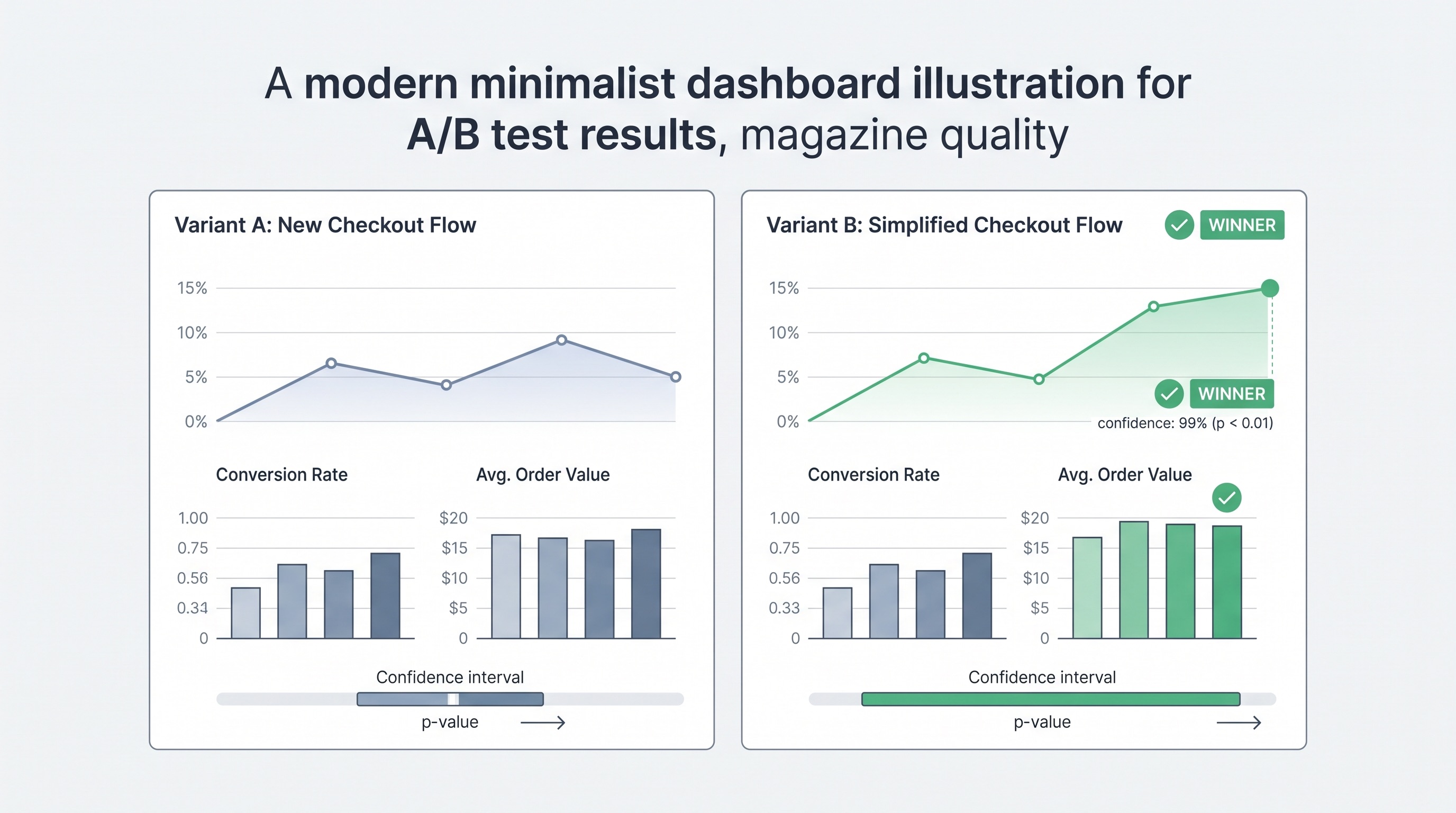
Control: 4.8% conversion (n=24,600 sessions). Variant: 5.05% conversion (n=24,450 sessions). That's a +5.2% relative lift. Running a two-proportion z-test on these numbers gives a p-value of approximately 0.041 — just inside the conventional 0.05 significance threshold, with a 95% confidence interval on the lift of roughly [+0.1%, +10.3%] relative. Post-hoc power at this effect size and sample size lands around 52%, well below the 80% threshold you'd want for a decision this consequential. In plain terms: the result is nominally significant, but the confidence interval is wide enough that the "true" lift could be barely above zero or as high as 10% — you don't have enough data to know which.
Business Interpretation
A +5.2% relative lift on checkout conversion is commercially meaningful if real — at your traffic volume that's roughly 60 incremental orders per day. But the wide confidence interval means you're not choosing between "ship" and "don't ship," you're choosing between "possibly a strong winner" and "possibly noise." The guardrail metric (average order value) held flat at -0.3% (not significant), so there's no evidence the variant is cannibalizing basket size to win on conversion rate. No red flags there.
Recommendation: HOLD
Extend the test by at least 7-10 more days to reach ~80% power at the observed effect size (approximately 34,000 sessions per arm). The 14-day window also only covers two weekly cycles, borderline for ruling out a novelty effect on a redesigned flow — extending the window addresses both the power problem and the novelty-effect risk simultaneously. Shipping now on a 52%-powered result risks locking in a false positive that erodes checkout conversion once the novelty wears off.
Caveats & Follow-Up
Check whether the lift is concentrated in mobile vs. desktop traffic — redesigns often show device-specific effects that average out misleadingly. Also confirm the test wasn't peeked at and stopped early; if the 14-day window was chosen after seeing early results trending positive, treat this read with additional skepticism and weight the extension recommendation even more heavily.
A maioria das equipes lê um resultado de teste A/B da mesma forma: número do controle, número da variante, o que for maior vence. É assim que falsos positivos são lançados e como verdadeiros vencedores são descartados por stakeholders nervosos que veem uma amostra pequena e se assustam. Este Prompt existe para forçar cinco verificações que uma olhada no dashboard ignora — significância, poder, significância prática, regressões em métricas de proteção e riscos de viés como efeitos de novidade e espiada precoce — antes que alguém se comprometa com uma decisão de lançar, manter ou descartar.
Por que a estrutura funciona
A seção de Contexto pede deliberadamente os tamanhos de amostra e a duração do teste logo de início, não apenas as métricas principais. Os cálculos de significância e poder não têm sentido sem eles, e é exatamente a informação que a maioria das pessoas deixa de fora quando cola "o controle foi 4,8%, a variante foi 5,05%" em uma janela de chat esperando um veredito.
A seção de Restrições é onde reside o verdadeiro valor. Proibir explicitamente uma recomendação de "lançar" em um resultado com poder insuficiente interrompe o modo de falha mais comum: um teste que atingiu significância nominal (p logo abaixo de 0,05) mas nunca foi executado tempo suficiente para atingir um tamanho de amostra confiável. A bandeira de efeito de novidade sinaliza redesigns e mudanças de interface que disparam uma métrica temporariamente porque os usuários estão reagindo a algo novo, não porque a mudança é realmente melhor — uma distinção que só aparece se o teste durar o suficiente para cobrir múltiplos ciclos completos de uso. A bandeira de viés de espiada precoce aborda uma armadilha estatística bem conhecida: equipes que verificam os resultados diariamente e param o teste assim que ele parece bom estão efetivamente executando dezenas de testes de hipótese ocultos, o que infla a taxa de falsos positivos muito acima dos 5% nominais.
A seção de Formato de Saída separa propositalmente a "Leitura Estatística" da "Interpretação de Negócios". Um valor p de 0,03 não significa nada para um VP em uma revisão de roadmap — mas "há uma chance real de que esse aumento seja próximo de zero" significa. Separar os dois força o modelo a traduzir as estatísticas em uma frase utilizável para decisão, em vez de parar no número.
Como usar bem
Preencha os campos entre colchetes diretamente da exportação da sua plataforma de experimentação — não arredonde os números manualmente, pois o cálculo do poder depende dos tamanhos de amostra reais. Se você não tem uma métrica de proteção formal definida, escreva "nenhuma rastreada" em vez de deixar em branco — essa lacuna vale a pena ser sinalizada na saída, já que lançar com base em uma única métrica sem verificações de riscos secundários é um risco por si só.