Preparação para Negociação Salarial: Estratégia de Ancoragem, BATNA e Scripts de Objeção em um Único Prompt
Porque é que este prompt importa
Professionals who skip negotiation on their first offer at a new company leave an average of $5,000–$20,000 per year on the table — a gap that compounds because future raises are calculated as percentages of the base. Most people don't fail because the company refuses to negotiate. They fail because they open with a weak anchor, fold at the first objection, or don't know their BATNA well enough to hold the line when the recruiter says 'this is our best offer.'
Para que o usamos
You just received a job offer and have 24–48 hours to respond. You want to negotiate but don't know where to open, what to say when they push back, or how to use your competing offer without sounding manipulative. Paste the offer details and your situation into this prompt and walk into the conversation with a full playbook.
Prompt
Act as a senior compensation consultant and negotiation strategist with 15 years of experience helping professionals negotiate job offers, promotions, and contract renewals.

Context:
- Current role: [YOUR CURRENT TITLE AND YEARS OF EXPERIENCE]
- Current total compensation: [CURRENT BASE + BONUS % + EQUITY / RSU VALUE]
- Target company: [COMPANY NAME]
- Offer received: [BASE SALARY OFFERED] + [BONUS %] + [EQUITY GRANT OR RSU SCHEDULE]
- Market data you have: [PASTE DATA FROM LEVELS.FYI / GLASSDOOR / BLIND / YOUR RECRUITER — OR STATE "none available"]
- Your BATNA (best alternative to a negotiated agreement): [YOUR NEXT-BEST OPTION — COMPETING OFFER, STAYING IN CURRENT ROLE, FREELANCE, ETC.]
- Non-negotiables for you: [ANYTHING YOU REFUSE TO COMPROMISE ON — E.G. REMOTE POLICY, TITLE, START DATE]
- Negotiation style preference: [COLLABORATIVE / ASSERTIVE / DATA-DRIVEN]

Task:
Produce a complete negotiation preparation package covering:
1. Anchoring strategy: the exact number to open with and why (apply the 15% buffer rule above market midpoint, adjusted for seniority and location)
2. Justification narrative: 3-4 bullet points connecting your specific experience and proven results to their specific role requirements
3. BATNA analysis: how to signal you have alternatives without lying or revealing too much — in 3 sentences
4. Negotiation script: an opening statement, the 3 most likely objections they will raise, and verbatim response scripts for each
5. Follow-up email: a draft to send within 2 hours of the verbal conversation to confirm changes and create a paper trail — ready to copy-paste with [BRACKETED] fields
6. Red-lines checklist: 3 specific conditions under which you should walk away from this offer

Constraints:
- Every script line must sound natural when spoken aloud, not rehearsed
- Do not suggest fabricating competing offers or inflating compensation numbers
- Optimize for total compensation (base + equity + bonus + benefits + flexibility), not just base salary alone
- If the offer is already at or above market, reframe the negotiation toward equity cliff, signing bonus, title, remote policy, or start date
- Assume the recruiter has seen every trick — prioritize authenticity over cleverness

Output format:
Use a numbered section header for each of the 6 deliverables above. Format negotiation script exchanges as: [THEM]: "..." → [YOU]: "..." on separate lines. BATNA analysis as 3 plain sentences. Email draft in a fenced block with [BRACKETED] placeholders clearly marked.
Resultado
1. Anchoring Strategy
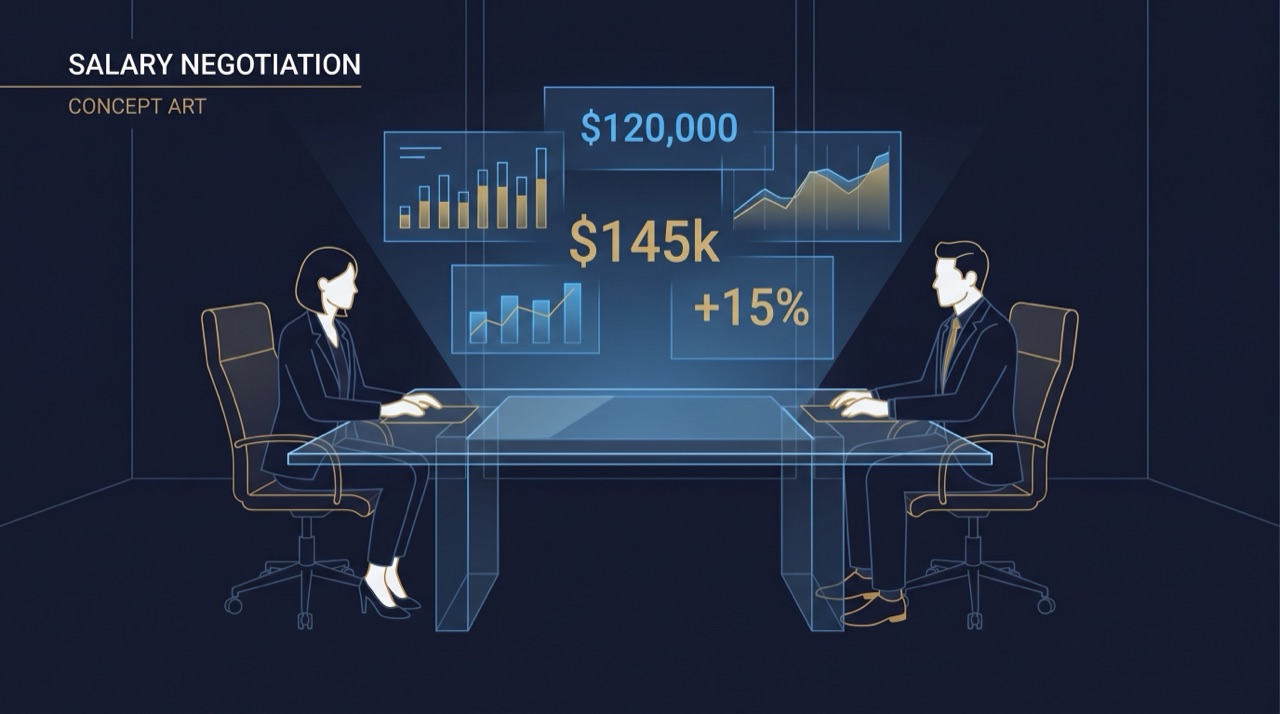
Your offer is $145,000 base with a 10% target bonus and $80,000 in RSUs vesting over 4 years. Levels.fyi shows P4 engineers at this company median at $158,000 base. Your anchor: $175,000 base. This is 10.8% above market median — aggressive but defensible given your 6 years of directly relevant distributed-systems experience and the fact you're coming in at a level above your current title. Opening at $175K gives you room to land at $162–165K and still outperform the median.
2. Justification Narrative
- You've shipped two services handling >50M requests/day at [CURRENT COMPANY] — directly comparable to their stated scale requirements in the JD.
- Your last project reduced infrastructure costs by 34%, which maps to their public focus on cost efficiency in the engineering blog.
- You have production experience with their exact stack (Go + Kubernetes + Postgres), meaning no ramp-up period.
- You're interviewing with two other companies at the same level — which signals market validation of your experience tier without naming specifics.
3. BATNA Analysis
Your BATNA is a second offer at $155,000 base from [COMPANY B], which you expect to receive within the week. You don't need to name the company — signaling that you are "in final-stage conversations with another company at a similar level" is both true and sufficient. If this offer doesn't move above $160K total base, your alternative is financially comparable and you should take it.
4. Negotiation Script
[THEM]: "We're excited to extend this offer at $145,000."
→ [YOU]: "I'm genuinely excited about the role and the team — the distributed systems problems you're working on are exactly where I want to spend the next few years. I'd like to discuss the compensation. Based on market data for this level and location, and given my directly applicable experience, I was expecting something closer to $175,000. Is there flexibility to get there?"
[THEM]: "That's above our band for this role."
→ [YOU]: "I understand bands exist for a reason. Can you tell me where I'd land in the band, and whether there are ways to make up the difference through equity or a signing bonus? I want to find a structure that works for both of us."
[THEM]: "We've already given you our best offer."
→ [YOU]: "I appreciate the transparency. I'm in late-stage conversations elsewhere at a similar level, and I want to join your team — but I need the total package to reflect my market value. If the base is fixed, let's look at the equity schedule or a one-time signing bonus to close the gap."
5. Follow-Up Email Draft
Subject: [YOUR NAME] — Compensation Discussion Follow-Up

Hi [RECRUITER NAME],

Thank you for taking the time to discuss the offer today. I wanted to follow up in writing to confirm where we landed:

- Base salary: $[AGREED FIGURE]
- Target bonus: [BONUS %]
- Equity: [RSU GRANT AND VESTING SCHEDULE]
- Signing bonus: $[AMOUNT IF APPLICABLE]
- Start date: [DATE]
- Remote policy: [POLICY AS AGREED]

I'm excited to move forward and look forward to receiving the updated offer letter reflecting these terms.

Best,
[YOUR NAME]
6. Red-Lines Checklist
- Walk away if the final base offer is below $155,000 AND there is no signing bonus or equity top-up to compensate — your BATNA is financially equivalent.
- Walk away if the equity cliff is longer than 12 months with no acceleration clause — at your seniority, a 1-year cliff is market standard.
- Walk away if they won't confirm the remote policy in writing — verbal agreements on remote work have not held up historically, and this is non-negotiable for your situation.
Cole sua oferta, dados de mercado e BATNA neste prompt e receba um pacote completo de negociação: o número inicial correto, tópicos de justificativa, scripts para objeções e um e-mail de acompanhamento pronto para envio — para que você pare de deixar dinheiro na mesa.
O Problema que Este Prompt Resolve
Profissionais que pulam a negociação na primeira oferta de uma nova empresa deixam, em média, de US$ 5.000 a US$ 20.000 por ano na mesa — uma lacuna que se agrava porque aumentos futuros são calculados como percentuais do salário base. A maioria das pessoas não falha porque a empresa se recusa a negociar. Elas falham porque começam com um âncora fraco, desistem na primeira objeção ou não conhecem bem o próprio BATNA para manter a posição quando o recrutador diz 'esta é nossa melhor oferta'.
Quando Usar
Você acabou de receber uma oferta de emprego e tem de 24 a 48 horas para responder. Você quer negociar, mas não sabe por onde começar, o que dizer quando houver resistência ou como usar sua oferta concorrente sem parecer manipulador. Cole os detalhes da oferta e sua situação neste prompt e entre na conversa com um roteiro completo.
Como o Prompt é Estruturado
O prompt segue uma estrutura de Papel + Contexto + Tarefa + Restrições + Formato de Saída. O Papel define o modelo como um consultor sênior de remuneração — não um assistente genérico — o que direciona as respostas para um enquadramento estratégico, em vez de lugares-comuns. O bloco de Contexto está inteiramente entre [COLCHETES], para que você insira seus números específicos em vez de receber conselhos genéricos.
A seção de Tarefa solicita seis entregas concretas: um valor âncora com justificativa, uma narrativa de justificativa vinculada à descrição específica do cargo, uma análise de BATNA, um roteiro de diálogo textual, um e-mail de acompanhamento para copiar e colar e linhas vermelhas explícitas. O bloco de Restrições impede que o modelo sugira táticas desonestas e o direciona para a otimização da remuneração total, em vez de apenas o salário base.
Compatibilidade com Modelos
Este prompt tem melhor desempenho no Claude Sonnet 4.6 ou no GPT-4o, ambos seguindo instruções estruturadas com múltiplas entregas de forma confiável. O Claude tende a produzir scripts de diálogo com som mais natural; os rascunhos de e-mail do GPT-4o são ligeiramente mais formais. O Gemini 1.5 Pro funciona, mas ocasionalmente colapsa a estrutura de 6 seções em prosa — adicione "Você deve usar cabeçalhos de seção numerados exatamente como especificado" se isso acontecer.
Dicas para Melhores Resultados
- Cole dados salariais reais do Levels.fyi ou Glassdoor no bloco de contexto — quanto mais específicos os números, mais defensável será a âncora produzida pelo modelo.
- Se você não tiver uma oferta concorrente, declare seu BATNA honestamente (permanecer no cargo atual, trabalho freelancer, etc.) — o modelo trabalhará com isso sem inventar uma oferta falsa.
- Execute o prompt duas vezes com preferências de estilo de negociação diferentes (assertivo vs. colaborativo) e compare os scripts — eles diferem significativamente.
- Após a conversa, volte e cole o que realmente aconteceu para obter uma análise pós-evento e um e-mail de acompanhamento revisado, caso o resultado verbal tenha sido diferente do planejado.