Construtor de Matriz de Decisão para Qualquer Escolha Importante
Porque é que este prompt importa
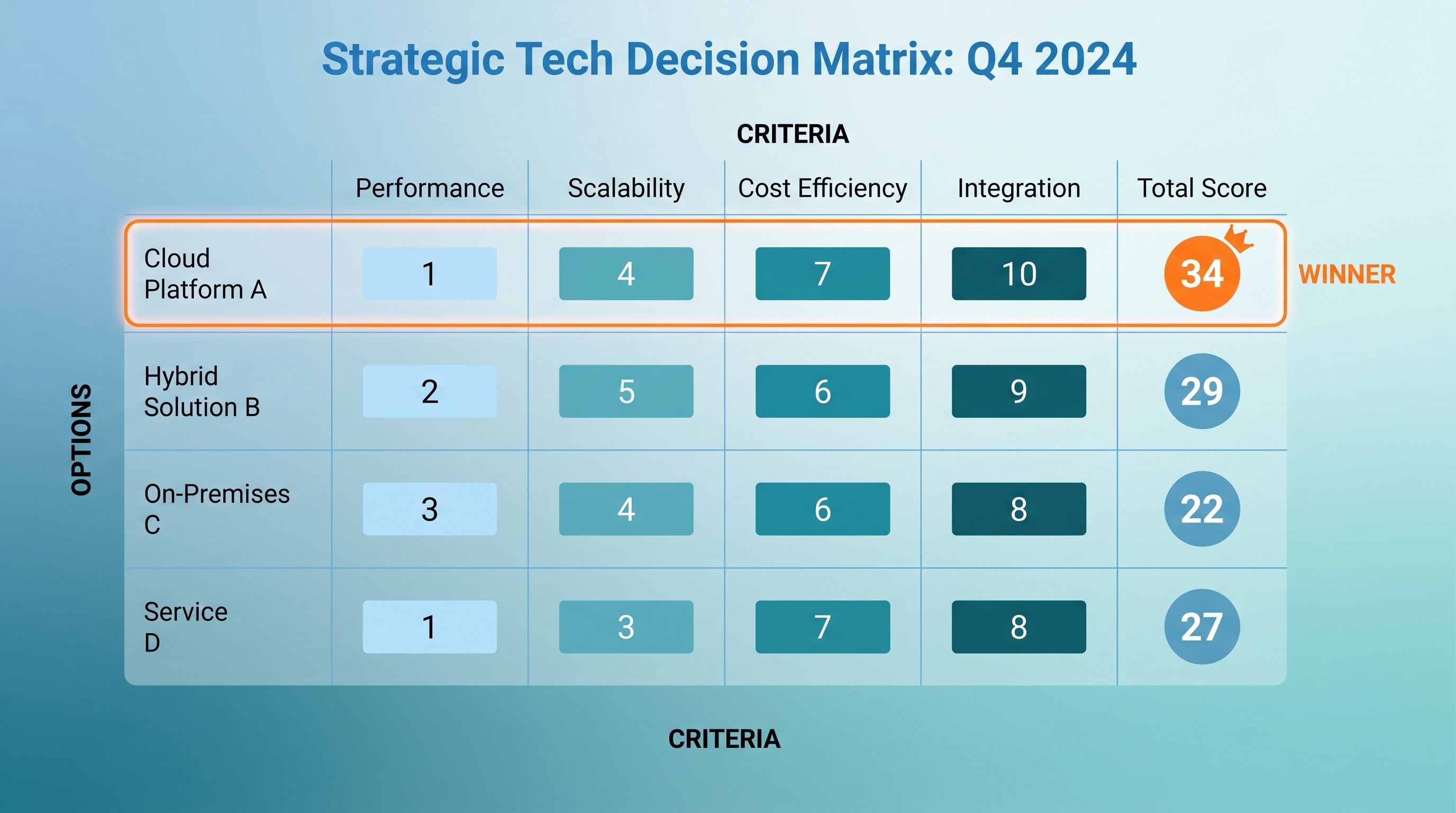
Most people make complex decisions on gut feel, which introduces cognitive biases like anchoring (over-weighting the first option seen) and recency bias (favoring the last option considered). A weighted scoring matrix forces you to define what matters before you evaluate options, separating criteria-setting from scoring — the same technique used in formal procurement, engineering design reviews, and McKinsey-style strategy work. The result is a defensible, documented decision you can explain to a team.
Para que o usamos
Use this prompt when you are facing a significant decision with multiple options and competing priorities — choosing a new tech stack, picking a vendor, deciding between job offers, evaluating business strategies, or selecting among product features to build next quarter.
Prompt
Act as a senior strategy consultant who specializes in structured decision-making frameworks.

I need to make a major decision and want to use a weighted scoring matrix to evaluate my options objectively.

My decision: [DESCRIBE YOUR DECISION IN 1-2 SENTENCES]

My options:
1. [OPTION A]
2. [OPTION B]
3. [OPTION C]
(Add more if needed)

My criteria for evaluating these options (list what matters most):
- [CRITERION 1, e.g. cost]
- [CRITERION 2, e.g. implementation time]
- [CRITERION 3, e.g. team capability]
- [CRITERION 4, e.g. long-term scalability]
(Add or remove criteria as needed)

Constraints and context:
- [ANY HARD CONSTRAINTS — e.g. budget cap, deadline, must-have features]
- [RELEVANT CONTEXT — e.g. team size, current situation, strategic goals]

Do the following:
1. Review my criteria and suggest adjustments if any important factor is missing or if two criteria overlap significantly.
2. Ask me to assign weights to each criterion (1-5, where 5 = most important) — or assign sensible weights yourself based on the context I provided and explain your reasoning.
3. Score each option against every criterion on a scale of 1-10.
4. Calculate the weighted score for each option (score × weight, summed).
5. Present a clean scoring table with: criteria | weight | scores per option | weighted scores | totals.
6. Identify the winning option and explain in 2-3 sentences why it scored highest.
7. Flag any minority concern: if the runner-up is close or if the top scorer has a critical weakness, call it out explicitly.

Output format:
- Start with the scoring table (use markdown table formatting)
- Follow with a 3-paragraph analysis: winner rationale, key tradeoffs, one risk to watch
Resultado
Scoring Matrix: Cloud Provider for Our SaaS Product
| Criterion | Weight | AWS | GCP | Azure | AWS x W | GCP x W | Azure x W |
|---|---|---|---|---|---|---|---|
| Cost at scale | 5 | 7 | 8 | 6 | 35 | 40 | 30 |
| ML/AI tooling | 4 | 8 | 9 | 7 | 32 | 36 | 28 |
| Team familiarity | 5 | 9 | 5 | 6 | 45 | 25 | 30 |
| Enterprise support | 3 | 9 | 7 | 9 | 27 | 21 | 27 |
| Vendor lock-in risk | 3 | 5 | 6 | 5 | 15 | 18 | 15 |
| TOTAL | 20 | 154 | 140 | 130 |
Winner: AWS (154 points)
AWS wins primarily because of team familiarity (weight 5), which carries the most points. Ramp-up time for a new platform would cost 3-4 engineering months — a real cost that GCP marginal ML advantage does not offset at your current AI workload scale.
Key tradeoff: GCP leads on ML/AI tooling and is the better long-term bet if AI inference becomes your core product. If your roadmap shifts heavily toward custom model serving in the next 12 months, revisit this matrix with ML tooling weighted at 5 instead of 4 — GCP would likely overtake AWS.
Risk to watch: AWS scored lowest on vendor lock-in risk across all three providers. Before committing, audit which AWS-specific services you plan to use. If the answer includes proprietary services like Lambda, DynamoDB, and SageMaker together, your vendor dependency compounds fast.
Pare de tomar decisões importantes no feeling
Toda decisão importante tem o mesmo problema: opções demais, critérios demais e um cérebro programado para tomar atalhos. Você pesa as opções na cabeça, se deixa influenciar pela última que considerou e termina com uma escolha que não consegue defender com clareza.
A matriz de decisão ponderada é uma das ferramentas mais antigas e confiáveis na tomada de decisão estruturada — utilizada há décadas em licitações públicas, revisões de projeto de engenharia e consultoria de gestão. Este prompt traz esse framework diretamente para o Claude.
O que o prompt faz
Você descreve sua decisão, lista suas opções e especifica os critérios que importam. A IA primeiro audita seus critérios buscando lacunas ou sobreposições, depois atribui pesos, pontua cada opção, calcula a matriz e entrega uma tabela com pontuações mais uma análise de três parágrafos: justificativa do vencedor, principais tradeoffs e um risco a monitorar.
A etapa de definição de restrições é deliberada. Ao definir os pesos antes de ver as pontuações, você evita reengenheirar os critérios para favorecer uma resposta predeterminada — uma falha comum em processos informais de decisão.
Quando usar
- Escolher uma plataforma tecnológica ou fornecedor
- Avaliar propostas de emprego ou mudanças de carreira
- Selecionar funcionalidades de produto para o próximo sprint ou trimestre
- Comparar estratégias de negócio ou abordagens de go-to-market
- Qualquer decisão em que você precise de uma justificativa documentada para uma equipe ou stakeholder
Funciona melhor com
Claude Sonnet 4.6 lida bem com saídas estruturadas e raciocínio em múltiplas etapas. GPT-4o é uma alternativa sólida. Para decisões com mais de cinco critérios ou seis opções, considere dividir a análise em duas etapas: primeiro a ponderação dos critérios, depois a pontuação.