Le Pont Conceptuel : Apprenez Instantanément Tout Sujet Technique en le Mappant à Ce Que Vous Savez Déjà
Pourquoi ce prompt est important
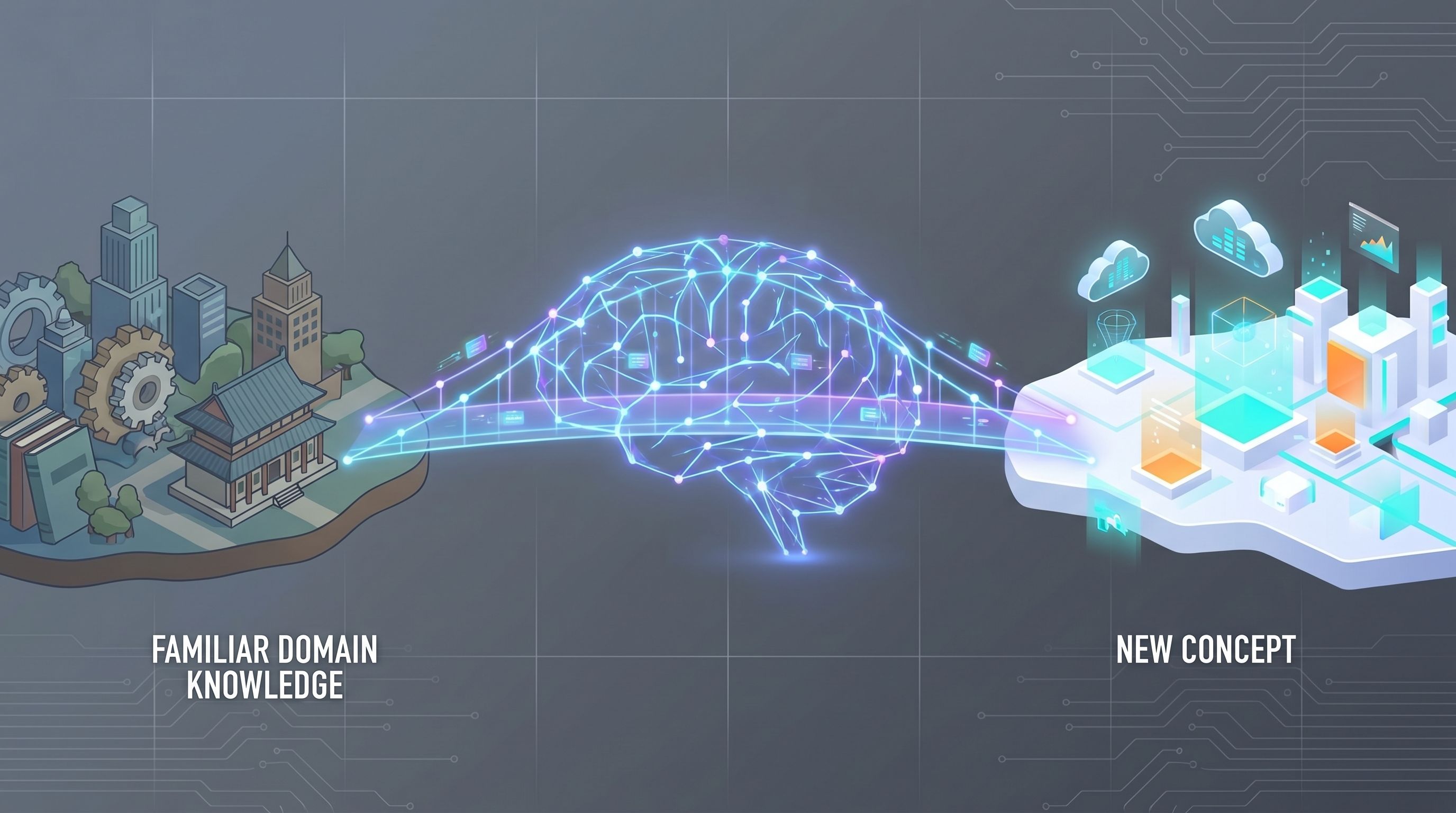
Standard technical documentation is written for people who already understand adjacent concepts in the same field. If you're a database engineer learning ML, those resources assume the wrong baseline. Anchoring new concepts to your existing mental models is measurably faster — cognitive science research on analogical transfer consistently shows 3–5x better retention when learners map new information to known structures. The prompt also forces the AI to identify where the analogy breaks, which is where most self-taught understanding fails silently.
À quoi nous l'utilisons
You've been handed a task involving a technology you've never touched: a backend engineer suddenly needs to understand transformer attention mechanisms, a product manager needs to grasp distributed consensus before a 10am meeting, or a lawyer needs a working mental model of blockchain before a client call. You have 30 minutes and need genuine intuition, not a textbook overview.
Prompt
Act as a master teacher and domain translator. Your job is to explain [CONCEPT YOU WANT TO LEARN] entirely through analogies drawn from [DOMAIN YOU ALREADY KNOW WELL] — without using direct technical jargon from the new concept until after it has been introduced through analogy.

Context: I have deep expertise in [DOMAIN YOU ALREADY KNOW WELL] and I am trying to build an intuitive mental model of [CONCEPT YOU WANT TO LEARN]. I do NOT want a standard textbook explanation. I want to understand it the way a colleague who knows my domain deeply would explain it over coffee.

Task: Explain [CONCEPT YOU WANT TO LEARN] by:
1. Creating a Core Mapping — a table that maps each key component of the new concept to its closest equivalent in [DOMAIN YOU ALREADY KNOW WELL]
2. Walking through 2–3 concrete scenarios using only the language and mental models of [DOMAIN YOU ALREADY KNOW WELL]
3. Identifying clearly where the analogy breaks down — the specific points where my intuition from [DOMAIN I KNOW] will mislead me about [CONCEPT YOU WANT TO LEARN]
4. Ending with 3 self-check questions I can ask myself to verify I genuinely understood it and not just pattern-matched the words

Constraints:
- Do NOT open with a Wikipedia-style overview — go straight into analogy
- Every technical term must be introduced via its analogy before being named
- The breakdown section must be honest and specific, not just "the analogy isn't perfect"
- Keep the full response under 800 words

Output Format:
## The Concept Bridge: [CONCEPT] through the lens of [DOMAIN]

### Core Mapping
[Table: New Concept Term | What It Maps To In Your Domain]

### How It Works (in your domain's language)
[2–3 scenarios told entirely in the language of [DOMAIN YOU ALREADY KNOW WELL]]

### Where the Analogy Breaks Down
[Specific, honest limitations — the places your intuition will lie to you]

### 3 Questions to Test Your Understanding
[Self-check questions that require real understanding, not recall]
Résultat
The Concept Bridge: Transformer Attention through the lens of SQL Databases
Core Mapping
| Transformer Concept | Database Equivalent |
|---|---|
| Token | Row in a table |
| Attention weight | JOIN relevance score / query selectivity |
| Query vector (Q) | The SELECT + WHERE clause you're searching with |
| Key vector (K) | The indexed column being searched against |
| Value vector (V) | The actual data returned when a row matches |
| Multi-head attention | Running 8 parallel queries on the same table, each asking a different question |
| Context window | The table size limit — only rows within it can be JOINed |
How It Works (in database language)
Scenario 1: A single attention head. Imagine you're running: "Find all rows most relevant to the current row I'm processing." Every token simultaneously acts as both the query (what am I looking for?) and a potential result (am I relevant to others?). The attention weight is the relevance score — like a fuzzy full-text search rank rather than an exact JOIN.
Scenario 2: Multi-head attention. You run 8 different queries on the same dataset in parallel. One asks "which words are grammatically connected?", another asks "which words share meaning?", another asks about position. Each returns its own ranked result set. The outputs are then concatenated — like a UNION ALL followed by a final aggregation.
Scenario 3: The context window as table size. Your database can only hold 128,000 rows in memory at once. Any row outside that window simply doesn't exist for the current query — it can't be JOINed against or referenced. This is why context length matters: it's your working table size.
Where the Analogy Breaks Down
Weights are learned, not declared. In SQL, you define your schema and indexes explicitly. The Q, K, V matrices — the "query structure" — are learned from billions of examples. There's no schema designer.
All rows query all rows simultaneously. In SQL, you write one query at a time. In attention, every token is simultaneously acting as a query against every other token in one parallelized matrix multiplication — N² comparisons at once.
There's no primary key. A word's "identity" as a key shifts based on what surrounds it, unlike a database row with a fixed ID.
3 Questions to Test Your Understanding
- If you doubled the context window from 64K to 128K tokens, what happens to computational cost — and why? (Hint: think N².)
- Why can't a transformer "look up" information from a document it wasn't given in context, even if trained on it?
- In multi-head attention, each head learns different patterns. What would be the database equivalent of a head that specializes in long-range dependencies?
La plupart des explications techniques sont écrites pour des personnes qui comprennent déjà les concepts adjacents dans le même domaine. Si vous êtes un ingénieur base de données essayant de comprendre comment fonctionne l’Attention dans un Transformer, les tutoriels standards feront référence à des notions d’algèbre linéaire et d’intuitions de Machine Learning que vous n’avez pas. Le Prompt Concept Bridge inverse cela — il force une IA à expliquer le nouveau concept entièrement à travers votre domaine existant, puis cartographie honnêtement où cette analogie se brise.
Ce Qui Rend Ce Prompt Efficace
Le Prompt repose sur trois choix structurels que la plupart des prompts « explique X simplement » omettent :
Le Core Mapping vient en premier. Avant toute explication narrative, l’IA doit produire un tableau mappant chaque terme clé du nouveau concept à son équivalent le plus proche dans votre domaine. Cela vous donne un vocabulaire avant l’histoire — ainsi, lorsque les analogies deviennent complexes, vous avez une référence sur laquelle vous ancrer.
La section Breakdown est obligatoire. La plupart des explications basées sur des analogies l’omettent, ce qui signifie que vous repartez avec un modèle mental qui échoue silencieusement. Ce Prompt exige que l’IA identifie exactement où votre intuition de domaine vous induira en erreur. C’est là que la plupart des apprentissages techniques autodidactes échouent — pas en surface mais aux limites où l’analogie cesse de tenir.
Les questions d’auto‑vérification utilisent la compréhension, pas la mémorisation. Les trois questions finales sont conçues pour exiger un véritable raisonnement sur le modèle mental, pas simplement répéter ce qui a été dit. Si vous pouvez y répondre en utilisant le langage de votre domaine, vous avez le concept. Sinon, vous savez exactement où creuser plus loin.
Comment l’Utiliser
Remplacez [CONCEPT YOU WANT TO LEARN] par n’importe quoi : mécanismes d’Attention dans un Transformer, consensus distribué (Raft/Paxos), Smart Contracts, structures de données CRDT, chiffrement homomorphe, ordonnancement Kubernetes. Remplacez [DOMAIN YOU ALREADY KNOW WELL] par votre expertise la plus solide : bases de données SQL, génie électrique, droit civil, théorie musicale, comptabilité, logistique.
Le modèle fonctionne mieux lorsque l’écart entre les domaines est grand — un avocat apprenant la Blockchain, un ingénieur Backend apprenant le Machine Learning, un Product Manager apprenant les systèmes distribués. Plus l’écart est large, plus le pont est utile. Ne l’utilisez pas pour des concepts adjacents où les ressources standard vous rejoignent déjà là où vous êtes.
Notes sur les Modèles
Claude Opus 4.8 produit les analogies les plus riches et les sections Breakdown les plus honnêtes — il est particulièrement bon pour identifier où l’analogie induit en erreur plutôt que de simplement dire « l’analogie a des limites ». GPT‑4o est une alternative solide avec des tableaux légèrement plus structurés. Évitez les modèles plus petits pour ce Prompt ; ils ont tendance à produire des mappings superficiels qui semblent corrects mais manquent les détails mécaniques où réside la compréhension.