Constructeur de Matrice de Décision pour tout Choix Majeur
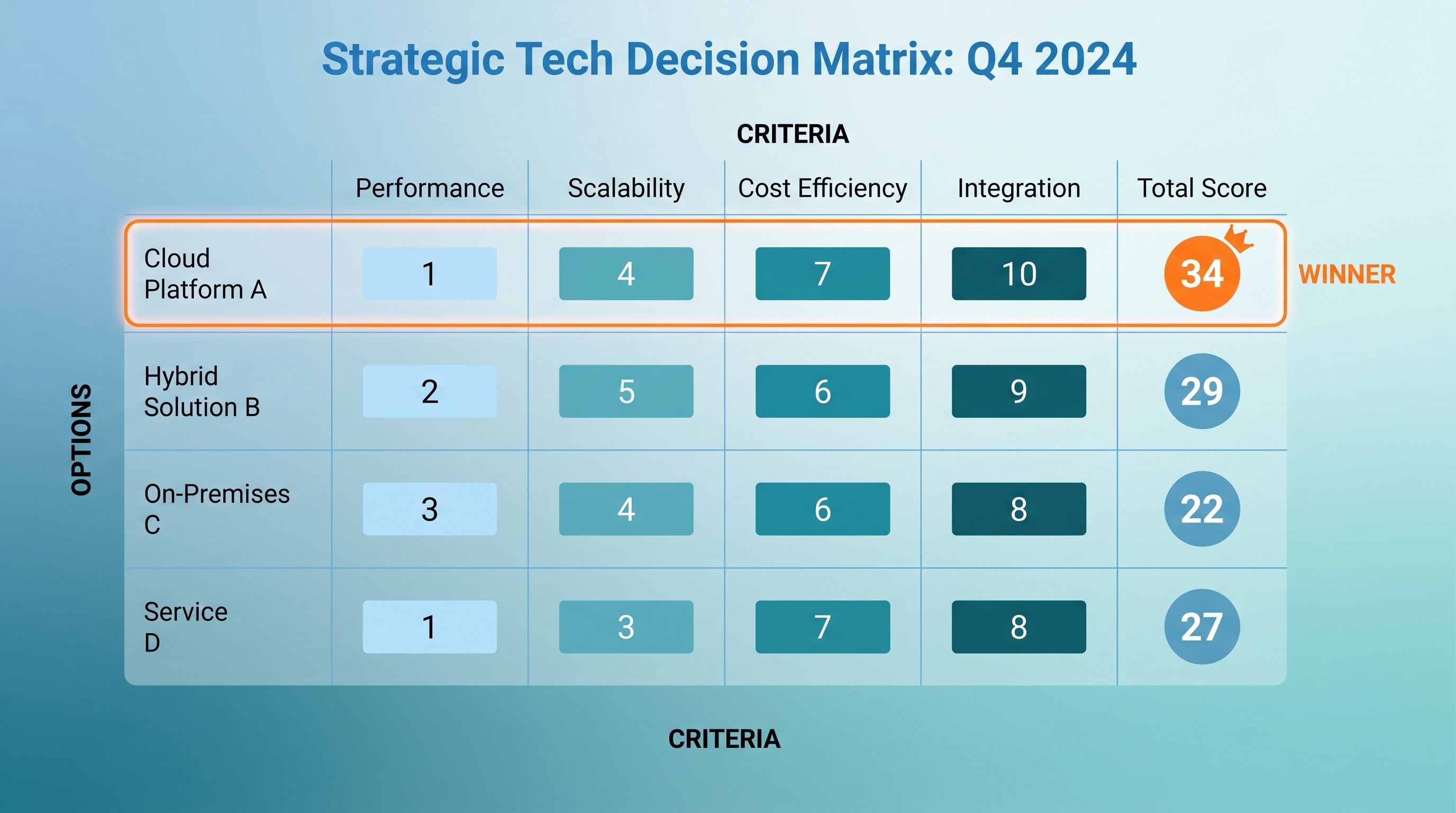
Pourquoi ce prompt est important
Most people make complex decisions on gut feel, which introduces cognitive biases like anchoring (over-weighting the first option seen) and recency bias (favoring the last option considered). A weighted scoring matrix forces you to define what matters before you evaluate options, separating criteria-setting from scoring — the same technique used in formal procurement, engineering design reviews, and McKinsey-style strategy work. The result is a defensible, documented decision you can explain to a team.
À quoi nous l'utilisons
Use this prompt when you are facing a significant decision with multiple options and competing priorities — choosing a new tech stack, picking a vendor, deciding between job offers, evaluating business strategies, or selecting among product features to build next quarter.
Prompt
Act as a senior strategy consultant who specializes in structured decision-making frameworks.

I need to make a major decision and want to use a weighted scoring matrix to evaluate my options objectively.

My decision: [DESCRIBE YOUR DECISION IN 1-2 SENTENCES]

My options:
1. [OPTION A]
2. [OPTION B]
3. [OPTION C]
(Add more if needed)

My criteria for evaluating these options (list what matters most):
- [CRITERION 1, e.g. cost]
- [CRITERION 2, e.g. implementation time]
- [CRITERION 3, e.g. team capability]
- [CRITERION 4, e.g. long-term scalability]
(Add or remove criteria as needed)

Constraints and context:
- [ANY HARD CONSTRAINTS — e.g. budget cap, deadline, must-have features]
- [RELEVANT CONTEXT — e.g. team size, current situation, strategic goals]

Do the following:
1. Review my criteria and suggest adjustments if any important factor is missing or if two criteria overlap significantly.
2. Ask me to assign weights to each criterion (1-5, where 5 = most important) — or assign sensible weights yourself based on the context I provided and explain your reasoning.
3. Score each option against every criterion on a scale of 1-10.
4. Calculate the weighted score for each option (score × weight, summed).
5. Present a clean scoring table with: criteria | weight | scores per option | weighted scores | totals.
6. Identify the winning option and explain in 2-3 sentences why it scored highest.
7. Flag any minority concern: if the runner-up is close or if the top scorer has a critical weakness, call it out explicitly.

Output format:
- Start with the scoring table (use markdown table formatting)
- Follow with a 3-paragraph analysis: winner rationale, key tradeoffs, one risk to watch
Résultat
Scoring Matrix: Cloud Provider for Our SaaS Product
| Criterion | Weight | AWS | GCP | Azure | AWS x W | GCP x W | Azure x W |
|---|---|---|---|---|---|---|---|
| Cost at scale | 5 | 7 | 8 | 6 | 35 | 40 | 30 |
| ML/AI tooling | 4 | 8 | 9 | 7 | 32 | 36 | 28 |
| Team familiarity | 5 | 9 | 5 | 6 | 45 | 25 | 30 |
| Enterprise support | 3 | 9 | 7 | 9 | 27 | 21 | 27 |
| Vendor lock-in risk | 3 | 5 | 6 | 5 | 15 | 18 | 15 |
| TOTAL | 20 | 154 | 140 | 130 |
Winner: AWS (154 points)
AWS wins primarily because of team familiarity (weight 5), which carries the most points. Ramp-up time for a new platform would cost 3-4 engineering months — a real cost that GCP marginal ML advantage does not offset at your current AI workload scale.
Key tradeoff: GCP leads on ML/AI tooling and is the better long-term bet if AI inference becomes your core product. If your roadmap shifts heavily toward custom model serving in the next 12 months, revisit this matrix with ML tooling weighted at 5 instead of 4 — GCP would likely overtake AWS.
Risk to watch: AWS scored lowest on vendor lock-in risk across all three providers. Before committing, audit which AWS-specific services you plan to use. If the answer includes proprietary services like Lambda, DynamoDB, and SageMaker together, your vendor dependency compounds fast.
Arrêtez de prendre vos décisions importantes au flair
Toute décision importante souffre du même problème : trop d'options, trop de critères, et un cerveau câblé pour prendre des raccourcis. Vous pesez les options dans votre tête, vous laissez influencer par la dernière que vous avez étudiée, et vous vous retrouvez avec un choix que vous ne pouvez pas défendre clairement.
La matrice de décision pondérée est l'un des outils les plus anciens et les plus fiables en matière de prise de décision structurée — utilisée depuis des décennies dans les marchés publics, les revues de conception technique et le conseil en management. Ce prompt apporte ce framework directement dans Claude.
Ce que fait le prompt
Vous décrivez votre décision, listez vos options et spécifiez les critères qui comptent. L'IA audite d'abord vos critères pour détecter des lacunes ou des chevauchements, puis attribue des poids, note chaque option, calcule la matrice et fournit un tableau de scores accompagné d'une analyse en trois paragraphes : justification du gagnant, compromis clés et un risque à surveiller.
L'étape de définition des contraintes est délibérée. En définissant les poids avant de voir les scores, vous vous empêchez de rétro-ingénier les critères pour favoriser une réponse prédéterminée — un écueil courant dans les processus de décision informels.
Quand l'utiliser
- Choisir une plateforme technologique ou un fournisseur
- Évaluer des offres d'emploi ou des reconversions professionnelles
- Sélectionner des fonctionnalités produit pour le prochain sprint ou trimestre
- Comparer des stratégies commerciales ou des approches go-to-market
- Toute décision nécessitant une justification documentée pour une équipe ou des parties prenantes
Fonctionne mieux avec
Claude Sonnet 4.6 gère bien la sortie structurée et le raisonnement en plusieurs étapes. GPT-4o est une alternative solide. Pour les décisions avec plus de cinq critères ou six options, envisagez de diviser l'analyse en deux passes : pondération des critères d'abord, puis notation.