Ce prompt de briefing transforme des notes dispersées en préparation de réunion en 5 minutes
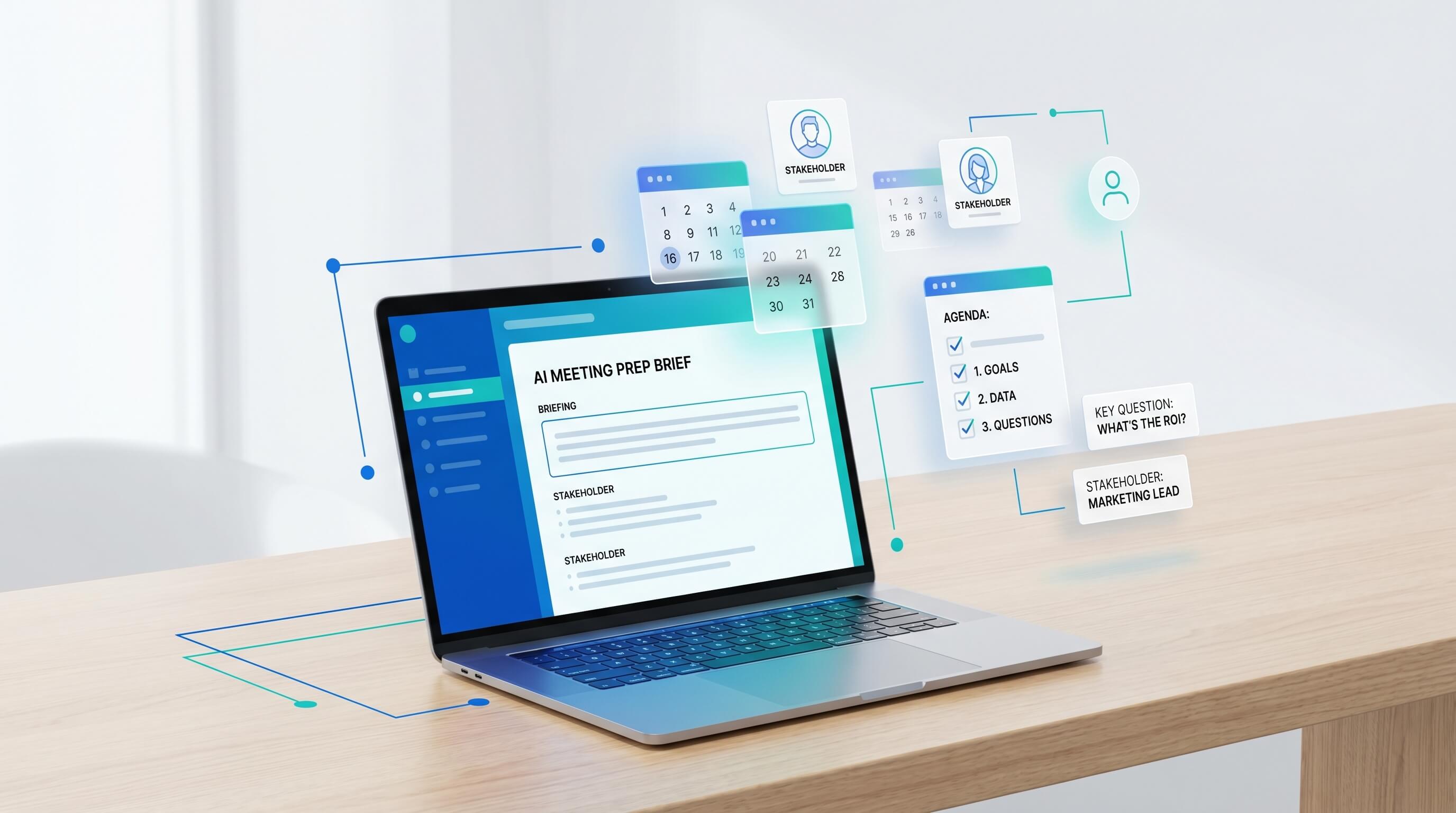
Pourquoi ce prompt est important
Weak meeting prep wastes attention twice: first in the meeting, then in the cleanup after nobody leaves with a clear decision. A structured brief helps you surface hidden stakeholder tension, ask better questions, and protect important outcomes before the conversation drifts into status updates.
À quoi nous l'utilisons
Use this prompt when you have a client call, internal review, stakeholder alignment meeting, or board prep session coming up fast and your context is scattered across notes, Slack threads, email fragments, and half-written agendas.
Prompt
Role: Act as a chief of staff preparing an executive for an upcoming meeting.

Context: I will give you the meeting title, attendees, my role, the agenda if I have one, recent context from email or chat, known sensitivities, and the outcome I want. Some of the material may be incomplete, messy, or contradictory.

Task: Create a decision-ready meeting brief that helps me walk into the meeting prepared in under five minutes.

Constraints:
- Use only the information provided. If something is missing, label it as an assumption or an open question.
- Do not invent company facts, metrics, or people.
- Prioritize what is actionable before the meeting, during the meeting, and immediately after.
- Highlight political or stakeholder risks if the context suggests them.
- Keep the brief concise but specific.
- If the agenda is weak, suggest a sharper structure.
- If any attendee likely has different incentives, call that out.

Output Format:
1. Meeting Snapshot
   - Meeting title: [MEETING TITLE]
   - Date/time: [DATE/TIME]
   - My role: [YOUR ROLE]
   - Desired outcome: [DESIRED OUTCOME]

2. Who Is in the Room
   - For each attendee: likely priorities, influence level, and what they may care about most

3. What Matters Most
   - Top 3 issues likely to shape the conversation
   - Why each issue matters now

4. Recommended Opening
   - A 30-second opener I can actually say

5. Questions to Ask
   - 5 to 7 sharp questions in priority order

6. Risks and Tensions
   - Misalignment risks
   - Topics to avoid or handle carefully
   - Assumptions that need confirmation

7. Decision Paths
   - Best-case outcome
   - Acceptable fallback
   - Walk-away condition

8. Follow-up Checklist
   - Immediate next steps, owners, and deadlines

Input to use:
- Meeting title: [MEETING TITLE]
- Date/time: [DATE/TIME]
- My role: [YOUR ROLE]
- Desired outcome: [DESIRED OUTCOME]
- Attendees: [ATTENDEES]
- Agenda: [AGENDA]
- Background context: [PASTE EMAILS/NOTES/CHAT]
- Known sensitivities: [SENSITIVITIES]
- Constraints: [TIME/POLITICAL/TECHNICAL CONSTRAINTS]
Résultat
Meeting Snapshot - Meeting title: Q3 renewal and expansion review with Northstar Health - Date/time: Tuesday, 10:00 AM - My role: VP of Customer Success - Desired outcome: Secure a 12-month renewal, protect pricing, and gain verbal alignment on expanding analytics seats in Q4
Who Is in the Room - Dana Lewis, CIO: Final internal recommender. Cares about reliability, compliance posture, and whether your team can support rollout without creating operational noise. High influence. - Mark Feldman, Procurement Lead: Focused on discount pressure and contract terms. Medium-to-high influence because he can slow the deal even if he cannot kill it alone. - Priya Shah, Director of Data Operations: Day-to-day champion. Wants better dashboard performance and faster support escalation. High practical influence because her team lives with the product.
What Matters Most 1. Pricing pressure. Procurement will likely frame market softness as justification for a discount. This matters now because once the conversation anchors on price, it is hard to move back to value. 2. Product trust. Priya’s team experienced two slow-report incidents last quarter. If not addressed early, that history will weaken any expansion ask. 3. Expansion timing. The analytics seat expansion is plausible, but only if Dana believes the adoption plan is controlled and low-risk.
Recommended Opening "Thanks for making time. I’d like to use this session to confirm what Northstar needs from the next 12 months, address the reporting issues directly, and see whether we have the right conditions to expand analytics access without adding rollout risk."
Questions to Ask 1. Since the reporting incidents, what concerns are still unresolved for your team? 2. Which renewal outcome would make this feel like a strong decision internally? 3. Where do you expect the biggest adoption bottlenecks if analytics seats expand in Q4? 4. What would procurement need to see beyond price to move quickly? 5. Which success metrics matter most to Dana over the next two quarters? 6. Are there compliance or change-management concerns that would block a broader rollout?
Risks and Tensions - Dana may support the product strategically while still asking Priya to prove operational readiness. - Procurement may use the incident history to seek concessions beyond standard discount bands. - Assumption to confirm: Priya is still willing to act as internal champion if support commitments are tightened.
Decision Paths - Best case: renewal confirmed at near-current pricing with a Q4 expansion plan tied to a success checkpoint. - Acceptable fallback: renewal closes now, expansion deferred pending a 60-day performance review. - Walk-away condition: customer demands pricing terms that create an unhealthy precedent without a meaningful scope commitment.
Follow-up Checklist - Send a written support-improvement summary by end of day, owner: VP Customer Success - Share a phased adoption plan for analytics seats by Thursday, owner: Solutions Architect - Confirm procurement redlines and approval timeline within 48 hours, owner: Account Executive
La plupart des réunions ne ratent pas parce qu’il manque une agenda. Elles ratent parce que la personne qui entre dans la salle n’a pas anticipé la vraie conversation.
Ce Prompt répond précisément à ce problème. Vous donnez au modèle un ensemble désordonné de participants, de points d’agenda incomplets, d’e-mails récents et du résultat visé. Il produit alors un brief structuré qui fait ressortir les intérêts en jeu, les points de friction probables, une meilleure ouverture et les questions qui peuvent réellement faire avancer une décision.
La structure du Prompt est essentielle. La partie Role pousse le modèle à raisonner comme un chief of staff plutôt que comme un assistant générique. La partie Context accepte des informations incomplètes, ce qui reflète la réalité de la préparation d’une réunion. Les Constraints limitent les hallucinations et obligent le modèle à distinguer les faits, les hypothèses et les questions ouvertes. Enfin, l’Output Format maintient le résultat court et exploitable sous pression.
Ce qui rend ce Prompt utile, c’est qu’il fait plus qu’un simple résumé. Il vous aide à voir la dynamique de la pièce avant d’y entrer. C’est particulièrement précieux pour les réunions de renouvellement client, les revues de direction, les sessions de planification inter-équipes et toutes les réunions où les participants n’ont pas les mêmes intérêts.
Si vous ne deviez conserver qu’un seul Prompt de travail à réutiliser chaque semaine, celui-ci serait un très bon choix. Il réduit le temps de préparation, améliore la qualité des questions et facilite le suivi, car les trajectoires de décision sont déjà posées.