20 accroches qui font stopper le scroll — un générateur de déclencheurs psychologiques
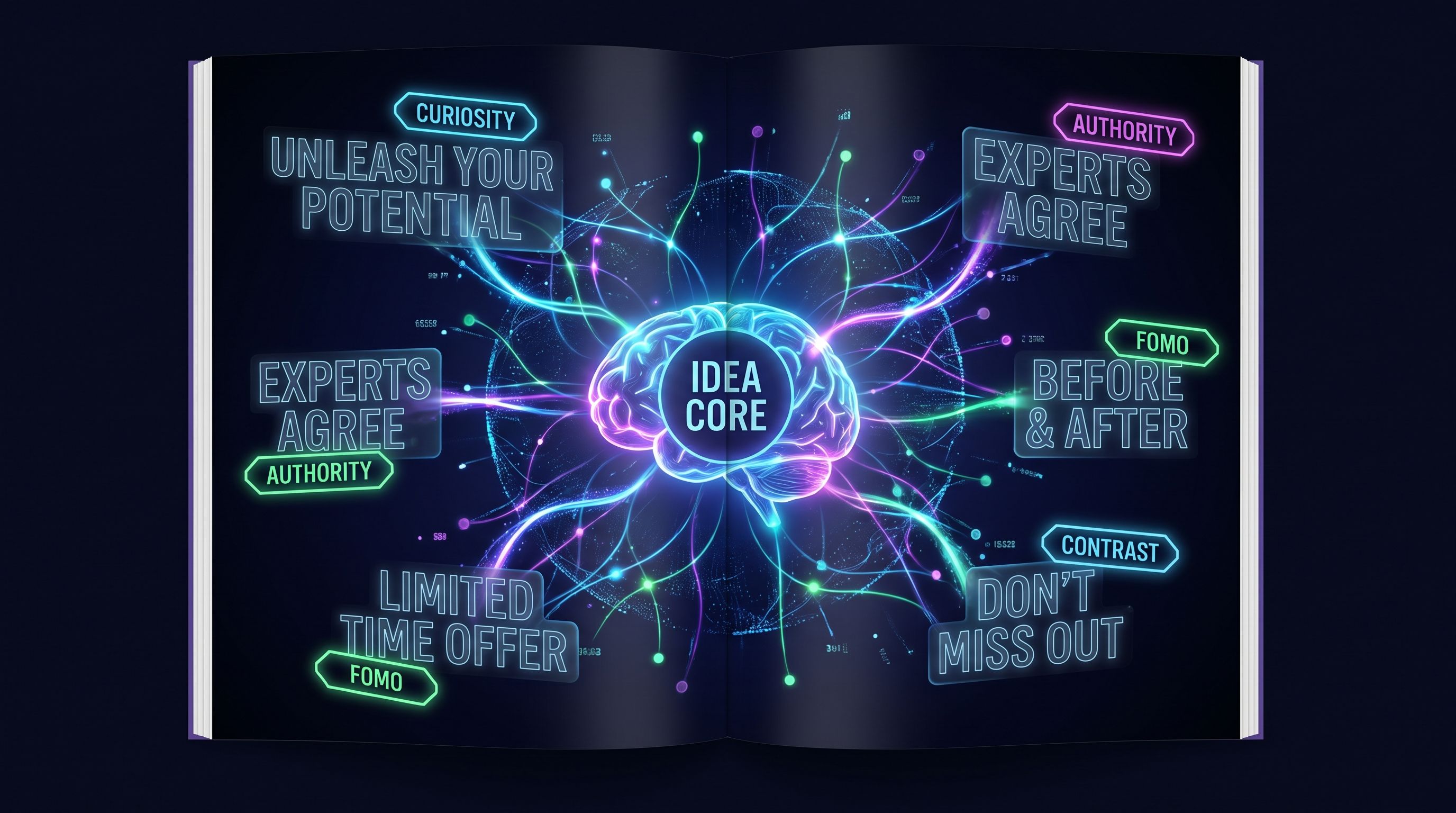
Pourquoi ce prompt est important
Most content creators reuse the same 2–3 hook patterns until their audience goes numb. The real failure happens before the first paragraph: a hook that doesn't match how attention actually works means the content never gets read, no matter how good it is. Without labeling the psychological trigger behind each line, you can't learn what actually resonates with your specific audience — you're just guessing repeatedly. This prompt forces variety across 20 distinct mechanisms and teaches you the science behind each one.
À quoi nous l'utilisons
You have a new piece of content to publish — a LinkedIn post, YouTube video, newsletter issue, or blog — and you need to test multiple angles before committing to one. You know the topic cold but can't find the angle that will actually make someone stop scrolling. Paste in your topic, audience, platform, and goal and get 20 distinct, psychologically-grounded hooks ready to evaluate.
Prompt
Act as a world-class content strategist and copywriter who specializes in attention psychology and viral content mechanics.

Context: I'm creating content for [PLATFORM: e.g., LinkedIn / Twitter-X / YouTube / Newsletter] targeting [TARGET AUDIENCE: e.g., "B2B SaaS founders", "fitness beginners over 40", "junior developers"]. The topic I want to write about is: [TOPIC OR MAIN IDEA].

My goal: [CONTENT GOAL: e.g., "drive newsletter signups", "get shares from peers", "position myself as an expert", "sell a course"].

Task: Generate exactly 20 hooks for this topic. Each hook must be distinct — no two hooks may use the same psychological trigger or structural pattern.

For each hook:
1. Write the hook (1–2 lines, punchy and complete)
2. Label the psychological trigger it uses
3. Rate its estimated emotional intensity (Low / Medium / High)

Psychological triggers to draw from (mix these, do not repeat):
Curiosity gap, Pattern interrupt, Social proof, Authority, Loss aversion, Specificity, Contrarian take, Before/after transformation, Controversy, FOMO, Insider knowledge, Aspirational identity, Shock/surprise, Story hook, Problem agitation, Counter-intuitive truth, Status appeal, Empathy/shared pain, Humor, Urgency

Constraints:
- No hooks longer than 2 sentences
- At least 4 hooks must use numbers or specific data points
- At least 3 hooks must be contrarian or challenge a common assumption
- Hooks must feel native to [PLATFORM] — not copied from a different medium
- Do NOT use the phrases "Are you tired of..." or "Most people don't know..."

Output format:
Hook #[N]
[Hook text]
Trigger: [name]
Intensity: [Low/Medium/High]
---

After all 20 hooks, add a section called "TOP 3 PICKS" recommending the 3 hooks most likely to perform best for my stated goal, with 1–2 sentences explaining why each made the list.
Résultat
Example run: Topic: "Why most productivity advice backfires for developers" | Platform: LinkedIn | Audience: Senior software engineers | Goal: Build thought leadership
Hook #1
Senior developers don't have a time management problem. They have a context-switching tax that productivity gurus have never experienced.
Trigger: Contrarian take
Intensity: High
Hook #2
I tracked every interruption in my workday for 30 days. Average deep work session: 11 minutes. Then I changed one meeting rule.
Trigger: Story hook + Specificity
Intensity: Medium
Hook #3
The GTD system was designed for a knowledge worker in 1992. Your codebase wasn't.
Trigger: Pattern interrupt
Intensity: Medium
Hook #4
Every "10x developer" tip I ignored for years turned out to be real. Here's the one that actually scaled.
Trigger: Authority + Curiosity gap
Intensity: High
Hook #5
Pomodoro timers are productivity theater. A 25-minute session is exactly long enough to get into flow — and then break it.
Trigger: Controversy
Intensity: High
Hook #6
The engineers shipping the most code don't work more hours. They've eliminated one category of work entirely.
Trigger: Curiosity gap
Intensity: Medium
Hook #7
We tell junior devs to "time-block." We don't tell them that senior engineers quietly stopped doing it three years ago.
Trigger: Insider knowledge
Intensity: High
Hook #8
What if the reason you're behind on your backlog has nothing to do with your backlog?
Trigger: Problem agitation
Intensity: Medium
... [hooks #9–20 continue with: Before/after transformation, Social proof, Aspirational identity, FOMO, Loss aversion, Urgency, Empathy/shared pain, Counter-intuitive truth, Status appeal, Humor, Shock/surprise, Authority] ...
TOP 3 PICKS for thought leadership goal:
#2 (Story hook + Specificity) — Concrete numbers signal credibility. Engineers respond to data-backed claims; "11 minutes" is memorable and shareable. Comments will pour in from people comparing their own numbers.
#7 (Insider knowledge) — Positions you as a practitioner, not a theorist. The implicit message: "I know what the seniors actually do." This builds the authority your goal requires.
#5 (Controversy) — Contrarian takes on Pomodoro specifically will generate responses from both camps — exactly the engagement that signals LinkedIn's algorithm you're worth amplifying.
Le contenu vit ou meurt par ses deux premières lignes. Peu importe la qualité de l'analyse ou le temps passé à rédiger — si l'accroche ne correspond pas à la façon dont l'attention humaine fonctionne réellement, le contenu ne sera jamais lu.
La plupart des rédacteurs règlent ce problème en improvisant. Ils écrivent trois accroches, choisissent celle qui semble la meilleure et publient. Quelques mois plus tard, ils se demandent pourquoi leur engagement stagne. Le vrai problème: ils recyclent inconsciemment les mêmes 2–3 schémas psychologiques.
Ce qui rend ce prompt différent
Ce prompt génère 20 accroches en exigeant que chacune utilise un déclencheur psychologique différent. Il puise dans 20 mécanismes étiquetés — lacune de curiosité, prise de position contraire, aversion à la perte, connaissance interne — et impose la diversité dans l'ensemble.
Les décisions de conception
La section Role établit une intersection spécifique d'expertise. Il faut au moins quatre accroches avec des données chiffrées spécifiques. Il faut au moins trois accroches contraires pour éviter de se réfugier dans des angles consensuels.
La section TOP 3 PICKS
Générer 20 accroches est facile; savoir lesquelles des trois utiliser nécessite un jugement sur l'objectif, l'audience et le contexte. Cette section oblige le modèle à appliquer ce jugement explicitement.