Startup Runware builds AI data centers on an assembly line, ships them in 48 hours
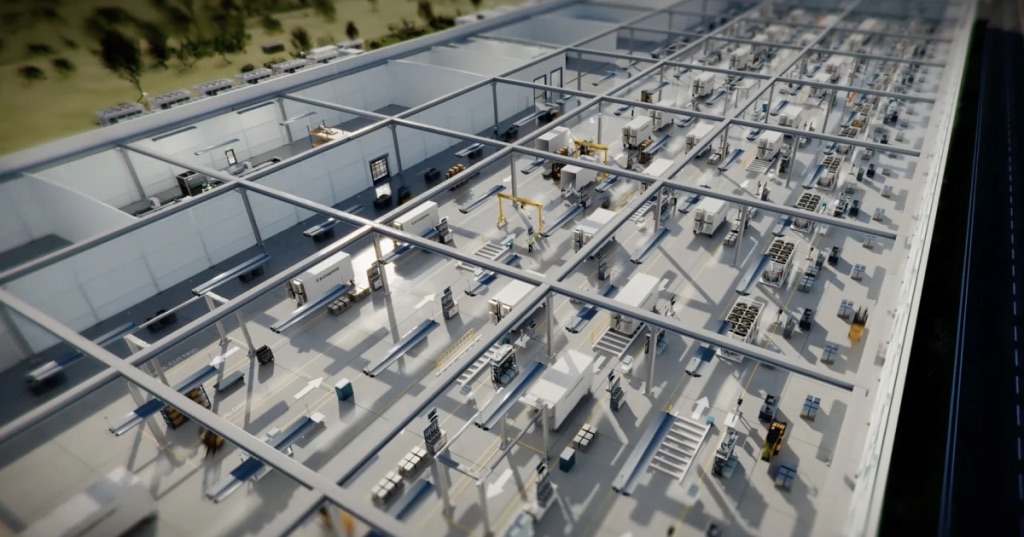
Runware, an AI infrastructure startup based in Romania, has built a factory that assembles data centers the way automakers build cars — on a production line, in standardized modular units, rather than as one-off construction projects. The company's product, called the Sonic Inference Pod, is designed to ship pre-built and go live within 48 hours of arriving on site, down from roughly three weeks when the company started. CEO and co-founder Flaviu Radulescu says Runware has built one factory already and is constructing a second.
The bottleneck Runware is targeting is real and well-documented: AI companies are compute-constrained, and conventional data centers take one to three years to permit and build. Modular, prefabricated data centers aren't a new idea — Crusoe raised $3.9 billion in September to build truck-transportable sites, and Schneider Electric sells prefabricated pods too — but Runware's pitch is that it has actually built a working factory and production line, where Nvidia's recently announced DSX POD and Vera Rubin "AI factory" designs are blueprints for customers to build themselves rather than finished products Nvidia manufactures and ships.
Runware has raised more than $60 million to date, including a $50 million Series A in December 2025 led by Dawn Capital and Comcast Ventures. It's planning a Series B but is funding the factory buildout with the Series A money for now. The company says it has hired a plant manager from the automotive industry to run production alongside its chief of hardware — a deliberate borrowing of car-manufacturing discipline rather than data center construction norms. Its stated targets: 30 megawatts of data center capacity produced per day by 2028 — nearly 1 gigawatt a month — from the Romania factory, a site pipeline of 397 megawatts with potential to reach 1.2 gigawatts, and $1 billion in committed customer interest representing over 20 megawatts of capacity already spoken for.
Technically, the pods use closed-loop liquid cooling with air-cooled radiators, meaning they need no water hookup — a meaningful detail given how much scrutiny data centers face over water consumption in drought-prone regions. They're designed to run quietly up to 86°F ambient temperature and can be configured for different GPU generations on a shared standard chassis. Customers can either rent compute directly or bring their own GPUs and pay Runware a monthly fee for the pod and operations, with power and internet billed separately. Runware says it designs its own systems around widely available components to keep costs down, though it still depends on Nvidia for networking hardware and on German suppliers for pumps and fans — a reminder that even a vertically-integrated manufacturing pitch has outside dependencies it can't fully control.
The obvious comparison, and one the company is aware of, is Arrival — the electric vehicle startup once valued above $13 billion that promised to reinvent vehicle manufacturing with modular "microfactories" and collapsed in 2023 after failing to scale production profitably. Mass-producing hardware is a different discipline from designing it, and Runware's claims about staffing, supply chain reliability, and funding its factory expansion with just a $50 million round are unproven at the scale the company is promising. Runware argues its pods are smaller and faster to site than hyperscaler-sized facilities built by Amazon, Microsoft, and Google, often on properties that already have power access, which sidesteps some of the grid-strain criticism aimed at giant AI data center campuses. The real test comes next year, when the company's second factory is due online and it plans to expand into the US and other regions.
As reported by TechCrunch, Runware has not disclosed the terms or timeline of its planned Series B raise.
در ابتدا توسط TechCrunch گزارش شده است. برای جزئیات بیشتر مقالهٔ اصلی را بخوانید.
مشاهدهٔ منبع اصلی