Un Prompt de matriz de decisión ponderada para elegir mejor en equipo
Por qué importa este prompt
Teams waste weeks revisiting the same decision when criteria are implicit, stakeholders optimize for different goals, and nobody can explain why an option won. A weighted matrix turns vague debate into an auditable decision record and exposes where disagreement actually lives.
Para qué lo usamos
Use this when you need to choose between several real options under time pressure, such as selecting a project management tool, vendor, framework, or job offer, and you want a defensible recommendation instead of gut feel.
Prompt
Role: Act as a senior strategy analyst helping me make a high-stakes decision with a transparent weighted scoring model.

Context: I am deciding between [OPTION 1], [OPTION 2], [OPTION 3], and [OPTION 4] for [DECISION CONTEXT]. The decision matters because [WHY THIS DECISION MATTERS]. My constraints include [BUDGET], [TIMELINE], [TEAM SIZE], and [NON-NEGOTIABLE REQUIREMENTS].

Task: Build a weighted decision matrix that compares the options across the criteria I provide. Use these criteria and weights, adding up to 100: [CRITERION 1 + WEIGHT], [CRITERION 2 + WEIGHT], [CRITERION 3 + WEIGHT], [CRITERION 4 + WEIGHT], [CRITERION 5 + WEIGHT]. Score each option from 1 to 10 on every criterion, explain each score in one or two sentences, calculate weighted totals, rank the options, and recommend the best choice. Then stress-test the recommendation by showing which option would win if the top-weighted criterion changed by plus or minus [SENSITIVITY %].

Constraints: Do not use vague language. If information is missing, list the missing inputs explicitly and make the smallest reasonable assumption. Do not force a tie. Call out hidden risks, second-order effects, and cases where the highest-scoring option may still be the wrong practical choice.

Output Format: 1) Decision summary, 2) assumptions and missing data, 3) weighted decision matrix in table form, 4) ranking with weighted totals, 5) recommendation with rationale, 6) sensitivity analysis, 7) next steps before committing.
Resultado
Decision summary: Based on the weighted matrix, Notion is the strongest fit for a 12-person remote product team choosing a project management platform for the next 18 months. It does not win every category, but it delivers the best overall balance of flexibility, cross-functional collaboration, documentation, and cost. Jira remains the better pure engineering tracker, while Asana is the easiest to adopt quickly, but neither matches Notion's combined score across the broader operating model this team needs.
Assumptions and missing data: I assumed the team needs one shared workspace for product, engineering, design, and operations, with a monthly software budget below $500. I also assumed the company values fast onboarding and documentation quality as much as sprint planning. Missing inputs that would affect the outcome include existing tool lock-in, compliance requirements, and whether the engineering team needs advanced issue hierarchy and release reporting.
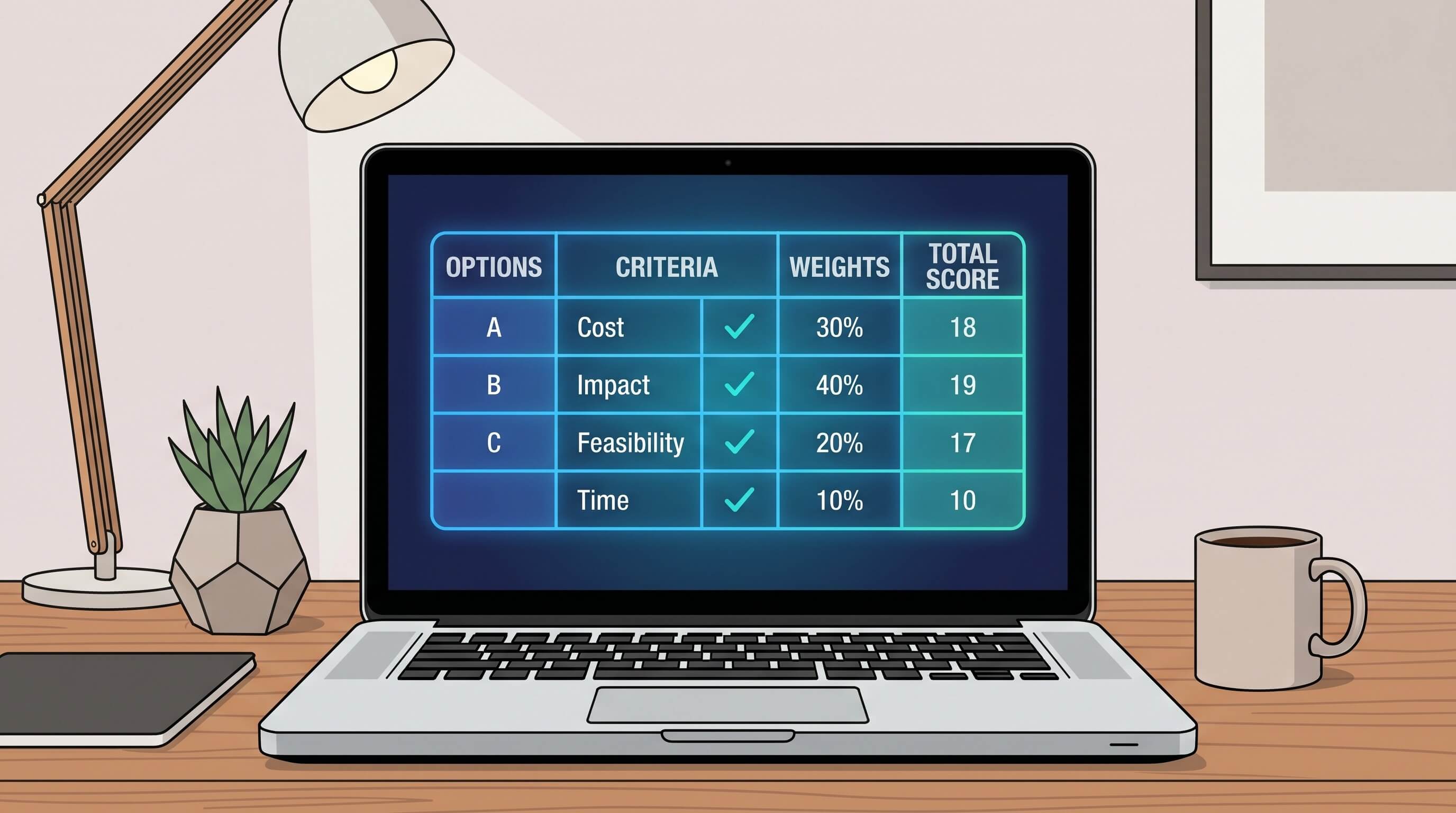
Weighted decision matrix: Criteria were weighted as follows: collaboration and documentation 30, ease of adoption 20, engineering workflow support 20, automation and integrations 15, total cost 15. Notion scored 9, 8, 7, 8, and 9 respectively, producing a weighted total of 8.30. Jira scored 6, 5, 10, 9, and 7 for a total of 7.20. Asana scored 8, 9, 6, 7, and 6 for a total of 7.35. ClickUp scored 7, 6, 7, 8, and 8 for a total of 7.10.
Recommendation with rationale: Choose Notion if the company wants one system that supports planning, documentation, meeting notes, lightweight roadmapping, and cross-team visibility without adding another knowledge base. Its main weakness is deeper engineering workflow structure, so teams with strict release governance may still prefer Jira despite the lower blended score.
Sensitivity analysis: If engineering workflow support rises from 20 to 35, Jira becomes much more competitive and may overtake Notion, especially if the company already uses GitHub and wants stronger issue discipline. If collaboration and documentation fall below 20, Asana also narrows the gap. That means the decision is robust only if the organization truly values a shared operating system over a specialist tracker.
Next steps before committing: Run a two-week pilot with one live project, measure onboarding time, check migration friction, and ask each function to list one blocker that would make the chosen tool fail in practice.
Elegir entre varias opciones buenas es justo donde los equipos pierden tiempo. La conversación parece útil, pero los criterios siguen implícitos, la voz más fuerte empuja el resultado y la decisión se reabre dos semanas después. Este Prompt corrige eso al obligar a poner los tradeoffs dentro de una matriz ponderada que todo el equipo puede revisar.
La estructura importa. La sección Role lleva al modelo al modo analista en lugar de dejarlo en brainstorming genérico. La sección Context define lo que está en juego, las restricciones y los no negociables, para que la recomendación se mantenga anclada a una decisión real de negocio y no a una preferencia abstracta. La sección Task hace el trabajo duro: puntuar cada opción, explicar cada puntuación, calcular los totales ponderados y luego poner a prueba el resultado con sensitivity analysis.
Esa última parte es lo que vuelve valioso este Prompt. Un Prompt de comparación normal te da una lista ordenada. Uno mejor te muestra si la opción ganadora sigue ganando cuando se mueve el criterio más importante. Si un pequeño cambio en el peso altera el resultado, el problema real no es la herramienta ni el proveedor. Es la alineación entre stakeholders.
Este Prompt también evita un fallo común de la AI: respuestas seguras construidas sobre datos faltantes. La sección Constraints obliga al modelo a mostrar huecos de información, hacer la suposición razonable más pequeña posible y señalar casos en los que la opción con mayor puntuación quizá no sea la mejor decisión práctica. Eso se parece más a un decision memo que a una conjetura elegante.
Úsalo para elegir software, tomar decisiones de contratación, revisar agencias, comparar modelos de precios, resolver tradeoffs de roadmap o cualquier otra elección en la que varias alternativas compitan en dimensiones distintas. El resultado se puede pegar en un documento, defender en una reunión y revisar más tarde si cambian las suposiciones.