El Generador de Hojas de Referencia de Personajes: Convierte Una Descripción en un Giro de Tres Vistas
Por qué importa este prompt
Commissioning a professional character turnaround sheet typically costs $150-$400 and takes several days of back-and-forth revision, which is a real bottleneck for a solo developer or small studio that needs a rough but usable reference today to keep pre-production moving, not a final production asset.
Para qué lo usamos
A solo indie game developer has designed an NPC on paper — a dwarf blacksmith with a specific beard, apron, and hammer — and needs a turnaround sheet before handing the character off to a contract artist or feeding it into a 3D modeling reference, without paying for a full commissioned turnaround just to get the project started.
Prompt
Act as a character design assistant specializing in consistent multi-angle reference sheets for game, comic, and animation artists.

Context:
- Character description: [FULL DESCRIPTION — age, build, face, hair, clothing, props, and any distinguishing features like scars or accessories]
- Art style: [E.G. SEMI-REALISTIC PAINTERLY FANTASY GAME ART, CEL-SHADED ANIME, FLAT VECTOR CARTOON, PIXEL ART]
- Intended use: [E.G. GAME NPC SPRITE, COMIC BOOK CHARACTER, ANIMATION RIG REFERENCE, TABLETOP RPG PORTRAIT]

Task:
Generate a single reference sheet image containing three panels of the same character side by side: a front view, a three-quarter view, and a back view. All three panels must show identical proportions, identical clothing and props, and the same art style, so the sheet can be used as a consistency reference during later production work.

Constraints:
- Plain neutral grey or white background with no scenery, props, or set dressing that would distract from the character
- Consistent lighting direction and intensity across all three panels
- Neutral standing pose (not a dynamic action pose) so proportions are easy to read and trace
- No text, labels, or watermarks baked into the image
- If the character has asymmetric details (a scar, a prop held in one hand, an off-center accessory), keep that detail consistent and on the correct side across the front and three-quarter panels

Output format:
One image, three panels arranged left to right in this order: front view, three-quarter view, back view. No additional panels, no text overlay, no border frames between panels beyond natural spacing.
Resultado
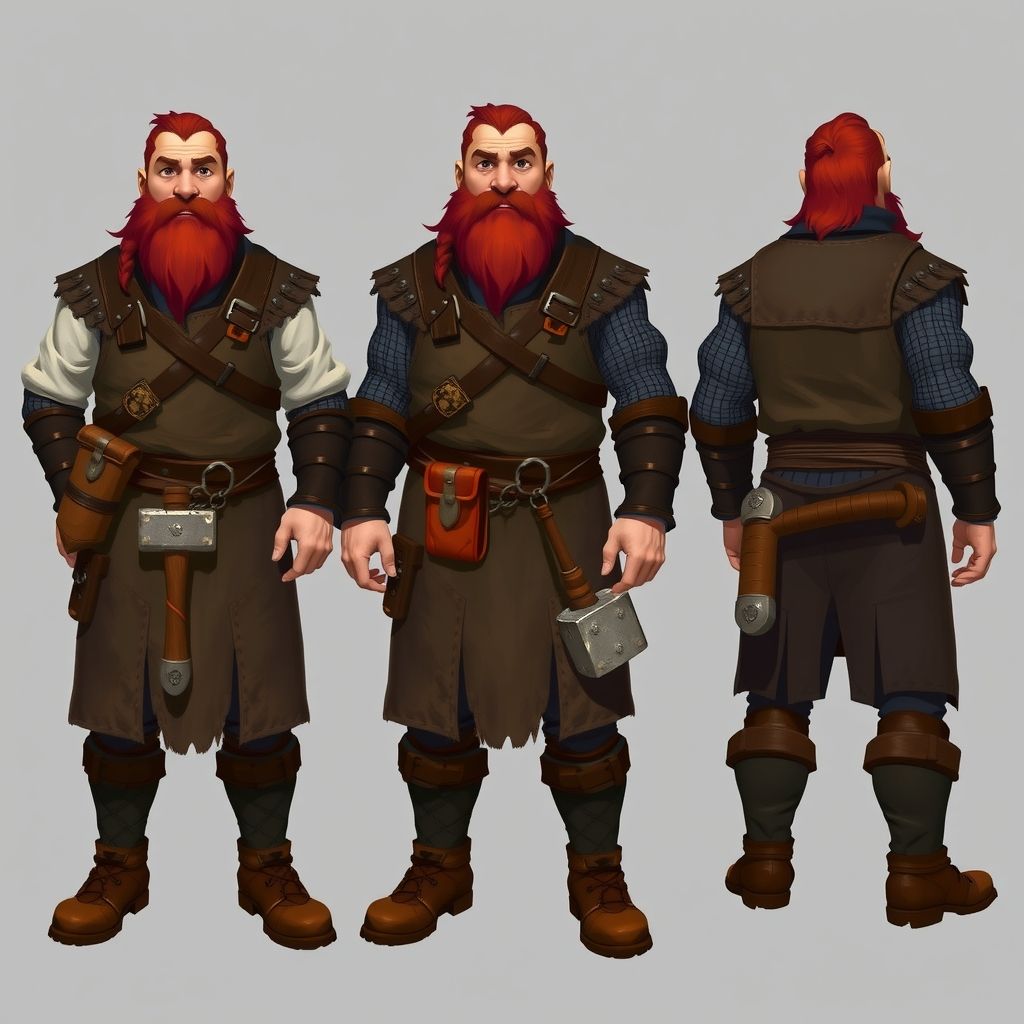
The example output above shows a dwarf blacksmith character — red braided beard, leather apron over chainmail, a battle-worn hammer on the belt — rendered in front, three-quarter, and back views on a neutral grey background, in a semi-realistic painterly fantasy game art style.
The result is genuinely usable as a rough reference: the face, beard, armor pieces, and boots stay recognizably consistent across all three panels, and the back view correctly omits the face while keeping the same silhouette and proportions. It's not perfect — look closely and the hammer has moved from a hip holster in the front panel to a hand-held grip in the three-quarter panel, and the belt pouch position shifts slightly. That's a realistic limitation of single-shot diffusion models asked to hold fine prop placement across multiple views in one image, and it's worth knowing going in: treat the output as a strong starting reference for an artist to clean up, not a pixel-perfect production asset.
Imagen generada
Todo proyecto de videojuego, cómic o animación que involucre un personaje original eventualmente necesita una hoja de giro: el mismo personaje mostrado desde múltiples ángulos, para que un artista, modelador o animador pueda mantener proporciones y detalles consistentes en docenas de dibujos o fotogramas posteriores. Encargar una profesionalmente es práctica estándar, y por buena razón — pero también cuesta entre 150 y 400 dólares y lleva días.
Este prompt genera un giro básico de tres vistas — frontal, tres cuartos, posterior — en una sola imagen, construido específicamente para ser una referencia de trabajo y no un activo terminado.
Por qué tres vistas, no las cinco o seis estándar
Las hojas de giro profesionales suelen incluir cinco o seis ángulos más primeros planos de manos, rostro y props clave. Pedirle a un modelo de imagen de una sola pasada tantas vistas consistentes en una generación produce de forma fiable desviaciones — las proporciones y detalles se degradan cuanto más paneles metes en una sola salida. Tres vistas — frontal, tres cuartos, posterior — es el mínimo que realmente permite a un artista inferir el volumen y la silueta del personaje desde la mayoría de los ángulos.
Por qué importan las restricciones de fondo y pose
El trabajo completo de un giro de personaje es hacer que el personaje sea fácil de referenciar, lo que significa que todo lo demás en el cuadro es ruido. Los escenarios, poses dinámicas e iluminación dramática son exactamente lo que quieres en una ilustración terminada y exactamente lo que hace que una hoja de referencia sea más difícil de usar realmente.
Qué esperar realmente
Los modelos de difusión de una sola pasada son buenos manteniendo el rostro, color y silueta general del personaje consistentes entre paneles en una generación. Son notablemente menos fiables manteniendo consistente la posición de props pequeños — qué mano sostiene un objeto, exactamente dónde se sitúa una bolsa o hebilla — entre las tres vistas. Eso no es un fallo de redacción del prompt que se arregle con más adjetivos; es una limitación real de pedirle a una sola llamada de modelo que rastree detalles espaciales finos a través de múltiples puntos de vista simultáneos.
Cómo usar el resultado
Entrega la hoja generada a quien vaya a construir sobre ella — artista contratado, modelador 3D, animador — con una nota explícita sobre qué detalles (si los hay) se desviaron entre paneles.