El redactor de Architecture Decision Record: Documenta cualquier decisión técnica con contexto completo y compensaciones
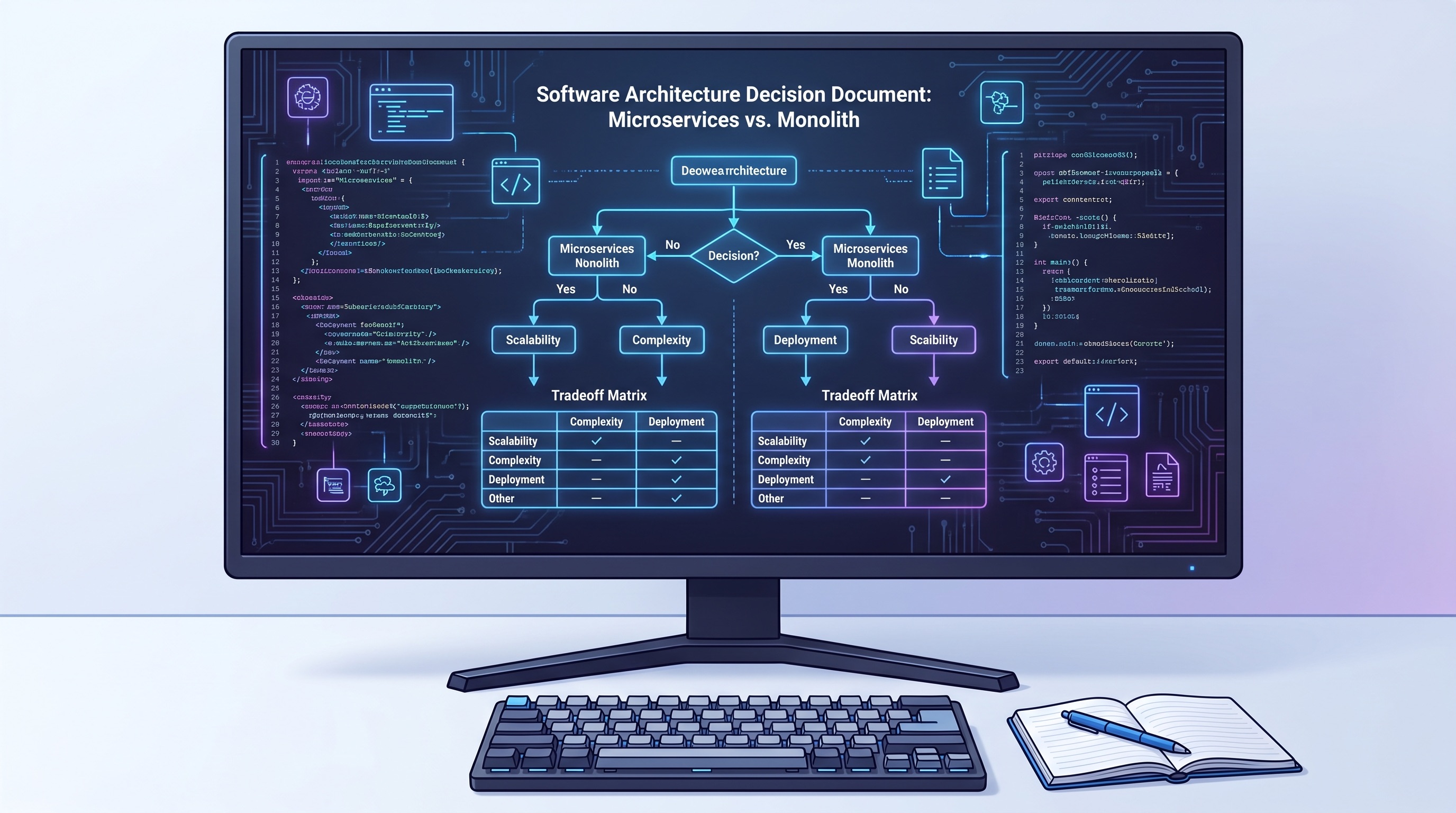
Por qué importa este prompt
Undocumented technical decisions are the single largest source of architectural drift in growing codebases. When the engineers who made a decision leave, their reasoning leaves with them. Future teams reverse correct decisions, repeat past debates, and build on assumptions nobody can verify — costing weeks of engineering time per incident and compounding with every hire who joins without the context.
Para qué lo usamos
Your team just decided to switch your mobile API from REST to GraphQL after a performance review, and the lead architect is leaving for three weeks tomorrow. You need a complete decision record committed to the repo before institutional memory walks out the door.
Prompt
Act as a Staff Software Engineer with extensive experience writing Architecture Decision Records (ADRs) for high-scale production systems.

CONTEXT:
Project/system: [YOUR PROJECT OR SYSTEM NAME]
Team size: [NUMBER] engineers
Current stack: [YOUR CURRENT TECH STACK — e.g., "Node.js, PostgreSQL, AWS, monolithic Rails app"]
Decision date: [DATE]
Decision status: [Proposed / Accepted / Deprecated / Superseded]

THE DECISION:
We have decided to: [STATE THE TECHNICAL DECISION IN ONE SENTENCE — e.g., "adopt GraphQL as our primary API layer, replacing the existing REST endpoints"]

CONTEXT AND PROBLEM STATEMENT:
[Describe in 2-4 sentences the situation that made this decision necessary. What problem were you trying to solve? What constraints were you working within?]

ALTERNATIVES CONSIDERED:
Option A: [ALTERNATIVE 1 NAME]
- Description: [brief description]
- Pros: [what made this attractive]
- Cons: [what ruled it out or made it less preferred]

Option B: [ALTERNATIVE 2 NAME]
- Description: [brief description]
- Pros: [what made this attractive]
- Cons: [what ruled it out or made it less preferred]

Option C (chosen): [YOUR CHOSEN APPROACH]
- Description: [brief description]
- Why chosen: [the decisive factors]

KNOWN RISKS OR CONSEQUENCES:
[List 2-4 anticipated consequences of this decision — both positive and negative. Include technical debt created, new capabilities unlocked, things that will become harder, and any reversibility concerns.]

TASK:
Write a complete Architecture Decision Record following the Michael Nygard format with these sections:
1. Title (ADR-[NUMBER]: [brief decision title])
2. Status ([Proposed/Accepted/Deprecated/Superseded])
3. Context (the situation and problem)
4. Decision (what was decided and the core rationale)
5. Alternatives Considered (structured comparison table)
6. Consequences (positive, negative, and neutral outcomes)
7. Compliance (how to verify this decision is being followed)
8. Notes (links to related ADRs, tickets, or documentation)

CONSTRAINTS:
- Keep the Decision section under 150 words — it should be scannable, not exhaustive
- Use plain, precise language that a new team member joining in 18 months will understand without context
- Do not hedge or write in passive voice — use active, declarative statements
- If the decision has an obvious sunset condition or review date, include it

OUTPUT FORMAT:
Markdown, suitable for committing to a /docs/decisions/ folder. Use ## for section headers. Include a metadata block at the top with date, deciders, and technical story link.
Resultado
# ADR-024: Adopt GraphQL as Primary API Layer, Replacing REST Endpoints

**Date:** 2026-06-15
**Status:** Accepted
**Deciders:** Elena Vasquez (Staff Eng), James Park (Backend Lead), Sarah Chen (Mobile Lead)
**Technical Story:** ENG-4821 — API Layer Modernization Q3 2026

---

## Context

Our REST API has grown to 87 endpoints over four years, with the mobile clients over-fetching an average of 3.2x the data they use per screen. The iOS team reports that the checkout screen alone requires seven sequential API calls, creating 1.4s of latency on 4G connections. Adding the new wishlist feature would require three additional endpoints and two new response shapes, extending a pattern we cannot sustain.

## Decision

We adopt GraphQL as the primary API layer for all new features starting Q3 2026. Existing REST endpoints remain in place and will be migrated opportunistically over 12 months, with checkout and product detail prioritized first. We use Apollo Server 5 with Prisma as the ORM bridge, and Apollo Client on both iOS and Android.

## Alternatives Considered

| Option | Pros | Cons | Verdict |
|---|---|---|---|
| Extend REST with BFF layer | Low risk, team knows it | Adds another service to maintain; doesn't fix over-fetching structurally | Rejected |
| gRPC | Strong typing, excellent performance | Requires protobuf tooling on mobile; poor browser support for direct calls | Rejected |
| GraphQL (chosen) | Solves over-fetching at the protocol level; strong mobile client libraries; enables schema-driven development | Learning curve for 4 engineers; N+1 query risk requires DataLoader discipline | Accepted |
| REST with sparse fieldsets (JSON:API) | Stays in REST paradigm | Non-standard; tooling fragmented; mobile teams unfamiliar | Rejected |

## Consequences

**Positive:**
- Mobile clients request exactly the fields they need — estimated 60–70% reduction in payload size on high-traffic screens
- Single endpoint for all queries eliminates sequential waterfall calls
- Schema becomes the living documentation of our data model
- Frontend and mobile teams can iterate on data requirements without backend deploys

**Negative:**
- Four engineers need GraphQL training (Q3 2026, estimated 3 days each)
- N+1 query problems require DataLoader implementation discipline — new code review checklist item added
- GraphQL introspection must be disabled in production (security requirement, ENG-4899)
- REST endpoints will exist alongside GraphQL for 12 months, creating dual maintenance burden during migration

**Neutral:**
- Caching strategy changes: REST HTTP caching no longer applies; Apollo's normalized cache and persisted queries replace it
- API documentation moves from Swagger to GraphQL Playground + auto-generated schema docs

## Compliance

Pull requests introducing new API capabilities must use GraphQL. REST additions require explicit sign-off from the API Guild. Schema linting (eslint-plugin-graphql) runs in CI and blocks merge on rule violations.

## Notes

- Related: ADR-019 (API versioning strategy), ADR-022 (mobile client architecture)
- DataLoader patterns: internal wiki at /eng/graphql-dataloader
- Review date: June 2027 — assess migration progress and REST endpoint sunset timeline
Las decisiones técnicas se toman constantemente: qué base de datos usar, si construir o comprar un componente, cómo estructurar una API, cuándo refactorizar versus extender el código existente. La mayoría de estas decisiones se toman con cuidado y luego se olvidan de inmediato. Seis meses después, un nuevo ingeniero pregunta por qué el sistema está estructurado de esa manera. Nadie lo recuerda. El equipo debate las mismas opciones de nuevo. A veces cambian de rumbo, revirtiendo algo que era correcto por razones que ya se han olvidado.
Los Architecture Decision Records (ADRs) son la respuesta de la industria de la ingeniería a este problema. Un ADR es un documento breve y estructurado que captura una decisión técnica significativa: el contexto en el que se tomó, las opciones que se consideraron, las compensaciones involucradas y las consecuencias de la elección. Empresas como AWS, Spotify y ThoughtWorks han publicado prácticas de ADR como estándares. El problema es que escribir un buen ADR desde cero lleva de 30 a 45 minutos y requiere una reflexión cuidadosa sobre qué incluir.
Este prompt hace el trabajo estructural por ti. Proporciona la decisión, las alternativas que consideraste y el contexto clave — y genera un ADR completo y bien razonado que tu equipo puede commit directamente al Repository.
Cuándo usarlo
Usa este prompt inmediatamente después de tomar una decisión técnica significativa, antes de que el contexto se desvanezca. Es especialmente valioso para decisiones difíciles de revertir, que afectarán a futuros miembros del equipo que no estaban en la sala, o que representan una desviación importante de los patrones anteriores en el codebase.
Qué hace efectivo este prompt
La mayoría de los equipos que intentan escribir ADRs lo hacen demasiado tarde (cuando el contexto se ha perdido) o demasiado brevemente (una línea que no comunica nada). Este prompt fuerza la completitud: requiere un estado, consecuencias explícitas y una declaración clara de lo que fue rechazado y por qué. El resultado está suficientemente estructurado para ser commiteado directamente en una carpeta /docs/decisions/ y ser recuperado por futuros ingenieros mediante búsqueda.
Adaptación del resultado
El prompt utiliza el formato ADR de Michael Nygard — el estándar más adoptado — pero puedes indicarle que siga el formato MADR (Markdown Architectural Decision Records) o la plantilla personalizada de tu equipo agregando una instrucción de formato. Para decisiones muy grandes con muchas alternativas, divide el prompt en dos llamadas: una para explorar las compensaciones y otra para escribir el registro final.