Constructor de Matriz de Decisiones para Cualquier Elección Importante
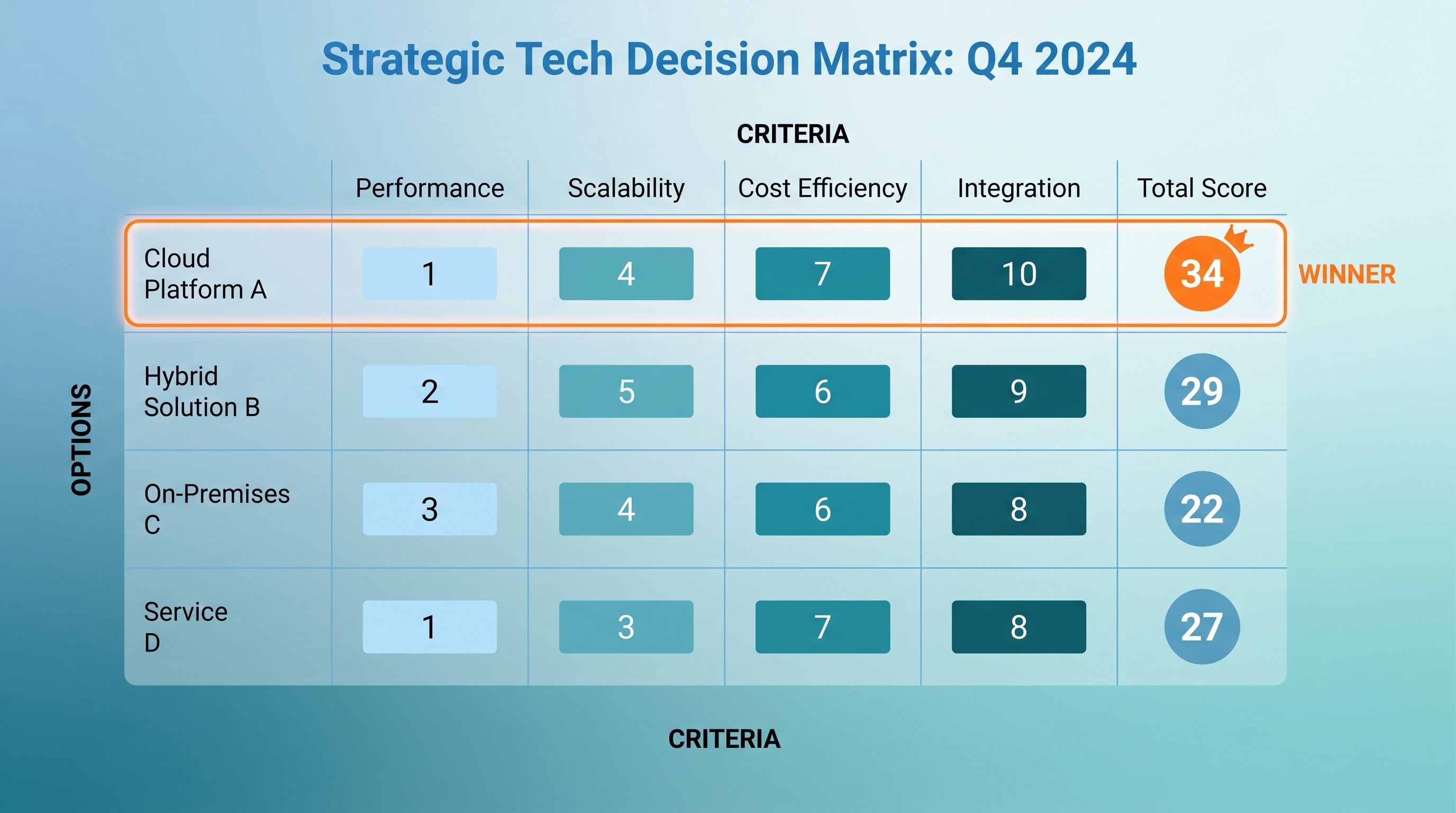
Por qué importa este prompt
Most people make complex decisions on gut feel, which introduces cognitive biases like anchoring (over-weighting the first option seen) and recency bias (favoring the last option considered). A weighted scoring matrix forces you to define what matters before you evaluate options, separating criteria-setting from scoring — the same technique used in formal procurement, engineering design reviews, and McKinsey-style strategy work. The result is a defensible, documented decision you can explain to a team.
Para qué lo usamos
Use this prompt when you are facing a significant decision with multiple options and competing priorities — choosing a new tech stack, picking a vendor, deciding between job offers, evaluating business strategies, or selecting among product features to build next quarter.
Prompt
Act as a senior strategy consultant who specializes in structured decision-making frameworks.

I need to make a major decision and want to use a weighted scoring matrix to evaluate my options objectively.

My decision: [DESCRIBE YOUR DECISION IN 1-2 SENTENCES]

My options:
1. [OPTION A]
2. [OPTION B]
3. [OPTION C]
(Add more if needed)

My criteria for evaluating these options (list what matters most):
- [CRITERION 1, e.g. cost]
- [CRITERION 2, e.g. implementation time]
- [CRITERION 3, e.g. team capability]
- [CRITERION 4, e.g. long-term scalability]
(Add or remove criteria as needed)

Constraints and context:
- [ANY HARD CONSTRAINTS — e.g. budget cap, deadline, must-have features]
- [RELEVANT CONTEXT — e.g. team size, current situation, strategic goals]

Do the following:
1. Review my criteria and suggest adjustments if any important factor is missing or if two criteria overlap significantly.
2. Ask me to assign weights to each criterion (1-5, where 5 = most important) — or assign sensible weights yourself based on the context I provided and explain your reasoning.
3. Score each option against every criterion on a scale of 1-10.
4. Calculate the weighted score for each option (score × weight, summed).
5. Present a clean scoring table with: criteria | weight | scores per option | weighted scores | totals.
6. Identify the winning option and explain in 2-3 sentences why it scored highest.
7. Flag any minority concern: if the runner-up is close or if the top scorer has a critical weakness, call it out explicitly.

Output format:
- Start with the scoring table (use markdown table formatting)
- Follow with a 3-paragraph analysis: winner rationale, key tradeoffs, one risk to watch
Resultado
Scoring Matrix: Cloud Provider for Our SaaS Product
| Criterion | Weight | AWS | GCP | Azure | AWS x W | GCP x W | Azure x W |
|---|---|---|---|---|---|---|---|
| Cost at scale | 5 | 7 | 8 | 6 | 35 | 40 | 30 |
| ML/AI tooling | 4 | 8 | 9 | 7 | 32 | 36 | 28 |
| Team familiarity | 5 | 9 | 5 | 6 | 45 | 25 | 30 |
| Enterprise support | 3 | 9 | 7 | 9 | 27 | 21 | 27 |
| Vendor lock-in risk | 3 | 5 | 6 | 5 | 15 | 18 | 15 |
| TOTAL | 20 | 154 | 140 | 130 |
Winner: AWS (154 points)
AWS wins primarily because of team familiarity (weight 5), which carries the most points. Ramp-up time for a new platform would cost 3-4 engineering months — a real cost that GCP marginal ML advantage does not offset at your current AI workload scale.
Key tradeoff: GCP leads on ML/AI tooling and is the better long-term bet if AI inference becomes your core product. If your roadmap shifts heavily toward custom model serving in the next 12 months, revisit this matrix with ML tooling weighted at 5 instead of 4 — GCP would likely overtake AWS.
Risk to watch: AWS scored lowest on vendor lock-in risk across all three providers. Before committing, audit which AWS-specific services you plan to use. If the answer includes proprietary services like Lambda, DynamoDB, and SageMaker together, your vendor dependency compounds fast.
Deja de tomar decisiones importantes por instinto
Toda decisión importante tiene el mismo problema: demasiadas opciones, demasiados criterios y un cerebro programado para tomar atajos. Sopesas opciones mentalmente, te dejas influir por la última que consideraste y terminas eligiendo algo que no puedes defender con claridad.
La matriz de decisión ponderada es una de las herramientas más antiguas y confiables en la toma de decisiones estructurada — utilizada durante décadas en licitaciones gubernamentales, revisiones de diseño de ingeniería y consultoría de gestión. Este prompt lleva ese framework directamente a Claude.
Qué hace el prompt
Describes tu decisión, listas tus opciones y especificas los criterios que importan. La IA primero audita tus criterios en busca de vacíos o superposiciones, luego asigna pesos, puntúa cada opción, calcula la matriz y entrega una tabla con puntuaciones más un análisis de tres párrafos: justificación del ganador, tradeoffs clave y un riesgo a vigilar.
El paso de definición de restricciones es deliberado. Al definir los pesos antes de ver las puntuaciones, evitas retroingeniería de los criterios para favorecer una respuesta predeterminada — un fallo común en los procesos de decisión informales.
Cuándo usarlo
- Elegir una plataforma tecnológica o proveedor
- Evaluar ofertas de trabajo o cambios de carrera
- Seleccionar características de producto para el siguiente sprint o trimestre
- Comparar estrategias de negocio o enfoques de go-to-market
- Cualquier decisión donde necesites una justificación documentada para un equipo o stakeholder
Funciona mejor con
Claude Sonnet 4.6 maneja bien la salida estructurada y el razonamiento en múltiples pasos. GPT-4o es una alternativa sólida. Para decisiones con más de cinco criterios o seis opciones, considera dividir el análisis en dos pasadas: primero la ponderación de criterios, luego la puntuación.