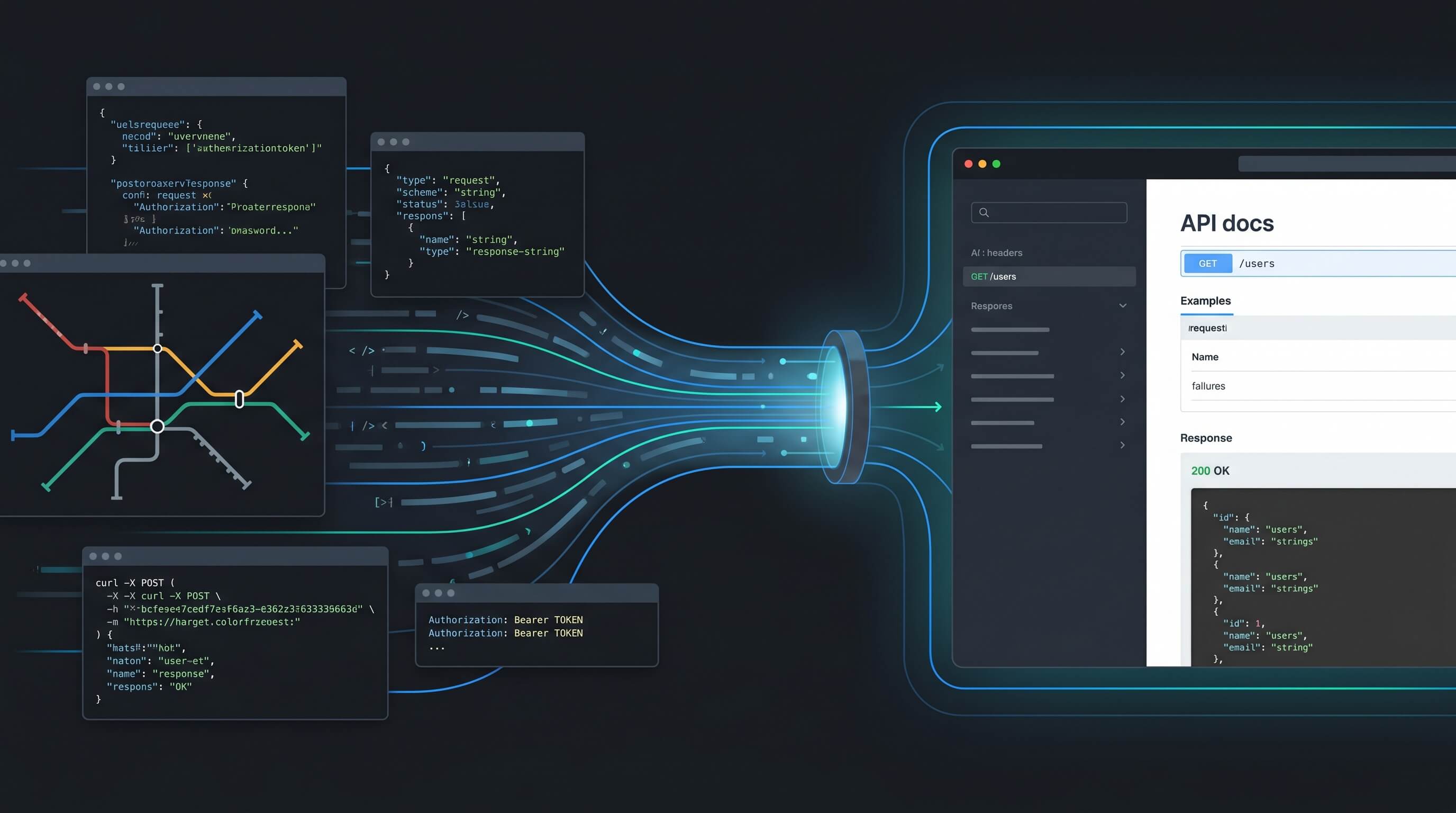
Los ingenieros pueden generar documentación de API directamente desde el código del endpoint
Por qué importa este prompt
Engineering teams often ship endpoints faster than they document them, which leaves frontend developers, partners, QA, and new teammates relying on source code to understand basic usage. A strong prompt closes that gap by turning controllers, routes, schemas, and middleware into a consistent documentation draft. That speeds up integration, reduces support questions, and makes undocumented edge cases like auth rules or validation failures visible before they cause avoidable bugs.
Para qué lo usamos
Turning endpoint implementations into reusable API documentation with parameters, authentication requirements, validation rules, error cases, and copy-pasteable curl examples.
Prompt
Act as a senior API technical writer and backend engineer. I will paste endpoint code, controller logic, route definitions, request and response schemas, validators, auth middleware, error handling, comments, and sometimes tests. Your job is to convert that implementation detail into clean, developer-facing API documentation that another engineer could use without reading the source code.

Return your answer in exactly these sections:
1. Endpoint Summary
2. HTTP Method and Path
3. What This Endpoint Does
4. Authentication Requirements
5. Request Headers
6. Path Parameters
7. Query Parameters
8. Request Body Schema
9. Validation Rules and Constraints
10. Success Response
11. Error Responses
12. Example cURL Request
13. Example Success Response JSON
14. Implementation Notes and Assumptions

Rules:
- Base the documentation only on the code and context provided. Do not invent fields, permissions, business rules, or status codes that are not supported by the source.
- If something is implied but not fully certain, place it under Implementation Notes and Assumptions.
- Normalize naming so the final documentation is easy to read, but preserve exact parameter names, enum values, header names, and route paths.
- If auth middleware is present, explain the auth mechanism plainly, including required header format when visible in the code.
- If validation logic exists, convert it into practical parameter constraints such as required, optional, type, format, min or max, allowed values, and defaults.
- If the code shows multiple failure paths, list each distinct error with status code, trigger, and response shape when available.
- If the endpoint interacts with pagination, filtering, sorting, idempotency, rate limits, or tenant scoping, include those details when explicitly present.
- Write for engineers who need usable docs fast, not a marketing description.
- Keep the output concise but implementation-ready.

Source code and related context:
[PASTE CODE HERE]
Resultado
La documentación de API suele quedarse atrás respecto al código que realmente se publica. Un equipo backend añade una ruta nueva, actualiza la validación, cambia un requisito de autenticación o introduce un nuevo camino de error, pero la documentación sigue incompleta o desactualizada. Eso crea un problema muy común en los equipos de ingeniería: la gente tiene que leer controladores, esquemas y middleware solo para responder preguntas básicas de integración.
Este prompt está diseñado para convertir esos detalles de implementación en documentación útil rápidamente. En vez de pedir un resumen vago, obliga al modelo a seguir una estructura concreta: resumen del endpoint, método y ruta, autenticación, headers, parámetros, esquema del request, reglas de validación, respuesta exitosa, errores y un ejemplo de cURL. Esa estructura importa porque coincide con las preguntas exactas que suelen tener frontend, QA, partners y redactores técnicos.
Además, el prompt reduce el riesgo de alucinaciones al indicar que la salida debe basarse solo en el código proporcionado y que los puntos dudosos deben ir a una sección de supuestos. Eso es especialmente importante en trabajo de API, donde inventar un campo o un código de estado vuelve la documentación peor que inútil. Al separar detalles confirmados de notas inferidas, el resultado se mantiene práctico y más seguro de reutilizar.
Otra razón por la que funciona es que traduce patrones de código de bajo nivel a lenguaje orientado al desarrollador. El middleware se convierte en una explicación clara de la autenticación. La lógica de validación se convierte en restricciones legibles para parámetros. Las ramas de error se convierten en fallos documentados con códigos y disparadores probables. Las pruebas y definiciones de rutas sirven como evidencia de apoyo para ejemplos y comportamiento.
Bien usado, este prompt puede ayudar a crear documentación interna más rápido, mejorar el handoff entre backend y frontend y producir un mejor primer borrador para referencias de API externas sin empezar desde cero.