Usa este Prompt de IA para afinar tu posicionamiento frente a competidores reales
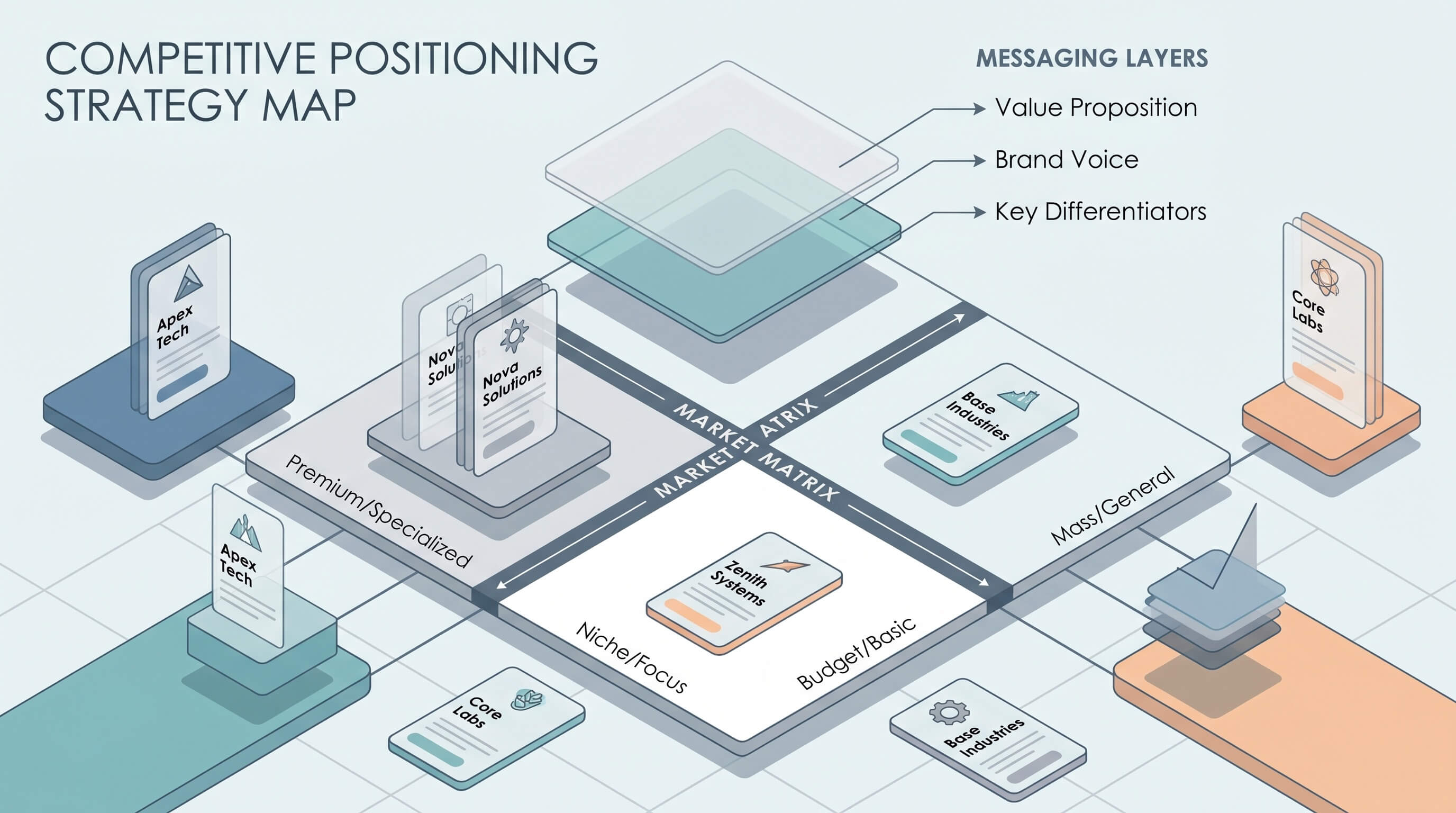
Por qué importa este prompt
Weak positioning quietly burns money. It makes paid campaigns more expensive, lengthens sales cycles, and pushes teams into generic claims that sound interchangeable with every other SaaS landing page. A strong prompt helps teams expose fake differentiation early, tighten the message, and give sales a sharper story before they waste another quarter testing vague copy.
Para qué lo usamos
You are about to update your homepage and sales deck before a launch, but your team cannot agree on what makes the product different. A founder thinks the main angle is speed, sales thinks it is lower cost, and product thinks the win is deeper workflow coverage. You need a single prompt that can turn competitor notes, pricing context, and current messaging into a structured positioning teardown you can review in one meeting.
Prompt
Role: Act as a senior product marketing strategist and competitive intelligence lead who helps companies sharpen positioning against real competitors.

Context: I need to compare my product against competing options in a way that is practical for strategy, sales, and messaging decisions. I do not want a shallow feature checklist. I need a structured teardown that shows where each competitor is strongest, where my messaging is weak or generic, what buyer each product is really optimized for, and how we should reposition based on the evidence.

Task: Analyze the product information I provide for my company and up to three competitors. Build a competitive positioning teardown that compares them on audience, promise, differentiation, pricing logic, strengths, weaknesses, implementation friction, and message clarity. Identify where my product is overclaiming, underselling, or blending into the market. Then recommend a sharper positioning strategy, a cleaner message hierarchy, and 3 to 5 concrete angles that sales or marketing can use immediately.

Constraints:
- Do not default to saying every product serves a “different audience” unless the evidence clearly supports that.
- Challenge vague claims such as “easy to use,” “AI-powered,” “enterprise-ready,” or “all-in-one” if they are not meaningfully differentiated.
- If the product inputs are incomplete, state the assumptions you are making and show how they affect the recommendation.
- Separate real differentiation from feature parity.
- Consider buyer risk, switching cost, deployment complexity, and trust signals, not just product features.
- If my product is not actually differentiated, say so clearly and explain what would need to change.
- Keep important business terms such as ICP, ROI, API, SLA, onboarding, compliance, and integration in English when useful.
- Make the output practical enough that a PMM, founder, or sales lead could use it this week.

Output Format:
1. Competitive snapshot in 4 to 6 bullet points
2. Positioning matrix table
3. Where each competitor is strongest
4. Where my product is blending in or mispositioned
5. Recommended positioning statement
6. Message hierarchy: headline, subhead, proof points
7. Sales-ready talking angles
8. Strategic risks and what could invalidate the recommendation

Inputs:
- My product: [PRODUCT NAME + 1 PARAGRAPH DESCRIPTION]
- Competitor 1: [NAME + DESCRIPTION]
- Competitor 2: [NAME + DESCRIPTION]
- Competitor 3: [OPTIONAL NAME + DESCRIPTION]
- Target buyer / ICP: [WHO BUYS THIS]
- Price range or pricing model: [OPTIONAL]
- Main use cases: [LIST]
- What we currently say about ourselves: [CURRENT POSITIONING OR WEBSITE COPY]
- Known weaknesses or objections: [OPTIONAL]
- Market context: [CATEGORY, TREND, OR BUYING ENVIRONMENT]
Resultado
1. Competitive snapshot - Your product is strongest when buyers care about operational depth and workflow control, but your current messaging hides that advantage behind generic “AI-powered productivity” language. - Competitor A wins the simplicity battle because its homepage makes one promise immediately: faster reporting for lean teams with no setup burden. - Competitor B is the safest choice for enterprise buyers because it signals compliance, admin control, and predictable rollout more clearly than anyone else in the category. - Your biggest positioning problem is not lack of capability. It is that the current message sounds like a broad platform pitch while the actual product is a focused workflow system with better proof points than the headline suggests. - If you keep selling “all-in-one intelligence,” you will continue blending into better-funded vendors with broader product suites and louder brand awareness.
2. Positioning matrix table Your product: Best for operations-heavy mid-market teams that need configurable workflows, deeper integration logic, and faster time-to-useful-output once setup is complete. Weakness: the first impression feels abstract and too broad. Competitor A: Best for small teams that want speed and ease of adoption. Weakness: lighter controls and limited extensibility. Competitor B: Best for large enterprises that prioritize governance and procurement comfort. Weakness: slower rollout and heavier implementation burden. Competitor C: Best for teams buying on feature breadth. Weakness: message sprawl and unclear ROI story.
3. Where each competitor is strongest Competitor A owns immediacy. Its value proposition is concrete, outcome-led, and easy for a buyer to repeat internally. Competitor B owns trust. It signals maturity through security, compliance, admin controls, and implementation predictability. Competitor C owns breadth, which appeals to buyers who want one vendor short-listed for many adjacent use cases.
4. Where your product is blending in or mispositioned The current copy overuses category clichés such as “transform work with AI” and “unify your team in one platform.” Those phrases do not tell the buyer why your product wins against known alternatives. You are underselling the real differentiators: workflow configurability, better handoff between teams, and stronger operational visibility after deployment. Right now the homepage sounds broader than the product actually needs to be, which makes the message weaker, not stronger.
5. Recommended positioning statement [PRODUCT NAME] helps [TARGET BUYER] run high-friction operational workflows with less manual coordination by combining structured automation, configurable review steps, and measurable visibility across the process.
6. Message hierarchy Headline: Built for teams that need operational control, not just another AI wrapper. Subhead: Replace manual coordination with configurable workflows, clearer accountability, and faster time to useful output. Proof points: - Handles multi-step workflows without forcing teams into rigid templates - Connects to existing systems through API and integration hooks - Gives managers visibility into bottlenecks, review load, and turnaround time - Delivers faster operational payback than broader platforms that take longer to implement
7. Sales-ready talking angles First, stop leading with “AI-powered” and lead with the operational problem you remove. Second, position against Competitor A by emphasizing control after onboarding, not just raw feature count. Third, position against Competitor B by showing faster rollout and lower organizational drag. Fourth, equip sales with one customer-proof story that connects workflow pain to measurable ROI, because your product wins when buyers can see the process improvement, not when they hear another platform slogan.
8. Strategic risks and what could invalidate the recommendation This recommendation changes if enterprise governance becomes the dominant buying driver, because Competitor B’s trust posture may outweigh your workflow advantage. It also weakens if your integration story is thinner than the current product team believes. If onboarding still requires heavy services involvement, then promising faster operational impact will create credibility problems quickly.
Muchos equipos creen tener un problema de producto cuando en realidad tienen un problema de posicionamiento. El producto puede ser bueno. El mercado puede estar ahí. Pero el mensaje es blando, genérico o está construido sobre afirmaciones que tres competidores pueden repetir con la misma facilidad. Así es como productos decentes terminan con homepages vagas, decks de ventas confusos y costos de adquisición elevados.
Este Prompt está diseñado para esa situación exacta. Le indica al modelo que se comporte como un estratega de marketing de producto y un líder de inteligencia competitiva, no como un asistente genérico de brainstorming. En lugar de producir una comparación superficial de competidores, obliga al modelo a comparar el ajuste con la audiencia, la diferenciación, la lógica de precios, la fricción de implementación, las señales de confianza y la claridad del mensaje en un único análisis estructurado.
La estructura es lo que hace útil al Prompt. El Rol le da al modelo una lente comercial afilada. El Contexto deja claro que el objetivo no es una lista de funcionalidades, sino una decisión de posicionamiento que ventas y marketing puedan usar realmente. La Tarea empuja el análisis más allá de 'quién tiene más funciones' y hacia una pregunta más difícil: qué debería afirmar este producto, qué debería dejar de afirmar y qué debería decir con más claridad si quiere ganar en una categoría abarrotada.
Las Constraints hacen gran parte del trabajo pesado. Evitan que el modelo se esconda detrás de consejos perezosos como 'cada competidor sirve a una audiencia diferente' cuando los productos obviamente pelean por el mismo comprador. También obligan al modelo a desafiar frases vagas como 'AI-powered', 'enterprise-ready' y 'all-in-one' cuando esas afirmaciones no son diferenciadores reales. Eso hace que el output sea más honesto, que es exactamente lo que la mayoría de los equipos necesitan antes de reescribir su mensaje.
El output de ejemplo muestra el valor. No solo resume el mercado. Señala dónde el producto se está mimetizando, recomienda una declaración de posicionamiento más ajustada, reescribe la jerarquía del mensaje y ofrece argumentos de venta listos para probar de inmediato. Eso lleva al Prompt de ser un ejercicio interesante a algo que un PMM, fundador o growth lead podría reutilizar cada mes.
Si tu equipo sigue debatiendo qué hace diferente al producto, guarda este Prompt. Ayuda a convertir notas desordenadas de competidores en una historia concreta que el mercado pueda entender realmente.