20 Titulares, 20 Disparadores Psicológicos, Un Prompt
Por qué importa este prompt
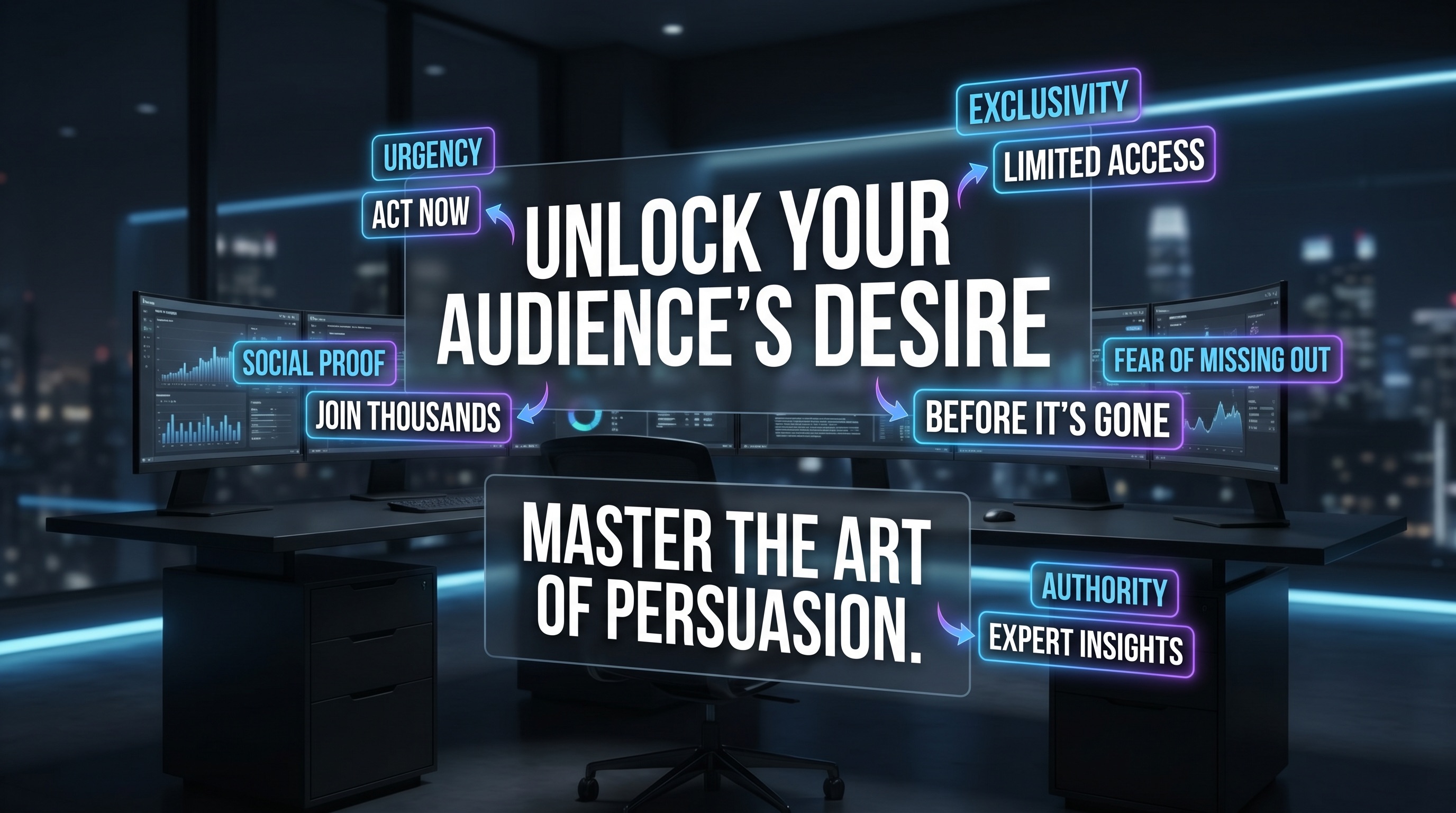
Most content fails in its first line. Posts with weak hooks see 3–8x lower engagement than posts with strong ones, and the average writer defaults to the same 3–4 trigger patterns — curiosity gap, social proof, how-to — by habit. Without systematically covering all psychological triggers, you leave the majority of your potential audience unreached. Teams that A/B test across trigger types consistently see 40–60% higher click-through rates versus single-hook campaigns, and the pattern of which triggers work with a specific audience becomes a compounding asset over time.
Para qué lo usamos
You're launching a new content series, ad campaign, or product announcement and need opening lines that stop the scroll. Instead of spending an hour brainstorming and ending up with five variations of the same hook, you paste your topic, audience, and goal into this prompt and get 20 tested psychological angles — each labeled, explained, and sorted by platform — in under 60 seconds.
Prompt
Act as a world-class copywriter and conversion specialist with 15 years of experience crafting high-performing content for [YOUR INDUSTRY — e.g., SaaS, e-commerce, coaching, B2B tech].Context: I'm promoting [TOPIC/PRODUCT/IDEA — e.g., "a productivity course for remote teams", "a new AI writing tool", "a local coffee roastery"]. My target audience is [DESCRIBE YOUR AUDIENCE — e.g., "marketing managers at mid-size B2B companies", "first-time homebuyers aged 28-40", "indie developers who ship solo"]. My primary goal with this content is to [YOUR GOAL — e.g., "drive email signups", "get LinkedIn shares", "convert cold traffic to buyers"].Task: Generate exactly 20 distinct headline hooks for this topic. Each hook must use a different psychological trigger from the list below. Every hook must be adapted to the specific language, pain points, and desires of my target audience.Psychological triggers to cover across the 20 hooks (assign one per hook, no repeats):Curiosity gap, Social proof, Loss aversion, Urgency/scarcity, Authority, Specificity, Novelty, Contrarian/pattern-interrupt, Aspiration, Fear, Humor, Self-interest, Exclusivity, Nostalgia, Challenge/dare, Validation, Simplicity, Story/narrative hook, Counter-intuitive data, Personal transformation.Constraints:- No clickbait or misleading claims — every hook must be deliverable- Maximum 12 words per hook- No generic phrases like "This will change your life" or "You won't believe..."- Each hook must stand alone without needing additional context- At least 6 hooks must be suitable for LinkedIn; at least 4 for email subject linesOutput Format — for each hook:[NUMBER]. [HOOK TEXT]- Psychological trigger: [name]- Why it works: [one sentence on the mechanism]- Best platform: [Twitter/X | LinkedIn | Email | YouTube | Ad headline | Multiple]- Adapt for your brand voice: [one tip for adjusting tone]
Resultado
Example run for: A time-tracking app for freelancers, targeting "freelance designers and developers who systematically undercharge for their work."
1. "The hour you forgot to bill last week cost you $340 this year."
- Psychological trigger: Specificity
- Why it works: A precise, plausible number makes the abstract loss feel concrete and personal.
- Best platform: Email, LinkedIn
- Adapt: Adjust the dollar figure to match your audience's average rate.
2. "Freelancers who track hours earn 23% more — same workload, different discipline."
- Psychological trigger: Social proof + counter-intuitive data
- Why it works: Attributes the income gap to behavior, not luck or talent — makes it feel achievable.
- Best platform: LinkedIn, Ad headline
- Adapt: Cite the actual stat source for a more authoritative tone.
3. "Every client who says 'just a quick question' is not paying you for that hour."
- Psychological trigger: Validation
- Why it works: Names a pain point freelancers already feel but haven't articulated — creates instant recognition.
- Best platform: Twitter/X, LinkedIn
- Adapt: Add a rhetorical question to deepen engagement on LinkedIn.
4. "I started tracking my actual hours. The first invoice I sent was 40% too low."
- Psychological trigger: Story/narrative hook
- Why it works: First-person confession creates credibility and a cliffhanger — readers want to know what changed.
- Best platform: LinkedIn, Email
- Adapt: Use as the opening sentence of a longer post rather than a standalone hook.
5. "Most freelancers retire early by accident — they just run out of clients to undercharge."
- Psychological trigger: Humor (dark)
- Why it works: Absurdist spin on a real fear makes it shareable and memorable without being preachy.
- Best platform: Twitter/X, LinkedIn
- Adapt: Tone this down for enterprise audiences — remove the word 'retire.'
[15 more hooks continue in the same format, covering: Curiosity gap, Loss aversion, Urgency/scarcity, Authority, Novelty, Contrarian/pattern-interrupt, Aspiration, Fear, Self-interest, Exclusivity, Nostalgia, Challenge/dare, Simplicity, and Personal transformation.]
La mayor parte del contenido muere en la primera frase. No porque la idea sea mala — sino porque la línea de apertura no da ninguna razón para seguir leyendo. Un gancho no es decoración; es la apuesta completa de que los próximos segundos de atención de alguien valen la pena.
Este prompt te da 20 ganchos para cualquier tema, cada uno anclado a un disparador psicológico diferente. El resultado cubre desde brechas de curiosidad y aversión a la pérdida hasta datos contraintuitivos y transformación personal — un barrido sistemático por todo el espectro de la motivación humana, no solo lo primero que viene a la mente.
Qué Produce Este Prompt
Para cada uno de los 20 ganchos, el prompt genera:
- El gancho en sí — 12 palabras o menos, adaptado al lenguaje y puntos de dolor de tu audiencia
- El disparador psicológico — nombrado explícitamente para que puedas rastrear qué ángulos has usado en campañas
- Por qué funciona — el mecanismo, no solo la etiqueta
- Mejor plataforma — algunos ganchos funcionan en LinkedIn, otros están hechos para líneas de asunto de email o miniaturas de YouTube
- Consejo de tono de marca — un ajuste para cambiar entre tonos formales, casuales o agresivos
Por Qué El Prompt Enumera Explícitamente Los 20 Disparadores
Sin restricciones, los modelos de lenguaje recurren a los 3–4 disparadores psicológicos que encuentran con más frecuencia en los datos de entrenamiento: brecha de curiosidad, prueba social, urgencia y cómo hacerlo. Dale al modelo el tema "seguimiento de tiempo freelance" sin una lista de disparadores y producirá 20 variaciones de los mismos tres ganchos. Enumerar los 20 disparadores explícitamente obliga al modelo a cubrir todo el espectro — autoridad, nostalgia, humor, datos contraintuitivos, desafío y el resto — generando un resultado genuinamente diversificado en lugar de repetición parafraseada.
El mismo principio aplica a la anotación de la plataforma. La efectividad del gancho depende del medio. Un gancho de brecha de curiosidad que funciona como línea de asunto de email no funciona como apertura de un post de LinkedIn, donde se espera un contexto más extenso. Clasificar por plataforma en el momento de generación obliga al modelo a escribir ganchos adecuados a su contexto, no líneas genéricas que rinden por debajo en todas partes.
Cómo Usar El Resultado Sin Desperdiciarlo
No publiques los 20. Úsalos como un backlog de pruebas. Ejecuta los mejores 5–6 como tests A/B en tu primera campaña, rastrea qué disparadores tienen tracción con tu audiencia específica y construye un patrón a partir de datos reales. Los disparadores que ganan consistentemente se convierten en tus predeterminados; los que crónicamente rinden por debajo se priorizan menos para esa audiencia.
Para calendarios de contenido, asigna un tipo de disparador por semana y rota deliberadamente. Esto previene la fatiga de la audiencia que viene de un feed que se ve y suena idéntico semana tras semana — la razón principal por la que el alcance del contenido disminuye con el tiempo incluso cuando la frecuencia de publicación se mantiene constante.
Compatibilidad de Modelos
Claude Sonnet 4.6 y GPT-4o funcionan bien con este prompt. Claude produce explicaciones más precisas de "por qué funciona" y una mejor diferenciación específica por plataforma. GPT-4o genera ganchos con un impacto emocional ligeramente más agresivo, lo que funciona mejor para copy de anuncios de respuesta directa. Para contenido enfocado en LinkedIn, los resultados de Claude tienden a sonar menos como anuncios y más como publicaciones orgánicas — lo que importa para el alcance en esa plataforma. En cualquier caso, el formato de salida estructurado mantiene resultados consistentes entre modelos.