A weighted decision matrix Prompt for faster team choices
Why this prompt matters
Teams waste weeks revisiting the same decision when criteria are implicit, stakeholders optimize for different goals, and nobody can explain why an option won. A weighted matrix turns vague debate into an auditable decision record and exposes where disagreement actually lives.
What we use it for
Use this when you need to choose between several real options under time pressure, such as selecting a project management tool, vendor, framework, or job offer, and you want a defensible recommendation instead of gut feel.
Prompt
Role: Act as a senior strategy analyst helping me make a high-stakes decision with a transparent weighted scoring model.

Context: I am deciding between [OPTION 1], [OPTION 2], [OPTION 3], and [OPTION 4] for [DECISION CONTEXT]. The decision matters because [WHY THIS DECISION MATTERS]. My constraints include [BUDGET], [TIMELINE], [TEAM SIZE], and [NON-NEGOTIABLE REQUIREMENTS].

Task: Build a weighted decision matrix that compares the options across the criteria I provide. Use these criteria and weights, adding up to 100: [CRITERION 1 + WEIGHT], [CRITERION 2 + WEIGHT], [CRITERION 3 + WEIGHT], [CRITERION 4 + WEIGHT], [CRITERION 5 + WEIGHT]. Score each option from 1 to 10 on every criterion, explain each score in one or two sentences, calculate weighted totals, rank the options, and recommend the best choice. Then stress-test the recommendation by showing which option would win if the top-weighted criterion changed by plus or minus [SENSITIVITY %].

Constraints: Do not use vague language. If information is missing, list the missing inputs explicitly and make the smallest reasonable assumption. Do not force a tie. Call out hidden risks, second-order effects, and cases where the highest-scoring option may still be the wrong practical choice.

Output Format: 1) Decision summary, 2) assumptions and missing data, 3) weighted decision matrix in table form, 4) ranking with weighted totals, 5) recommendation with rationale, 6) sensitivity analysis, 7) next steps before committing.
Result
Decision summary: Based on the weighted matrix, Notion is the strongest fit for a 12-person remote product team choosing a project management platform for the next 18 months. It does not win every category, but it delivers the best overall balance of flexibility, cross-functional collaboration, documentation, and cost. Jira remains the better pure engineering tracker, while Asana is the easiest to adopt quickly, but neither matches Notion's combined score across the broader operating model this team needs.
Assumptions and missing data: I assumed the team needs one shared workspace for product, engineering, design, and operations, with a monthly software budget below $500. I also assumed the company values fast onboarding and documentation quality as much as sprint planning. Missing inputs that would affect the outcome include existing tool lock-in, compliance requirements, and whether the engineering team needs advanced issue hierarchy and release reporting.
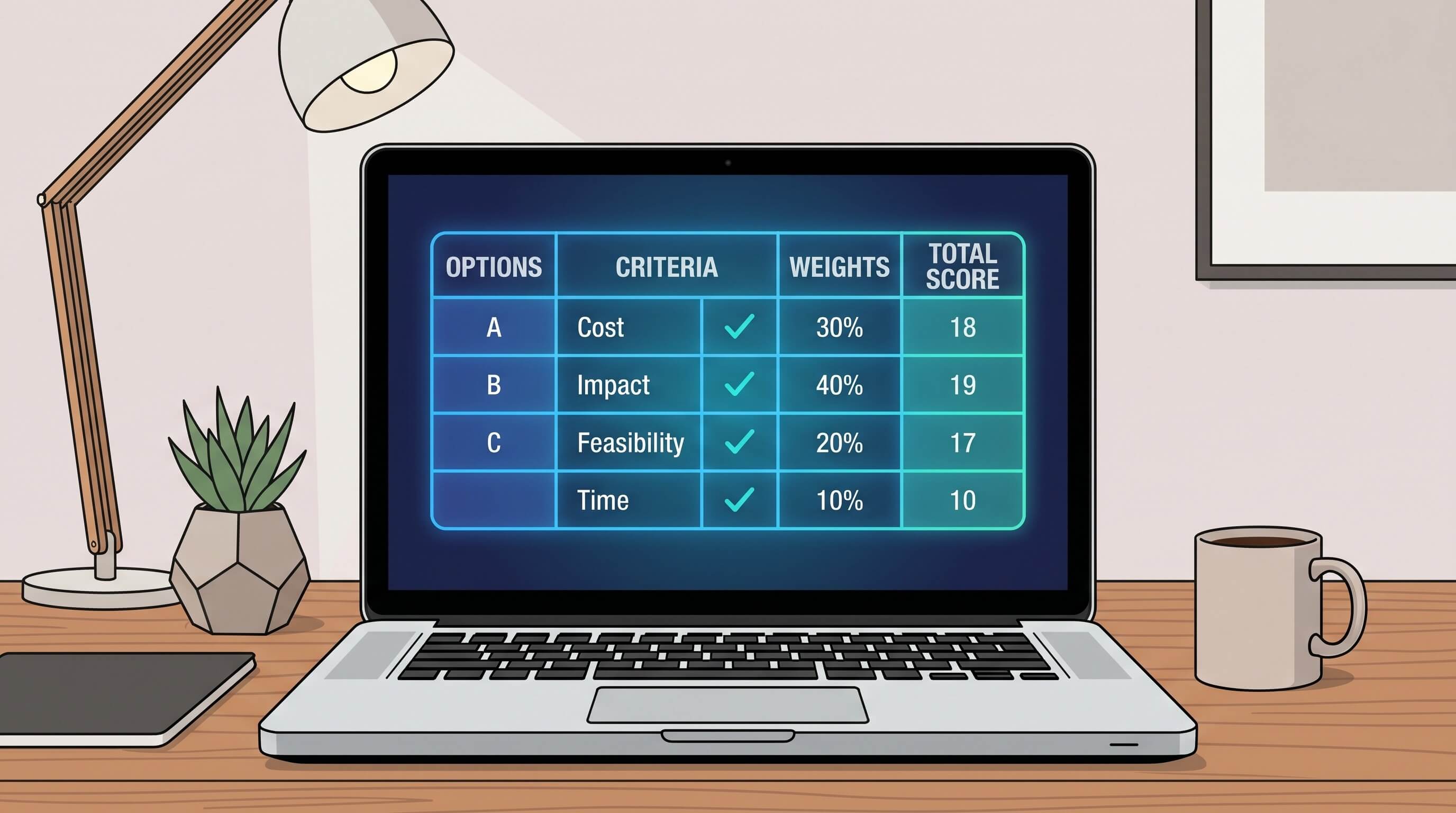
Weighted decision matrix: Criteria were weighted as follows: collaboration and documentation 30, ease of adoption 20, engineering workflow support 20, automation and integrations 15, total cost 15. Notion scored 9, 8, 7, 8, and 9 respectively, producing a weighted total of 8.30. Jira scored 6, 5, 10, 9, and 7 for a total of 7.20. Asana scored 8, 9, 6, 7, and 6 for a total of 7.35. ClickUp scored 7, 6, 7, 8, and 8 for a total of 7.10.
Recommendation with rationale: Choose Notion if the company wants one system that supports planning, documentation, meeting notes, lightweight roadmapping, and cross-team visibility without adding another knowledge base. Its main weakness is deeper engineering workflow structure, so teams with strict release governance may still prefer Jira despite the lower blended score.
Sensitivity analysis: If engineering workflow support rises from 20 to 35, Jira becomes much more competitive and may overtake Notion, especially if the company already uses GitHub and wants stronger issue discipline. If collaboration and documentation fall below 20, Asana also narrows the gap. That means the decision is robust only if the organization truly values a shared operating system over a specialist tracker.
Next steps before committing: Run a two-week pilot with one live project, measure onboarding time, check migration friction, and ask each function to list one blocker that would make the chosen tool fail in practice.
Choosing between several good options is where teams burn time. The discussion feels productive, but the criteria stay implicit, the loudest voice shapes the outcome, and the decision gets reopened two weeks later. This Prompt fixes that by forcing the tradeoffs into a weighted matrix the whole team can inspect.
The structure matters. The Role section pushes the model into analyst mode instead of generic brainstorming. The Context section defines the stakes, constraints, and non-negotiables, which keeps the recommendation grounded in an actual business decision rather than abstract preference. The Task section does the heavy lifting: score each option, explain each score, calculate weighted totals, then stress-test the result with sensitivity analysis.
That last part is what makes this Prompt worth saving. A normal comparison Prompt gives you a ranked list. A better one shows whether the winner still wins when your most important criterion moves. If a small weight change flips the outcome, the real issue is not the tool or vendor. It is stakeholder alignment.
This Prompt also avoids a common AI failure mode: confident nonsense built on missing inputs. The Constraints section tells the model to surface gaps, make the smallest reasonable assumptions, and call out situations where the highest score may still be the wrong practical choice. That gives you something closer to a decision memo than a polished guess.
Use it for software selection, hiring decisions, agency reviews, pricing models, roadmap tradeoffs, or any other choice where multiple decent options compete on different dimensions. The output is easy to paste into a doc, defend in a meeting, and revisit later if assumptions change.