The Error Message UX Rewriter: Turn a Stack Trace Into an Error Users Can Actually Act On
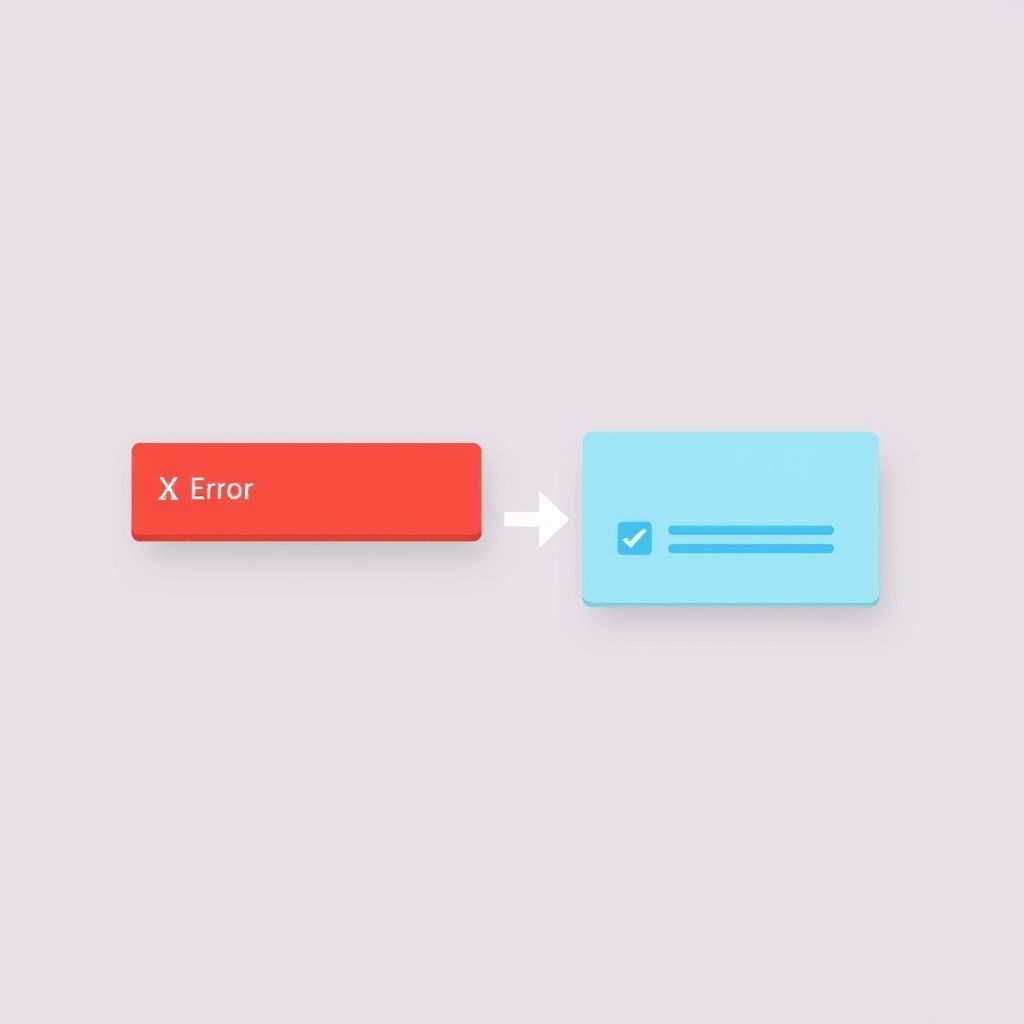
Why this prompt matters
Raw exception text in a user-facing error is a trust problem, not just a UX one: Nielsen Norman Group's research on error messages found users abandon a task within seconds of seeing jargon they can't parse, and every leaked stack trace is a few lines away from exposing file paths, library versions, or internal service names to anyone who opens dev tools. Support teams end up re-explaining the same five errors every week in plain English by hand because no one wrote the user-facing version when the exception was first thrown — this prompt makes that translation part of shipping the error, not an afterthought triaged weeks later.
What we use it for
A fintech support engineer is staring at a ticket where a customer saw "TypeError: Cannot read properties of undefined (reading 'balance') at AccountService.getBalance (account.service.ts:142)" on a production screen after a failed bank-link sync, and has to turn that into something a non-technical customer can read in the next 20 minutes before the ticket queue backs up further.
Prompt
ROLE: You are a technical writer and UX specialist who rewrites raw software errors into messages that respect both the end user and the support engineer who will see them later.

CONTEXT:
- Raw error: [PASTE THE EXACT ERROR MESSAGE, EXCEPTION TYPE, AND STACK TRACE HERE]
- Where the user sees this: [E.G., "a modal dialog after clicking Submit", "a toast notification", "a full-page error screen"]
- Who the user is: [E.G., "a non-technical small business owner", "a developer using our API", "an internal ops employee"]
- What the user was trying to do: [DESCRIBE THE ACTION THAT TRIGGERED THE ERROR]

TASK:
Produce THREE things from the raw error above:
1. A USER-FACING message: what happened, in plain language, without blaming the user unless it was genuinely their input.
2. A NEXT STEP: one specific, concrete action the user can take right now (retry, check a specific field, wait, contact support with a reference code) — never just "try again later" with no reason given.
3. An ENGINEERING LOG line: a terse, structured one-liner suitable for your logging/observability system, preserving the technical detail the user-facing message intentionally omits.

CONSTRAINTS:
- NEVER include file paths, line numbers, library/package names, internal service names, stack traces, or raw exception class names in the user-facing message or the next step.
- NEVER use the words "error", "failed", or "something went wrong" as the ENTIRE message with no further information — always say what specifically didn't work.
- If the error is ambiguous about root cause (e.g., could be network, could be server, could be bad input), say so honestly rather than guessing a cause with false confidence.
- Keep the user-facing message under 40 words. Keep the next step under 25 words.
- Generate a short, unique-looking reference code (format: XXX-###) the user can quote to support, and include that SAME code in the engineering log line so the two are linkable.
- Match tone to the audience in CONTEXT — a developer-facing API error can be more technical than a small-business-owner-facing one, but still never leak internals in constraints above.

OUTPUT FORMAT:
USER-FACING MESSAGE:
[your text]

NEXT STEP:
[your text]

REFERENCE CODE: [XXX-###]

ENGINEERING LOG LINE:
[your text, include the same reference code]
Result
USER-FACING MESSAGE:
We couldn't finish linking your bank account because we didn't receive your current balance from your bank in time. This isn't something you did wrong.
NEXT STEP:
Please try linking your account again in a few minutes. If it fails a second time, contact support with reference code BNK-417.
REFERENCE CODE: BNK-417
ENGINEERING LOG LINE:
[BNK-417] AccountService.getBalance returned undefined balance field — bank-link sync (account.service.ts:142) likely hit a null/partial response from the banking aggregator before the sync timeout; TypeError thrown on balance read, not a validation failure. Check aggregator webhook payload for this user's institution; probable upstream partial-response bug, not a client-side defect.
Why this version works: the user-facing message names the actual failure domain (receiving a balance from the bank) without exposing that it's a null-property crash in a TypeScript service — a customer doesn't need to know "AccountService" exists, and a support engineer definitely doesn't want a customer repeating "TypeError" back to them over the phone. The next step is concrete and bounded (retry, then escalate with a code) rather than the common failure mode of "please try again later," which gives the user no sense of whether retrying is even the right move.
The reference code does double duty: support can search ticket history for "BNK-417" and the engineering team can grep logs for the same string, so a once-separate translation step (support describes the bug in their own words, engineering tries to match it to a log line) collapses into a single lookup. The engineering log line keeps everything the user-facing version had to omit — the exact method, file, line number, and a hypothesis about root cause (upstream partial response vs. client defect) — which is exactly the information a support engineer needs to decide whether to escalate to the banking integrations team or just tell the customer to retry.
If the same prompt were run with the audience set to "a developer using our API" instead of "a non-technical small business owner," the user-facing message would legitimately include the field name and HTTP status, because an API consumer needs that to fix their own integration — the constraint against leaking internals adapts to who's actually allowed to see internals.
Every production system eventually throws an error straight at a user, and the default version of that error is almost always a raw exception: a type name, a file path, a line number, sometimes a stack trace. Engineers write these for other engineers, in the middle of debugging, and they ship to production because nobody wrote a user-facing version before the deadline. The gap between "what the code says" and "what the user needs to hear" becomes a support ticket, usually explained from scratch, by hand, every time the same error recurs.
This prompt closes that gap by forcing three distinct outputs from one error: a plain-language message for the user, a concrete next step, and an engineering log line that keeps everything the user-facing text had to leave out. The split matters because these two audiences need opposite things. A customer needs reassurance and a clear action, with zero file paths or exception class names. A support engineer or on-call developer needs the exact opposite — the file, the line, the method name, a working hypothesis about root cause — information the user-facing message is specifically constrained to omit.
Why the structure works
The ROLE section sets up a writer who treats both audiences as real constraints, not an afterthought. The CONTEXT fields force you to specify where the user sees the error and who that user is, because the same underlying bug needs a different translation for a non-technical small business owner than for a developer debugging your API — the prompt's own constraints say as much, instructing the model to scale technical detail to the audience rather than applying one blanket rule.
The CONSTRAINTS section is where most error-message rewrites fail without this prompt: a well-meaning but vague instruction like "make this error friendlier" tends to produce "Oops! Something went wrong 🙃" — which respects nobody. The explicit ban on file paths, stack traces, and the words "error" or "failed" with no further detail forces specificity instead of cheerful nothing. The reference-code requirement is the part most teams skip and then regret: without a shared identifier, a customer's phone call ("it said something about an account") and an engineer's log search ("grep for TypeError") never converge on the same incident.
When to use this versus just fixing the bug
This prompt is not a substitute for fixing the underlying defect — it's for the gap between "the bug exists" and "the bug is fixed," which in any real system is measured in days or weeks, not minutes. It's also useful permanently for errors that are expected and unavoidable (a third-party API timing out, a user uploading a corrupt file) where there's no bug to fix, only a translation to get right every time it happens.
A team that runs this prompt against its ten most common support-ticket-generating errors once will have ten plain-language messages, ten next steps, and ten engineering log templates they can hardcode directly into the error-handling code — turning a recurring translation chore into a one-time editorial pass.