The Character Reference Sheet Generator: Turn One Description Into a Three-View Turnaround
Why this prompt matters
Commissioning a professional character turnaround sheet typically costs $150-$400 and takes several days of back-and-forth revision, which is a real bottleneck for a solo developer or small studio that needs a rough but usable reference today to keep pre-production moving, not a final production asset.
What we use it for
A solo indie game developer has designed an NPC on paper — a dwarf blacksmith with a specific beard, apron, and hammer — and needs a turnaround sheet before handing the character off to a contract artist or feeding it into a 3D modeling reference, without paying for a full commissioned turnaround just to get the project started.
Prompt
Act as a character design assistant specializing in consistent multi-angle reference sheets for game, comic, and animation artists.

Context:
- Character description: [FULL DESCRIPTION — age, build, face, hair, clothing, props, and any distinguishing features like scars or accessories]
- Art style: [E.G. SEMI-REALISTIC PAINTERLY FANTASY GAME ART, CEL-SHADED ANIME, FLAT VECTOR CARTOON, PIXEL ART]
- Intended use: [E.G. GAME NPC SPRITE, COMIC BOOK CHARACTER, ANIMATION RIG REFERENCE, TABLETOP RPG PORTRAIT]

Task:
Generate a single reference sheet image containing three panels of the same character side by side: a front view, a three-quarter view, and a back view. All three panels must show identical proportions, identical clothing and props, and the same art style, so the sheet can be used as a consistency reference during later production work.

Constraints:
- Plain neutral grey or white background with no scenery, props, or set dressing that would distract from the character
- Consistent lighting direction and intensity across all three panels
- Neutral standing pose (not a dynamic action pose) so proportions are easy to read and trace
- No text, labels, or watermarks baked into the image
- If the character has asymmetric details (a scar, a prop held in one hand, an off-center accessory), keep that detail consistent and on the correct side across the front and three-quarter panels

Output format:
One image, three panels arranged left to right in this order: front view, three-quarter view, back view. No additional panels, no text overlay, no border frames between panels beyond natural spacing.
Result
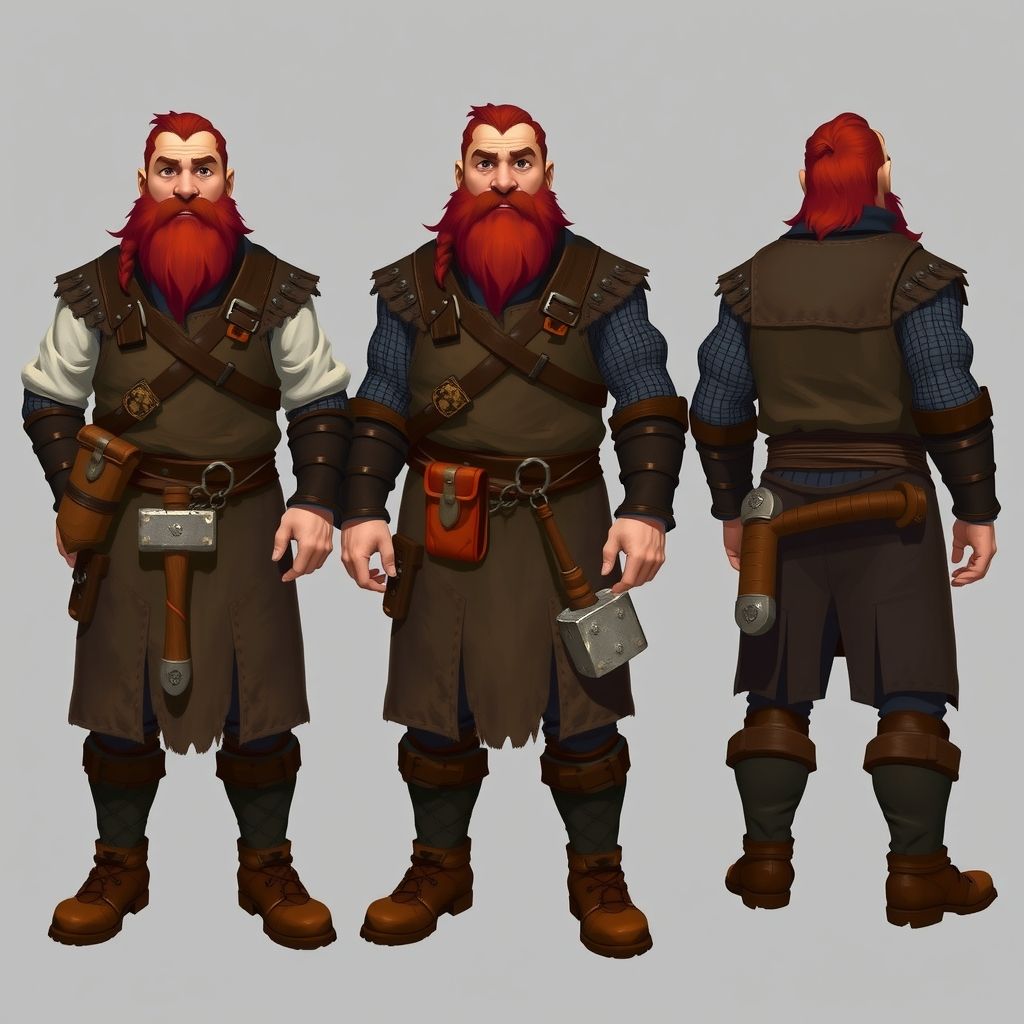
The example output above shows a dwarf blacksmith character — red braided beard, leather apron over chainmail, a battle-worn hammer on the belt — rendered in front, three-quarter, and back views on a neutral grey background, in a semi-realistic painterly fantasy game art style.
The result is genuinely usable as a rough reference: the face, beard, armor pieces, and boots stay recognizably consistent across all three panels, and the back view correctly omits the face while keeping the same silhouette and proportions. It's not perfect — look closely and the hammer has moved from a hip holster in the front panel to a hand-held grip in the three-quarter panel, and the belt pouch position shifts slightly. That's a realistic limitation of single-shot diffusion models asked to hold fine prop placement across multiple views in one image, and it's worth knowing going in: treat the output as a strong starting reference for an artist to clean up, not a pixel-perfect production asset.
Generated Image
Every game, comic, or animation project that involves an original character eventually needs a turnaround sheet: the same character shown from multiple angles, so an artist, modeler, or animator can keep proportions and details consistent across dozens of later drawings or frames. Commissioning one professionally is standard practice, and for good reason — but it also costs $150 to $400 and takes days, which is a real bottleneck when you just need something usable to keep a pre-production pipeline moving.
This prompt generates a rough three-view turnaround — front, three-quarter, back — in a single image, built specifically to be a working reference rather than a finished asset.
Why three views, not the standard five or six
Professional turnaround sheets often include five or six angles plus close-ups of hands, face, and key props. Asking a single-shot image model for that many consistent views in one generation reliably produces drift — proportions and details degrade the more panels you cram into a single output. Three views — front, three-quarter, back — is the minimum that actually lets an artist infer the character's volume and silhouette from most angles, and it's also roughly the ceiling of what current diffusion models can hold consistent within a single image before quality degrades. If you need the missing angles (profile, close-up details), that's a second, separate generation, not an attempt to cram six panels into one.
Why the background and pose constraints matter
A character turnaround's entire job is making the character easy to reference against, which means everything else in the frame is noise. Scenery, dynamic poses, and dramatic lighting are exactly what you want in a finished illustration and exactly what makes a reference sheet harder to actually use — a neutral background and a plain standing pose are there so an artist can look at any panel and immediately see proportions without mentally subtracting a bunch of visual distraction.
What to actually expect
Single-shot diffusion models are good at holding a character's face, coloring, and overall silhouette consistent across panels in one generation. They're noticeably less reliable at holding small prop placement — which hand holds an item, exactly where a pouch or buckle sits — consistent across all three views. That's not a prompt-writing failure to fix with more adjectives; it's a real limitation of asking one model call to track fine spatial detail across multiple simultaneous viewpoints. Treat a generation like this as a strong 80%-there reference an artist or modeler can clean up, not a replacement for a professional turnaround on a character that's actually shipping in a final product.
How to use the output
Hand the generated sheet to whoever is building on top of it — contract artist, 3D modeler, animator — with an explicit note about which details (if any) drifted between panels, so they know what to treat as authoritative versus what to eyeball-correct. For a character that's genuinely load-bearing for your project, commission a real turnaround once the design is locked; use this to get unstuck on the design decision itself.