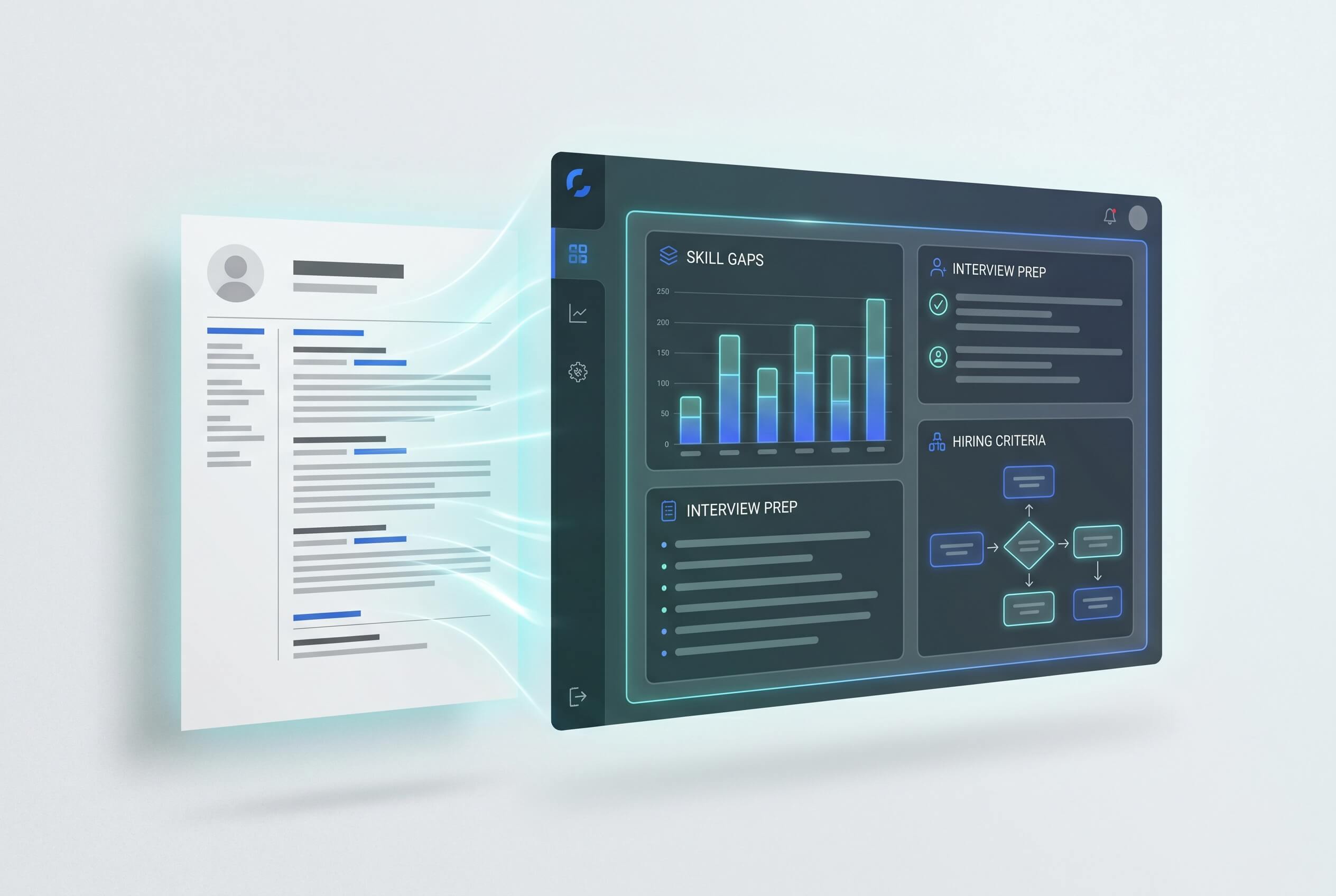
This AI prompt turns a resume into a job-match gap analysis
Why this prompt matters
Most applicants lose interviews before anyone speaks to them because their resume does not show fit clearly enough. A structured gap analysis helps you focus on the missing evidence that actually blocks callbacks instead of wasting time on cosmetic edits.
What we use it for
Use this before applying to a role that is close to your background but not an exact match, especially when you need to decide whether to apply now, revise your resume first, or spend a week closing obvious gaps.
Prompt
Role: Act as a senior recruiter, hiring manager, and career coach in one.

Context: I will paste a resume and a target job description. Your job is to compare them like a real hiring team would. I want an honest gap analysis, not generic encouragement.

Task:
1. Summarize the target role in plain English.
2. Extract the 10 most important requirements from the job description, separating must-have skills from nice-to-have skills.
3. Score the resume against each requirement on a 0-5 scale and explain the reasoning.
4. Identify the biggest gaps, including missing technical skills, weak evidence, unclear achievements, or missing keywords.
5. Rewrite the 5 weakest resume bullets so they better match the role without inventing experience.
6. Suggest a prioritized improvement plan for the next 7 days and the next 30 days.
7. Generate 12 likely interview questions based on the gaps, and give a short preparation note for each.
8. Flag any claims that sound vague, inflated, or unsupported.

Constraints:
- Do not invent achievements, employers, dates, metrics, certifications, or tools that are not in the resume.
- Be direct and specific. Avoid generic advice like 'tailor your resume more.'
- If the candidate appears underqualified, say so clearly and explain the fastest path to improve.
- Use the language of the job description where appropriate, but do not keyword-stuff.
- Separate issues of substance from issues of wording.

Output Format:
A. Role Summary
B. Requirement Matrix Table
C. Top Gaps
D. Rewritten Resume Bullets
E. 7-Day Improvement Plan
F. 30-Day Improvement Plan
G. Interview Questions and Prep Notes
H. Final Hiring Readiness Verdict

[PASTE TARGET JOB DESCRIPTION]
[PASTE CURRENT RESUME]
[OPTIONAL: PASTE LINKEDIN SUMMARY]
[OPTIONAL: PASTE PORTFOLIO OR GITHUB NOTES]
Result
A. Role Summary This Product Operations Manager role sits between product, analytics, and go-to-market teams. The company wants someone who can turn messy launch processes into repeatable systems, own KPI reporting, and coordinate cross-functional execution without slowing teams down. The job is less about pure project management and more about building operational discipline around product decisions.
B. Requirement Matrix Table 1. Cross-functional program leadership, Score: 4/5. Your resume shows coordination across product, engineering, and support, but the scale of launches is not quantified. 2. KPI dashboard ownership, Score: 2/5. You mention reporting, but there is no evidence that you defined metrics or maintained executive dashboards. 3. SQL proficiency, Score: 1/5. No direct SQL experience is listed. This is a clear must-have gap. 4. Process design, Score: 4/5. Strong evidence from onboarding workflow redesign and ticket triage improvements. 5. Stakeholder communication, Score: 4/5. Your examples show regular communication with leaders, but not enough evidence of executive-level decision support. 6. Experiment analysis, Score: 2/5. You mention A/B tests, but not the methodology or business impact. 7. Documentation and SOP creation, Score: 5/5. This is one of the strongest parts of the resume. 8. Product launch support, Score: 3/5. Relevant experience exists, but the bullets are generic. 9. Tools fit, Score: 3/5. Jira and Looker are relevant; the absence of SQL and Amplitude weakens the match. 10. Business impact storytelling, Score: 2/5. Several bullets describe activity, not results.
C. Top Gaps The biggest blocker is analytical credibility. A recruiter could plausibly believe you supported product operations, but not that you can independently drive KPI reviews or investigate launch performance. The second issue is evidence quality. Too many bullets use phrases like 'helped with' or 'supported' without showing ownership, scale, or measurable outcomes.
D. Rewritten Resume Bullet Example Original: Supported product launches across multiple teams. Rewritten: Coordinated launch readiness across product, engineering, support, and marketing for 6 feature releases in two quarters, reducing last-minute issue escalation by 28 percent through a standardized pre-launch checklist.
E. 7-Day Improvement Plan Add one analytics project to your resume, even if it comes from internal reporting work. Rewrite the summary around product operations outcomes, not responsibilities. Complete one SQL refresher project and add it to your skills section only if you can discuss it confidently.
F. 30-Day Improvement Plan Build a small portfolio artifact, such as a launch dashboard mockup or KPI review template. Collect two stronger metrics from past work. Replace weak verbs across the resume and LinkedIn with ownership language backed by evidence.
G. Final Hiring Readiness Verdict You are plausible for this role if the company is flexible on SQL and values operations maturity, but as written the resume will likely miss the interview cut at more competitive firms. Focus on evidence, analytics credibility, and sharper launch-impact bullets before applying broadly.
This Prompt is built for one of the most common job-search problems: knowing whether your resume actually matches the role you want. Instead of asking an AI tool to 'improve my resume,' this version forces a structured comparison between your current resume and a target job description.
What makes this Prompt useful
The structure matters. It separates must-have requirements from nice-to-have ones, scores each requirement, and then rewrites weak bullets without inventing experience. That keeps the result grounded in reality, which is where most resume prompts fail.
It also goes beyond editing. The output includes a 7-day plan, a 30-day plan, and likely interview questions. That makes it useful even when the answer is uncomfortable, like discovering that the real problem is missing evidence rather than bad wording.
How to use it well
Paste the exact job description, then paste your current resume without trying to pre-clean it. If you have a LinkedIn summary or project notes, include those too. The better the raw input, the better the gap analysis.
This works especially well for people applying to adjacent roles, such as moving from support operations into product operations, or from generalist marketing into lifecycle or growth roles. It helps you decide whether to apply now, revise first, or spend time closing one or two meaningful gaps.