Xiaomi's Xring O3 chip matches Apple A19 Pro and claims to beat the M4
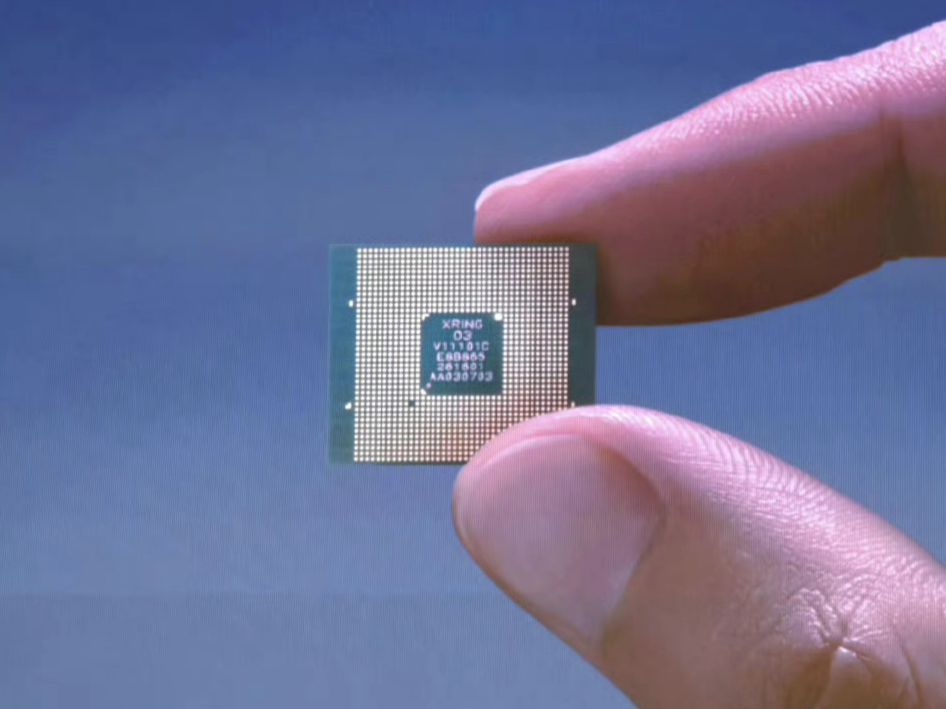
Xiaomi on August 24 unveiled the Xring O3, its most ambitious in-house chip to date — a 10-core mobile SoC built on TSMC's N3P (3nm) process that Xiaomi claims beats every current smartphone processor and rivals or exceeds Apple's M4 in raw CPU throughput.
No efficiency cores
The Xring O3 abandons the big.LITTLE hybrid architecture that has dominated mobile chips for a decade. Every core is a high-performance unit: two C1-Ultra cores at up to 4.35 GHz, four C1-Premium at 3.68 GHz, and four C1-Pro at 3.15 GHz. The chip packs 44 MB of on-chip cache — 12 MB private L2, 16 MB shared L3, and 16 MB SLC — more than most Intel laptop CPUs. The C1-Ultra cores are architecturally wide at 21 execution ports, six supporting 128-bit SIMD. They also implement SME2 (Scalable Matrix Extension 2) for matrix and AI workloads, and SVE2 for data parallelism.
Benchmark claims
In Geekbench 6.5, the Xring O3 scores approximately 3,945 single-core and 15,221 multi-core. Xiaomi says the multi-core result is roughly 40% ahead of Apple's A19 Pro and matches or beats the M4 in internal testing. Under controlled low-temperature lab conditions, AnTuTu V11 recorded 5,228,014 — a new mobile SoC record. The chip is also the first mobile SoC to support LPDDR6 memory, delivering higher memory bandwidth than any current flagship Android phone.
GPU and AI
The 16-core G2-Ultra NX GPU delivers what Xiaomi claims is an 85% graphics improvement and 182% more ray tracing throughput over its predecessor. Eight NX neural processing units provide 36 TOPS of on-device AI inference. The full die is 133 mm² with 24 billion transistors.
Why it matters
A Chinese consumer electronics company has built a mobile chip that, by independent benchmarks, genuinely competes with Apple Silicon in CPU architecture — not just in cherry-picked tests, but across the core metrics of core width, cache design, and raw throughput. Three years ago, Xiaomi's in-house chip efforts were still considered experimental. The Xring O3 changes that.
The geopolitical angle is significant: Xiaomi manufactures on TSMC's 3nm node (TSMC is Taiwanese and not subject to US semiconductor export restrictions to China), with the core CPU IP developed in-house. Whether this trajectory continues at 2nm — where access constraints grow more complex — will be the more consequential story to watch.
As reported by NotebookCheck, the Xring O3 ships in Xiaomi's 2026 flagship phone lineup.
Originally reported by NotebookCheck. Read the original article for additional details.
View original source