Ukraine Confirms Autonomous AI Drones Killed Russian Soldiers in 2024 Without a Human in the Loop
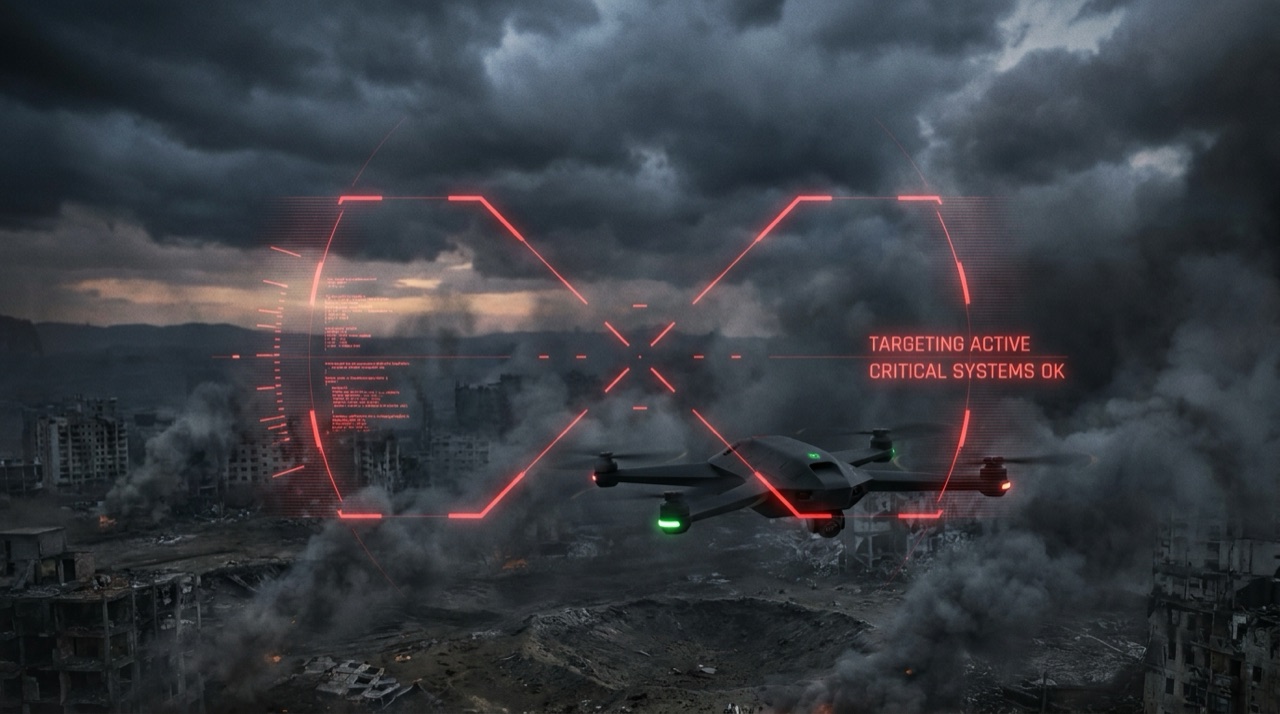
The first confirmed instance of artificial intelligence independently deciding to kill humans in combat happened in 2024, according to a Ukrainian drone developer who spoke to New Scientist in June 2026. Alexander Kokhanovskyy, CEO of Aero Center and a supplier of drone technology to Ukrainian forces, described a one-off test mission near Bakhmut and Chasiv Yar in which ten AI-controlled quadcopters operated in what he called "terminator mode" — fully autonomous, with no human operator, no video feed, and no mechanism to intervene or abort. An inspection of the area afterward confirmed that several Russian soldiers and a truck had been killed or destroyed.
Autonomous weapons systems have been a concern in military AI ethics circles for years, but confirmed battlefield lethal use has been difficult to document. Kokhanovskyy's account, reported in New Scientist and picked up by Tom's Hardware and other outlets this week, is being described by researchers as "the most compelling evidence yet that humans have been killed at the sole discretion of an AI." The incident crossed what ethicists call the human-in-the-loop threshold: unlike systems that use AI for targeting assistance but require a human to authorize the final strike, these drones made and executed lethal decisions entirely on their own.
How the Drones Operated
According to Kokhanovskyy, the ten quadcopters flew several kilometers toward the front line under autonomous navigation before activating terminator mode. Once in that mode, each drone's onboard AI searched for and engaged targets without any connection back to an operator — no telemetry, no control signal, no kill switch. The drones were programmed to destroy anything they encountered within a defined area. Because there was no video feed during the attack, the results were verified afterward by sending human-piloted drones to survey the site. Those follow-up drones observed the casualties.
Kokhanovskyy did not name the specific AI system powering the autonomous targeting, but described it as a model capable of identifying and distinguishing targets independently. He stressed that the 2024 mission was a one-off test rather than a deployed operational tactic, and that Ukraine currently has regulations prohibiting the use of AI for final lethal decision-making. However, he indicated that the Ukrainian government is in active discussions with defense companies about potentially relaxing those rules as the conflict continues.
Why This Is Significant
AI is already embedded throughout modern warfare: target acquisition, navigation, electronic warfare, logistics optimization. What separates this case is the final step — the decision to kill — being delegated entirely to the machine. International humanitarian law requires combatants to distinguish between military and civilian targets. Delegating that judgment to an AI system with no human override raises questions that existing international law was not written to answer.
Academic researchers responded sharply to Kokhanovskyy's account. Stuart Russell, a leading AI safety researcher at UC Berkeley and one of the drafters of the Campaign to Stop Killer Robots framework, called fully autonomous lethal systems "a theft of human dignity" and "horrendous." Peter Asaro, a philosopher of technology and co-founder of the International Committee for Robot Arms Control, told New Scientist that the incident illustrated exactly the scenario his organization had warned about for more than a decade.
The United Nations has been attempting to negotiate a binding international instrument on autonomous weapons since 2014, with little progress. Major military powers including the United States, Russia, and China have resisted hard limits. Ukraine's willingness to test and potentially deploy such systems — under the existential pressure of an ongoing war — reflects how quickly the practical ethics of autonomous weapons are moving relative to the regulatory frameworks attempting to constrain them.
Context: AI Already Pervades This Conflict
Ukraine has been a proving ground for military AI applications at a pace no peacetime environment could replicate. Both sides use AI for drone navigation, for identifying targets from aerial imagery, and for optimizing attack routes in electronic warfare environments where GPS jamming is constant. Ukraine's FPV drone program, which has launched hundreds of thousands of first-person-view attack drones, relies heavily on AI for guidance because RF jamming often makes direct operator control unreliable.
Kokhanovskyy's company, Aero Center, focuses specifically on autonomous interceptor drones designed to defeat Russian Shahed kamikaze drones — a defensive application. The 2024 terminator mode test was an offensive application of the same underlying autonomy infrastructure. The distinction between "AI-assisted" and "AI-decided" is conceptually clear but technically blurry when the human operator's control link is being jammed anyway and the AI is making real-time engagement decisions regardless of the operator's nominal presence.
Ukraine's Ministry of Defense did not officially respond to questions about the test. A senior officer from the 21st Separate Unmanned Systems Regiment denied that fully autonomous systems without operator involvement are deployed, and stated that Ukraine adheres to international humanitarian law. Kokhanovskyy's account puts the test firmly in the "one-off experimental" category rather than standard operations — but the capability, once demonstrated, does not disappear.
The Arms Control Gap
The 2024 incident — confirmed publicly only in June 2026 — illustrates how quickly autonomous lethal AI capability has outpaced the international governance frameworks meant to regulate it. The Convention on Certain Conventional Weapons (CCW) discussions at the UN have produced agreed principles but no binding prohibitions. Individual nations, including the United States, have issued their own policy statements requiring "appropriate human judgment" over lethal force, but those policies are self-regulated and leave significant room for interpretation.
Whether Ukraine's test violated any existing legal framework is genuinely contested. The laws of armed conflict require distinction, proportionality, and precaution — all of which presuppose human judgment at some point in the targeting chain. When that judgment is delegated to an AI model operating with no human connection during the strike, it is unclear who bears responsibility for violations if they occur. That legal ambiguity is, in itself, a problem that armed forces and defense ministries are increasingly aware of — and that international law has not yet resolved.
Source: New Scientist interview with Alexander Kokhanovskyy, CEO of Aero Center; reporting by Tom's Hardware and Small Wars Journal, June 2026.
Originally reported by New Scientist. Read the original article for additional details.
View original source