Tesla launches driverless Robotaxi in Miami with no safety monitor
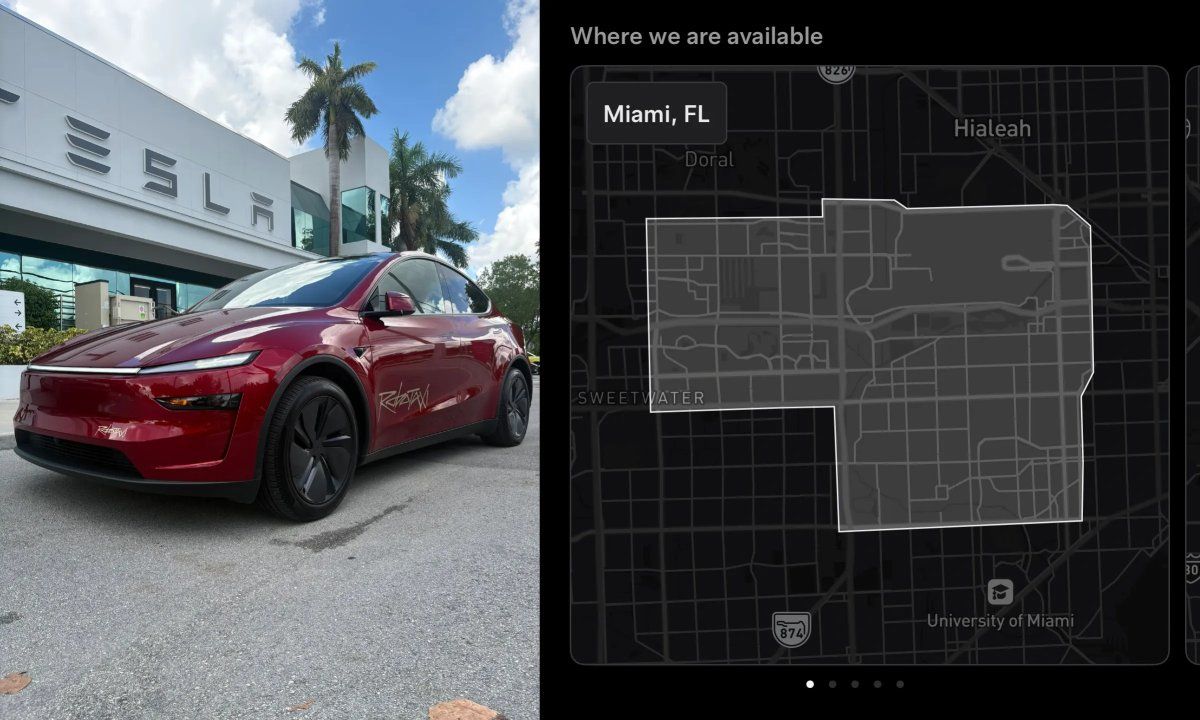
Tesla began fully unsupervised Robotaxi service in Miami on July 3, 2026, putting driverless Model Y vehicles on public roads with no safety monitor in the vehicle from day one. It is the fifth city in Tesla's Robotaxi network, after Austin, Houston, Dallas, and Phoenix, but the first outside Texas and California, and the first where Tesla skipped the supervised ramp-up period it used everywhere else. Ashok Elluswamy, Tesla's VP of AI Software, confirmed the launch on X within hours.
A narrow zone, an operator Tesla is chasing
The geofenced service area covers roughly 10 to 14 square miles in western Miami-Dade County, bounded by SR-826 (the Palmetto Expressway) to the north and US-41 (Tamiami Trail) to the south, spanning West Miami, Doral, and a corner of Coral Gables. Miami International Airport falls inside the boundary, though Tesla vehicles are not yet authorized for terminal pickups or drop-offs. Downtown Miami and Miami Beach are excluded entirely. The fleet is currently made up of Model Y vehicles identical to those used in Tesla's other Robotaxi markets; the purpose-built, two-seat Cybercab, which has no steering wheel or pedals, is expected to join later in 2026 once volume production scales up.
Tesla is not first to Miami. Alphabet's Waymo has been running paid, fully autonomous rides in the city since January 22, 2026, making it Waymo's sixth operating US market and giving it a head start and a larger operating footprint before Tesla's cars arrived.
Why the timing and location matter
In March 2026, the National Highway Traffic Safety Administration opened an engineering analysis, the formal step that precedes a possible recall, into Tesla's camera-only Full Self-Driving system. The agency's inquiry centers on reports that the system "fails to detect and/or warn the driver appropriately under degraded visibility conditions such as glare and airborne obscurants." Miami's climate produces exactly those conditions on a near-daily basis: sudden, intense tropical downpours, sharp low-angle sun glare off wet pavement, and persistent high humidity. Tesla's decision to deploy unsupervised, camera-only vehicles in this environment, without the multi-month supervised period it used in Austin, Houston, Dallas, and Phoenix before removing the safety monitor, means the system's performance in exactly the weather conditions under federal scrutiny is now being tested with no human in the car to intervene.
As first reported by Tech Times, this makes Miami the hardest real-world test yet for Tesla's camera-only approach to autonomy, since it is the first commercial deployment of that stack in a climate defined by the visibility conditions named in the NHTSA investigation. Not a Tesla App was among the first outlets to publish Tesla's own service-area map and vehicle photos confirming the rollout.
Early rides, early friction
Riders documenting early trips have reported long wait times, missed pickups, and software misfires during Tesla's first days of Miami service, and Tesla has filed multiple incident reports with federal regulators covering the rollout. None of this is unique to a new market launch, but it adds concrete data points to evaluate against the open NHTSA analysis rather than relying on Tesla's own safety claims alone.
Originally reported by Tech Times. Read the original article for additional details.
View original source