Stoke Space closes $1 billion round to fund its fully reusable Nova rocket
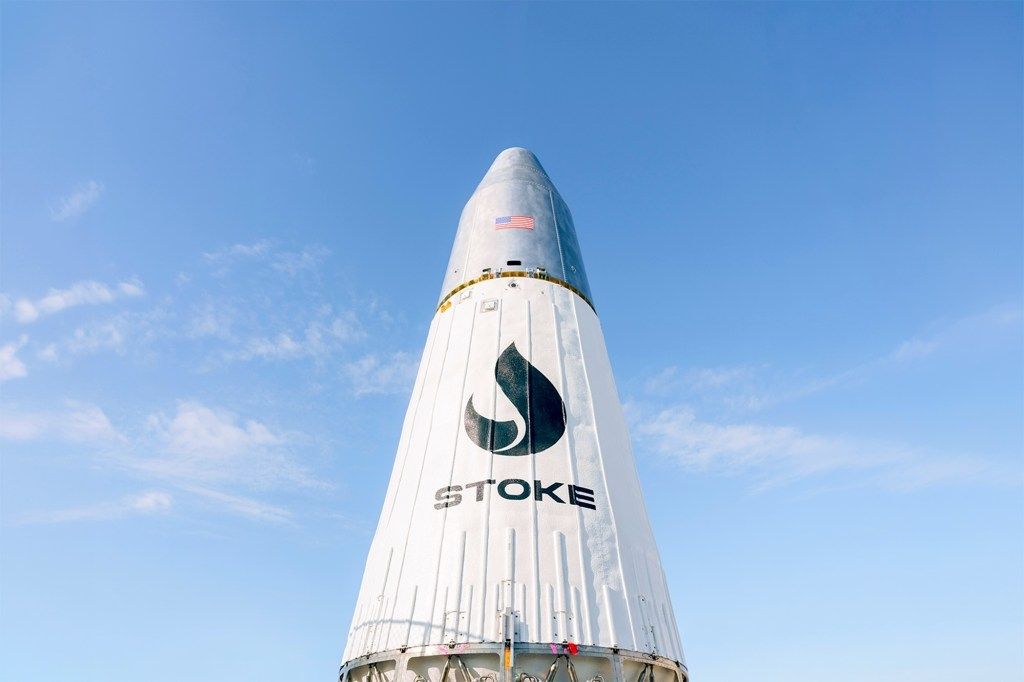
Stoke Space announced September 8 that it has completed the initial closing of a $1 billion Series E round, co-led by Point72 Ventures and Spark Capital, bringing the company's total funding to $2.3 billion at a valuation of roughly $9 billion before the new money. The round also drew General Innovation, Glade Brook Capital, US Innovation Technology, Washington Harbour Partners, Woven Capital, and Y Combinator, among other investors.
The capital is earmarked for three things, according to CEO Andy Lapsa: scaling production and flight frequency of the company's first rocket, Nova Pathfinder, and funding development of a larger second-generation vehicle, Nova Block 2. Nova Pathfinder is designed to carry roughly 3 metric tons to low Earth orbit and is expected to make its first flight in early 2027. Nova Block 2, targeting a 2029 deployment, would scale that capacity up to 15 metric tons — putting it in range of medium-lift missions currently served by rockets like Falcon 9.
What "fully reusable" actually means here
The distinction Stoke is betting the company on is real, not marketing. SpaceX's Falcon 9 recovers only its first stage; the upper stage and payload fairing are typically expended or, in the fairing's case, sometimes fished out of the ocean for refurbishment rather than landed intact. Nova is designed to recover both stages, with the upper stage using an actively cooled metallic heat shield — cycling super-cooled liquid hydrogen through the structure during re-entry — instead of the ablative or ceramic tile approaches used elsewhere. If it works at the vehicle's target cadence, full-stack reusability changes the unit economics of launch more fundamentally than partial reusability did, since the upper stage and its engine are typically among the most expensive components to rebuild for every flight.
That "if it works" is doing real work in that sentence. Nova Pathfinder has not yet flown, and reusable upper-stage thermal protection at orbital re-entry velocities is one of the harder unsolved problems in the launch industry — it's a big part of why even SpaceX has not attempted full second-stage recovery on Falcon 9 despite years of first-stage reuse experience. Stoke's $2.3 billion in total funding buys it a long runway to iterate, but a $9 billion pre-money valuation for a company that has not yet reached orbit reflects investor confidence in the team and architecture more than proven flight performance.
A crowded reusable-rocket field
Stoke is not alone in chasing this outcome. Rocket Lab, Relativity Space, and China's Landspace have all pursued various reusability architectures over the past two years, and the funding environment for space startups remains unusually generous relative to the sector's historical boom-bust cycles — a signal that investors expect launch demand, driven heavily by satellite constellations and in-space manufacturing, to keep outpacing available capacity through the end of the decade. For Stoke specifically, the near-term catalyst to watch is straightforward: does Nova Pathfinder actually fly in early 2027, and does the upper stage survive re-entry intact. Everything else — the Block 2 roadmap, the medium-lift ambitions, the case for full reusability as an economic model — depends on clearing that first, unproven hurdle.
As first reported by TechCrunch, September 8, 2026.
Originally reported by TechCrunch. Read the original article for additional details.
View original source