SpaceX joins the Nasdaq-100 just 15 days after its IPO
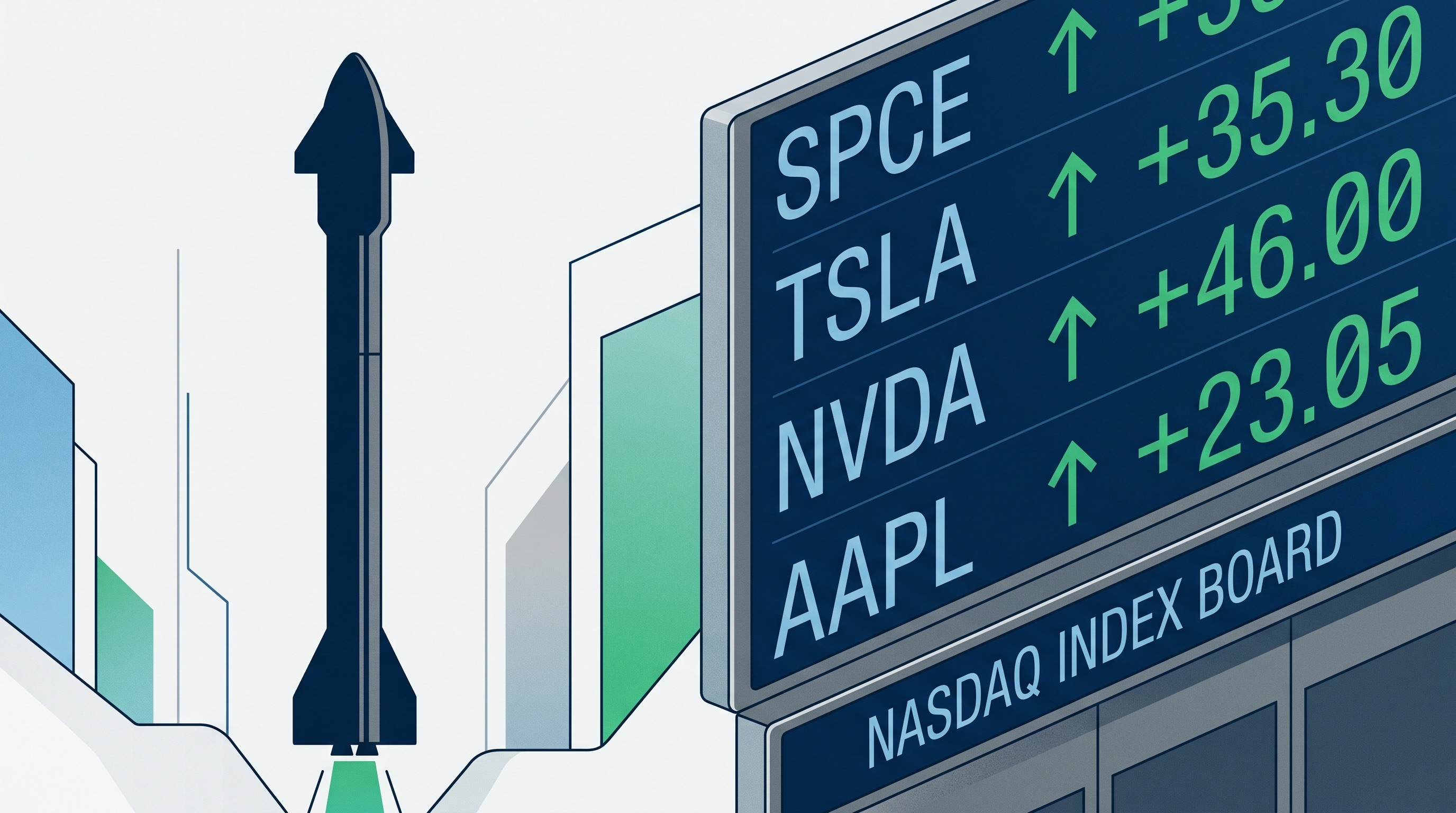
SpaceX will join the Nasdaq-100 index before trading begins on Tuesday, July 7, 2026, just 15 trading days after its June 12 initial public offering. The addition makes SpaceX's stock, trading under the ticker SPCX, one of the fastest companies ever to enter a major U.S. stock index following an IPO.
A fast-track built for giants
The speed is not an accident. Nasdaq adopted a fast-track eligibility framework specifically to accommodate large-cap listings that would otherwise wait months, or longer, for standard index inclusion under normal quarterly reconstitution rules. SpaceX's IPO valued the company at roughly $1.75 trillion, placing it among the five largest publicly traded companies in the United States on its first day of trading — a scale that made it an obvious candidate for the accelerated path. Under the framework, a company that ranks among the top 40 U.S.-listed firms by market capitalization at the time of its IPO becomes eligible for Nasdaq-100 entry after just 15 trading days, rather than waiting for the index's regular annual or quarterly reviews.
Index-tracking funds and product sponsors began purchasing SPCX shares after the market closed on July 6, positioning ahead of the effective inclusion date, as first reported by CNBC.
A $4.3 billion forced trade
SpaceX is expected to carry a weighting of under 1% of the Nasdaq-100 at inclusion. That sounds small, but the index is tracked by mutual funds and exchange-traded funds holding more than $800 billion in combined assets globally, including the two largest Nasdaq-100 ETFs, QQQ and QQQM. J.P. Morgan estimates that every fund benchmarked to the index will need to buy a combined $4.3 billion of SPCX shares to bring their holdings in line with the new index weighting, according to Seeking Alpha. Because SpaceX's public float is thin — commonly cited at only 3% to 5% of shares outstanding, with the rest held by insiders, employees, and pre-IPO investors — that buying pressure falls on a small pool of tradable stock, which can amplify price swings in either direction.
SPCX has been volatile since its June 12 debut at $135 a share. The stock has traded as high as roughly $225 and as low as around $147, and remains well below its post-IPO peak even as the company's market capitalization has risen toward $2.1 trillion on the back of strong Starlink subscriber growth and a reported $27.8 billion in AI compute contracts.
Why the S&P 500 is a different story
Despite the Nasdaq fast-track, SpaceX remains ineligible for the S&P 500. S&P Dow Jones Indices, which sets rules for that index independently of Nasdaq, has declined to create a comparable accelerated pathway. The S&P 500 maintains separate requirements around sustained profitability and a minimum seasoning period as a publicly traded company — thresholds SpaceX has not yet met. As The Motley Fool noted, that leaves SpaceX in an unusual position: a top-five U.S. company by market value that qualifies for one flagship index but not the other, illustrating how differently the two major index providers have responded to a wave of large, fast-growing companies going public.
The inclusion is widely described as a one-time event for SPCX rather than the start of a new precedent that will affect its stock every quarter — once the index-tracking funds complete their initial purchases, the forced-buying effect fades and the stock trades on its own fundamentals again.
Originally reported by CNBC. Read the original article for additional details.
View original source