SpaceX flies its 700th Falcon mission, closing out a decade-long SES satellite program
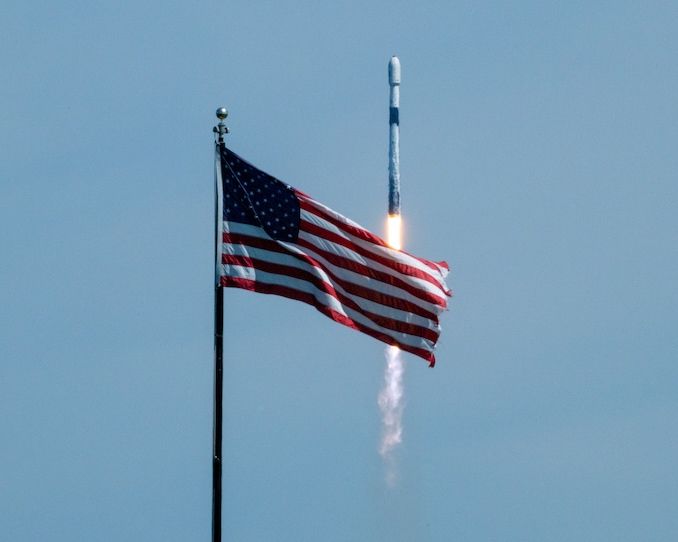
SpaceX launched a Falcon 9 rocket from Cape Canaveral Space Force Station on September 13, carrying the final three satellites of SES's O3b mPOWER broadband constellation into medium Earth orbit. The mission, which lifted off at 2:49 p.m. EDT, was the 700th flight in the Falcon program's history — a tally spanning 687 Falcon 9 missions and 13 Falcon Heavy launches since the rocket family's debut in 2010.
The booster that flew the mission, tail number B1080, was making its 29th flight, a flight count that illustrates how thoroughly SpaceX's reusability model has reshaped launch economics since Falcon 9 first flew. That single booster has previously carried four cargo resupply missions to the International Space Station, the European Space Agency's Euclid space telescope, SES's Astra 1P satellite, and 22 batches of SpaceX's own Starlink satellites. After releasing its payload, the first stage landed on the droneship "A Shortfall of Gravitas" — the 166th landing recorded on that specific vessel and the 661st successful Falcon booster landing overall.
A constellation over a decade in the making
The three satellites delivered on this flight — designated F11, F12, and F13 — complete SES's 13-satellite O3b mPOWER constellation, a medium Earth orbit broadband network built by Boeing and aimed at enterprise, government, and maritime customers who need higher-bandwidth, lower-latency connectivity than traditional geostationary satellite links provide. Each spacecraft in the constellation weighs roughly 1,900 kilograms dry mass. SES expects the completed network to enter full operational service in mid-2027, following a program that traces back more than a decade to O3b mPOWER's initial development.
The milestone underscores how far SpaceX's launch cadence has scaled since the Falcon program's early years, when reaching even a fraction of today's flight rate seemed ambitious. Reaching 700 total Falcon flights — the overwhelming majority flown on reused boosters rather than new hardware — reflects a launch cost structure that has made SpaceX the default choice for a wide range of commercial and government payloads, from resupply missions to observatory deployments to large broadband constellations like O3b mPOWER.
What comes next for SES
With the constellation's final satellites now in orbit, SES moves into a checkout and commissioning phase ahead of mid-2027 service entry. The completed O3b mPOWER network gives SES an MEO alternative to compete against both traditional geostationary broadband providers and low Earth orbit constellations like Starlink and Kuiper, positioning it specifically toward enterprise and government customers whose latency and bandwidth requirements a GEO satellite typically can't meet as efficiently.
Originally reported by Spaceflight Now. Read the original article for additional details.
View original source