SpaceX Catches Starship's Upper Stage for the First Time Ever
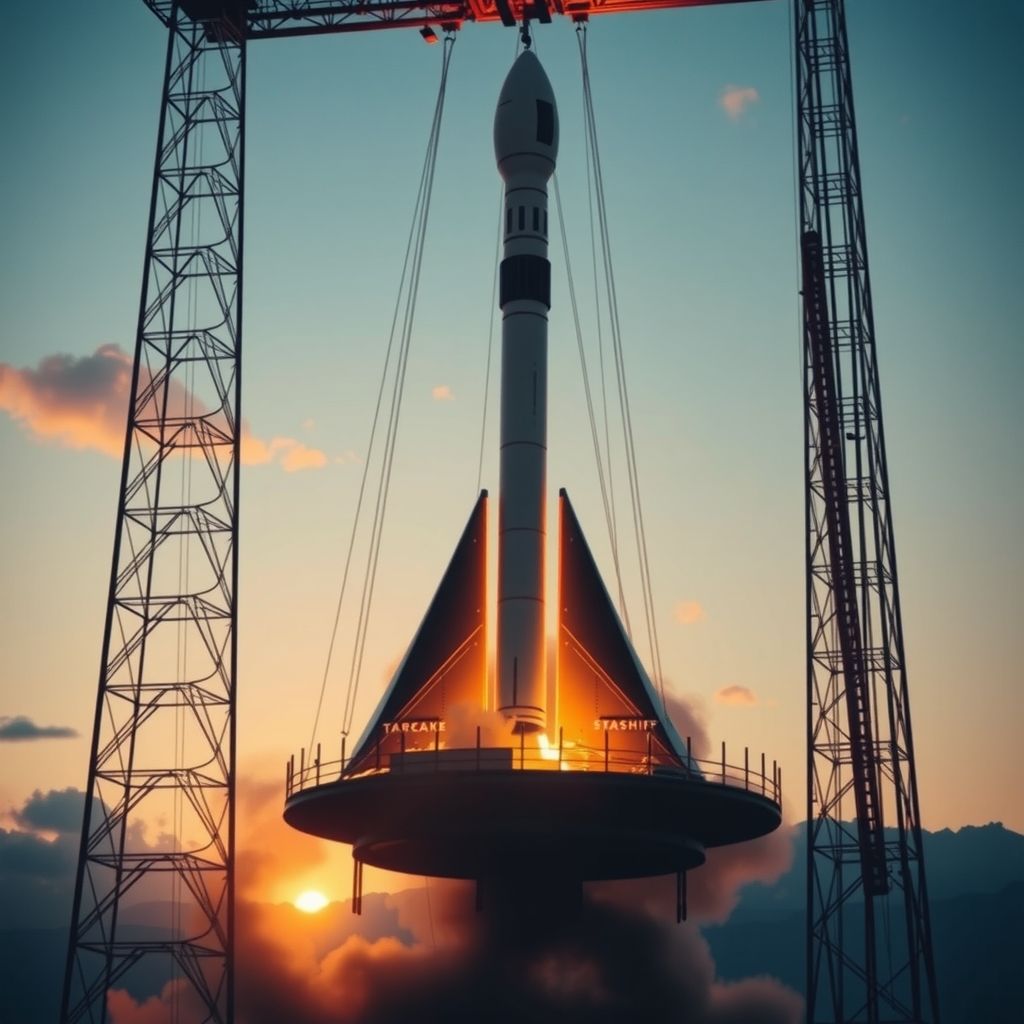
SpaceX caught the Starship upper stage with its launch tower's mechanical arms for the first time on Saturday, roughly 22.5 hours after the vehicle lifted off from Starbase, Texas — the first time an orbital rocket's upper stage has ever been returned to its launch site and physically recovered. The catch capped Starship's 15th test flight, a mission that had already cleared a major milestone of its own on Friday by reaching orbit and deploying 26 Starlink V3 satellites, but which lost its Super Heavy booster to a failed catch attempt and an ocean impact.
Ship 42 completed roughly 14 orbits of Earth before firing its engines to begin reentry, flipping from its signature belly-flop descent into a vertical orientation, and settling into the tower's "chopstick" arms at Starbase's Pad 2. SpaceX had cleared the attempt shortly beforehand, posting that "pad and tower systems are go for catch." The ship's heat shield, monitored in part by cameras mounted on three of the Starlink satellites it deployed a day earlier, had been reported in good condition heading into reentry.
The achievement follows three successful catches of the Super Heavy booster stage dating back to October 2024, but no Starship upper stage had previously survived long enough, or returned precisely enough, to attempt a tower catch — prior flights either lost the ship during ascent, splashed down in the ocean by design, or ended the mission before a catch was attempted. Saturday's recovery is the piece SpaceX needed to demonstrate that both halves of the Starship system can, in principle, be fully reused.
The mission's other half ended less cleanly. Booster 22 aborted its own return to the tower on Friday after detecting a guidance, navigation, and control (GNC) issue, diverting to a controlled — and ultimately explosive — impact in the Gulf of Mexico. SpaceX commentator Dan Huot said the booster "aborted itself for a GNC issue that it detected." Elon Musk later attributed the abort to the booster running short on propellant after its engines slightly underperformed, and said the fix involves tighter manufacturing consistency on the Raptor V3.2 engine and cutting engine burn roughly one second earlier in future flights. "This booster loss does not change our timeline to reach high volume, fully reusable Starship flights," Musk wrote.
Full reusability of both Starship stages is the cost threshold SpaceX has said it needs to make the vehicle viable for its stated goals: high-frequency Starlink V3 deployment, a planned orbital compute constellation Musk has called Starmind, and NASA's Artemis lunar lander program, which depends on repeated Starship tanker flights to refuel a lander in orbit before it can descend to the Moon. Musk said before the flight that a successful double catch would be a "profound technology milestone"; with the ship recovered and the booster still unrecovered, SpaceX now has a known, specific engineering fix to chase rather than an open question about whether ship recovery was achievable at all. Musk has said he expects Starship to reach a weekly launch cadence sometime in the first half of 2027.
Originally reported by Teslarati. Read the original article for additional details.
View original source