SK Hynix bets $720 billion on AI memory dominance, plans world's largest chip factory network
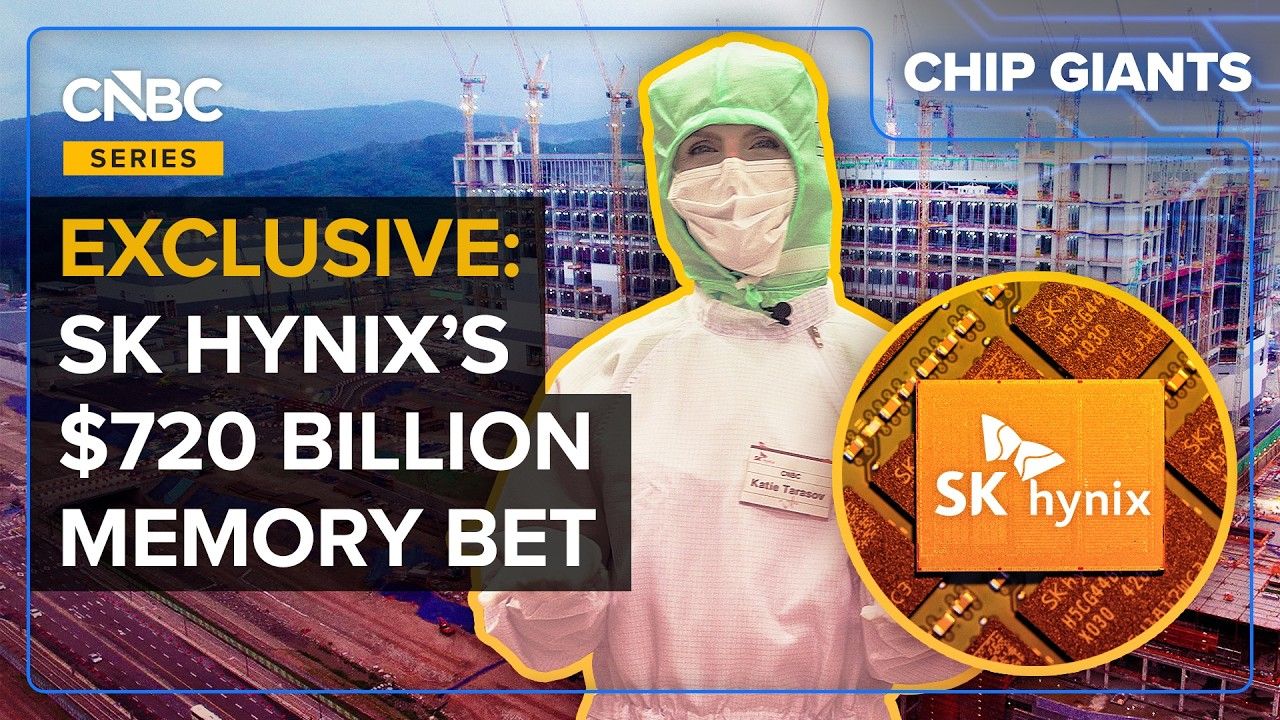
SK Hynix is committing $720 billion — roughly the GDP of Switzerland — to build what it describes as the world's largest network of memory factories, betting that AI-driven demand for high-bandwidth memory has permanently broken the semiconductor industry's traditional boom-and-bust cycle.
The investment plan, spanning from now through 2034, covers multiple new fabrication facilities in South Korea and a $4 billion advanced packaging plant in West Lafayette, Indiana. The board signed off on the first tranche — approximately $38 billion — in early August, approving two new facilities: the Yongin Y2 plant for DRAM and HBM production, and the Cheongju M17 line for NAND flash storage, as reported by CNBC.
The HBM bet
High-bandwidth memory has become the critical constraint in AI chip production. Every Nvidia H100 and H200 requires HBM stacks; the same is true for AMD's Instinct chips and Google's TPUs. Without memory, there is no AI acceleration — and SK Hynix currently controls 58% of the HBM market, with Samsung and Micron each holding 21%.
That position didn't happen by accident. SK Hynix was first to market with HBM3 in 2022, following ChatGPT's emergence, and developed a packaging technology called MR-MUF that creates stacks reportedly 40% thinner than prior generations while reducing heat and warpage. The company signed 10 long-term supply agreements with major customers in July, including a $500 billion deal with Nvidia, giving it revenue visibility that makes a decade-long capital commitment more defensible than it would appear from the outside.
The Yongin cluster
The centerpiece of the expansion is the Yongin semiconductor cluster in South Korea, a 45-million-square-foot complex — equivalent to roughly 600 soccer fields — where four new fabrication plants are planned. The first is on track to begin operations in the near term; the fourth has been pulled forward 12 years ahead of the original schedule, reflecting how quickly demand has outrun supply.
Chairman Chey Tae-won summed up the market reality driving the urgency: "Everybody wants the memory chips. Without that, they cannot produce their AI computing and AI chips." That statement reflects something more than a sales pitch — SK Hynix's order books are full, its lead times are long, and its market cap has jumped more than fivefold in the past year to top $1 trillion.
Government backing and geopolitical stakes
South Korea's government is providing up to $22 billion in support, covering infrastructure and incentives tied to the Yongin expansion. The US investment in Indiana, focused on advanced packaging rather than wafer fabrication, is partly a hedge against supply chain concentration and partly a response to CHIPS Act incentives designed to diversify semiconductor manufacturing away from East Asia.
The $720 billion bet is ultimately a structural call: that AI workloads will keep growing, that HBM will remain the memory of choice for AI accelerators for the foreseeable future, and that the customer who controls the supply of the most critical component in the AI stack holds enormous pricing power. SK Hynix is committing its next decade to that thesis.
Originally reported by CNBC. Read the original article for additional details.
View original source