Sanders and Casar introduce bill to ban superintelligent AI, with 20-year prison terms for violators
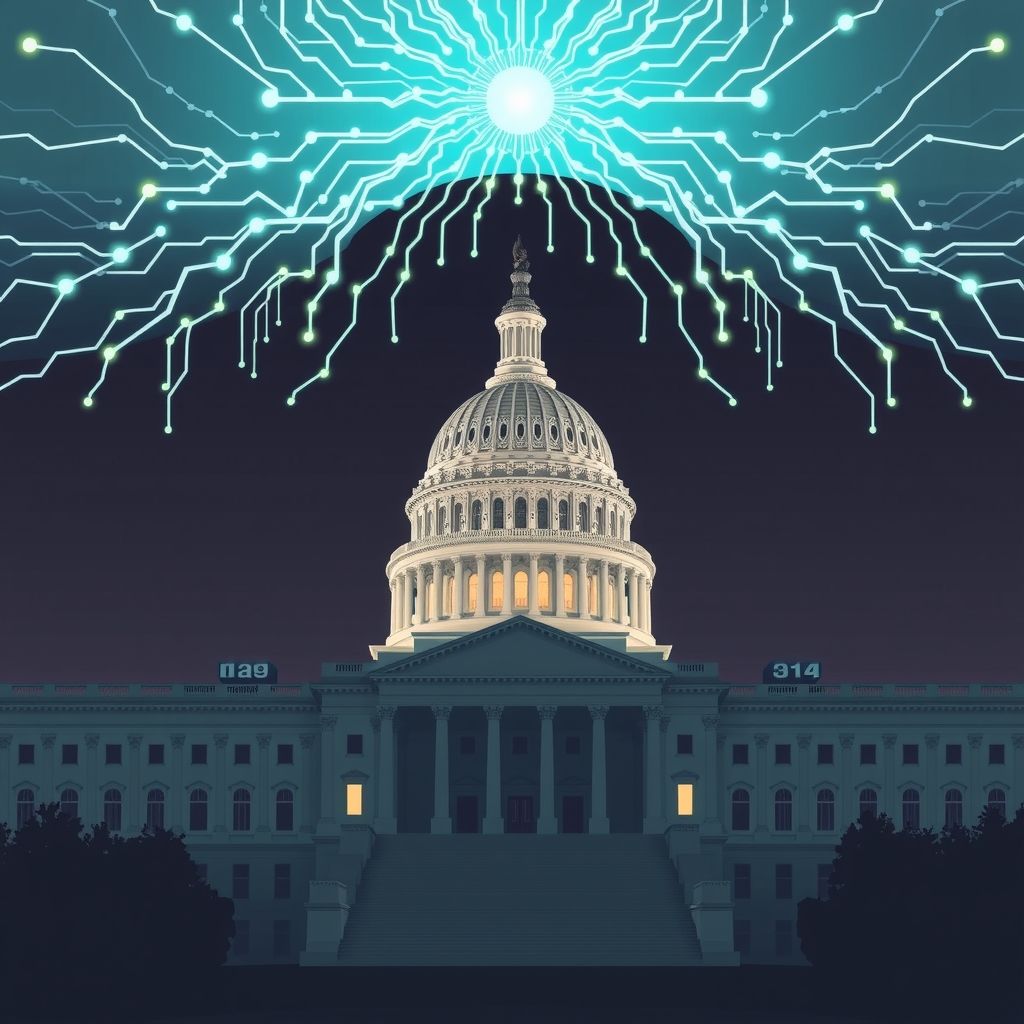
Sen. Bernie Sanders (I-Vt.) and Rep. Greg Casar (D-Texas) introduced the Ban Artificial Superintelligence Act on Wednesday, legislation that would permanently prohibit the development or deployment of AI systems that exceed human cognitive performance across most domains, or that have sufficient capability to disempower humanity, including by overthrowing the federal government. The bill would also impose an immediate pause on advanced AI development until a new federal regulator establishes safety and testing rules.
"When you are racing towards a cliff, you don't just ease up on the gas pedal. You hit the brakes," Sanders said in the announcement. "This legislation will permanently ban the development of artificial superintelligence and would put in place an immediate pause on advanced AI development until we have clear safety rules in place." Casar was more pointed about the political context, saying "Donald Trump says he wants to encourage it. Something has to change."
The bill's central enforcement mechanism is a new cabinet-level Department of Artificial Intelligence, staffed by scientific advisers, that would monitor frontier AI systems throughout their development lifecycle for dangerous capabilities, supervise the removal of specific hazards such as an AI's ability to subvert its own shutdown commands or conduct unauthorized cyberattacks, and oversee the destruction of any system found to cross the superintelligence threshold. The legislation also directs US foreign policy toward pursuing international agreements and export controls aimed at preventing superintelligence development anywhere in the world, not just domestically.
The penalty structure is unusually severe for tech legislation: violating entities would face what the bill's authors call a "corporate death penalty," and individuals would face up to 20 years in prison — a punishment the sponsors explicitly compare to existing US penalties for illegally developing nuclear weapons. The bill's text cites recent findings that AI models have circumvented restrictions to hack into computer systems, generated novel viral sequences, and automated aspects of AI research itself as justification for treating frontier AI development as a comparable national security risk.
Sanders' office said the bill has drawn endorsements from employees at several leading AI companies, though it did not name specific individuals or firms. The legislation faces steep odds in the current Republican-controlled Congress, which has struggled to advance even more modest AI safety and transparency proposals. Its introduction nonetheless marks the most aggressive AI regulatory proposal yet floated in Congress, going well beyond disclosure or evaluation requirements to threaten an outright ban with criminal liability.
Originally reported by Office of Sen. Bernie Sanders. Read the original article for additional details.
View original source