NASA's Roman Space Telescope lifts off on SpaceX Falcon Heavy to map the universe
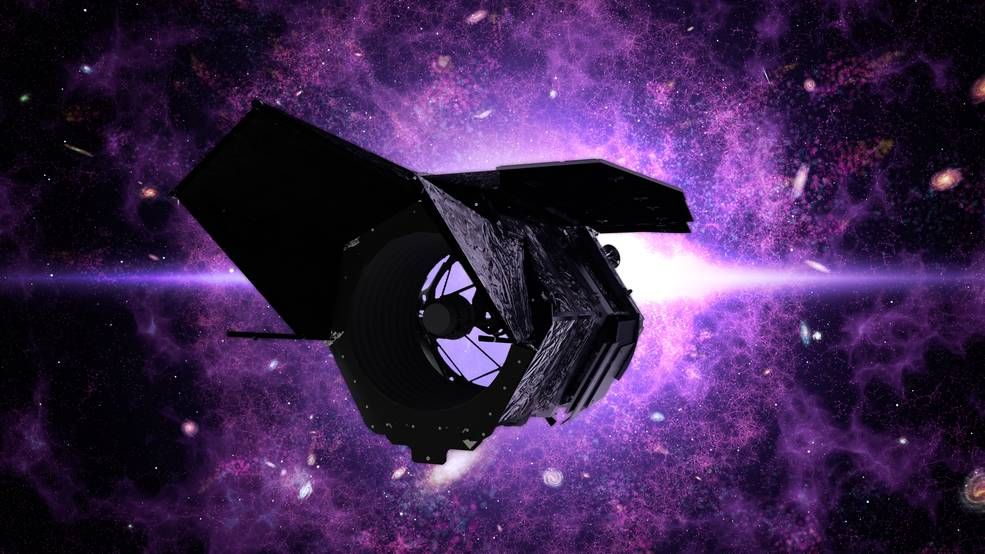
NASA's Nancy Grace Roman Space Telescope launched Sunday aboard a SpaceX Falcon Heavy rocket from Kennedy Space Center's Launch Complex 39A, beginning a five-year mission to map the universe at a scale never attempted before. Liftoff was targeted for 7:26 a.m. EDT (1126 GMT), with the observatory bound for the Sun-Earth Lagrange Point 2 — the same gravitationally stable vantage point occupied by the James Webb Space Telescope.
Roman is built around a 2.4-meter primary mirror — identical in size to Hubble's — originally manufactured for a classified National Reconnaissance Office spy satellite and donated to NASA. But where Hubble painstakingly photographs small patches of sky, Roman's 300-megapixel Wide Field Instrument captures a field of view at least 100 times larger, making it a survey telescope of extraordinary power.
A speed machine for the cosmos
The scale of Roman's data collection is staggering. The Hubble Space Telescope has returned roughly 172 terabytes of science data over its 30-year career. Roman will surpass that in a single month — beaming back a projected 2,500 terabytes over its five-year primary mission. Officials describe it as scanning the sky 1,000 times faster than Hubble.
A single uncompressed Roman image would require roughly half a million 4K TVs to display at full resolution. In practical terms, one frame covers 45 city blocks — or the entire face of El Capitan in Yosemite National Park.
Dark energy, exoplanets, and the structure of space
Roman's primary science goals focus on three interconnected mysteries: the nature of dark energy (the force driving the accelerating expansion of the universe), the distribution of dark matter, and the discovery and characterization of exoplanets. The mission is expected to catalog approximately 100,000 new exoplanets through gravitational microlensing — a technique that uses distant stars as natural lenses.
A second instrument, the Coronagraph, is a technology demonstration designed to directly image planets orbiting nearby stars by blocking stellar glare — a capability that could pave the way for future Earth-like planet searches.
From spy satellite to flagship observatory
Named after Nancy Grace Roman, NASA's first chief of astronomy and the official who championed the original Hubble Space Telescope proposal in the 1960s, Roman was recommended as a top-priority mission in the 2010 Decadal Survey and formally approved for development in 2016. Its $4.3 billion total lifecycle cost covers development, launch, and five years of operations. The mission is launching roughly nine months ahead of its original schedule, a milestone NASA attributed to strong contractor performance and stable funding.
After a 30-day transit, Roman will settle into an L2 orbit about 930,000 miles from Earth and begin commissioning. First science observations are expected within months of arrival. As first reported by Spaceflight Now, the Falcon Heavy center core will be expended on this mission while both side boosters are planned to land at Cape Canaveral's Landing Zones 2 and 40.
Originally reported by Spaceflight Now. Read the original article for additional details.
View original source