Microsoft's first cybersecurity AI model outperforms GPT and Gemini at half the cost
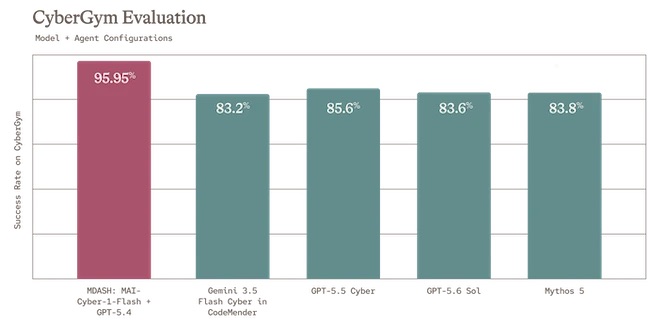
Microsoft unveiled its first dedicated cybersecurity AI model on Sunday, a compact specialist called MAI-Cyber-1-Flash that outperforms rival frontier models on the industry's primary security benchmark while cutting operational costs roughly in half. The announcement, made at a San Francisco event led by Microsoft AI CEO Mustafa Suleyman, also introduced Project Perception — an agentic security platform that deploys teams of specialized agents to simulate attacks, detect vulnerabilities, and write fixes autonomously.
MAI-Cyber-1-Flash is a code-tuned derivative of Microsoft's in-house MAI-Thinking-1 model, trained specifically on the company's own exploit and remediation records. On CyberGym — a benchmark covering 1,507 vulnerability reproduction tasks that Microsoft describes as the standard measure for AI security systems — MDASH running MAI-Cyber-1-Flash scored 95.95%, beating GPT-5.5 Cyber, GPT-5.6 Sol, Google Gemini, and Anthropic's Mythos 5. The model scores 12 points higher than Mythos on the same benchmark.
The cost architecture is where the launch gets more interesting. MAI-Cyber-1-Flash carries approximately 90% of the workload inside Microsoft's MDASH vulnerability-identification framework, routing only the hardest 10% of tasks to OpenAI's GPT-5.4. That routing split cuts the cost of running the full system by about half compared to Microsoft's previous production configuration — a meaningful advantage for enterprise security teams operating at scale.
Project Perception: Three Teams of Agents
Alongside the model, Microsoft introduced Project Perception, a new agentic security platform built on MDASH. Perception divides its work across three distinct agent teams: red agents simulate potential attacks with attacker context, blue agents detect and categorize existing bugs, and green agents execute fixes. According to lead engineer Dave Weston, the platform reduces work that previously required hours of effort from multiple specialized security engineers down to minutes — from initial vulnerability discovery through prioritization to deployed patches.
The system includes enterprise-grade controls: role-based access, tenant isolation, encryption, audit logging, and sandboxed execution environments. Microsoft confirmed the model went through its AI Red Team review, adversarial testing, and an independent third-party assessment before launch.
Availability and Context
MAI-Cyber-1-Flash will be available through Azure AI Foundry. Project Perception enters public preview on August 3, 2026, with Microsoft planning to expand it with additional specialized security agents over time.
The launch positions Microsoft directly against Anthropic's Mythos-based security offerings and OpenAI's Daybreak platform in the fast-expanding enterprise AI security market. As AI systems become both tools for and targets of cyberattacks, purpose-built security models trained on real-world exploit data represent a meaningful shift from applying general-purpose LLMs to security tasks, as first reported by TechCrunch.
Originally reported by TechCrunch. Read the original article for additional details.
View original source